
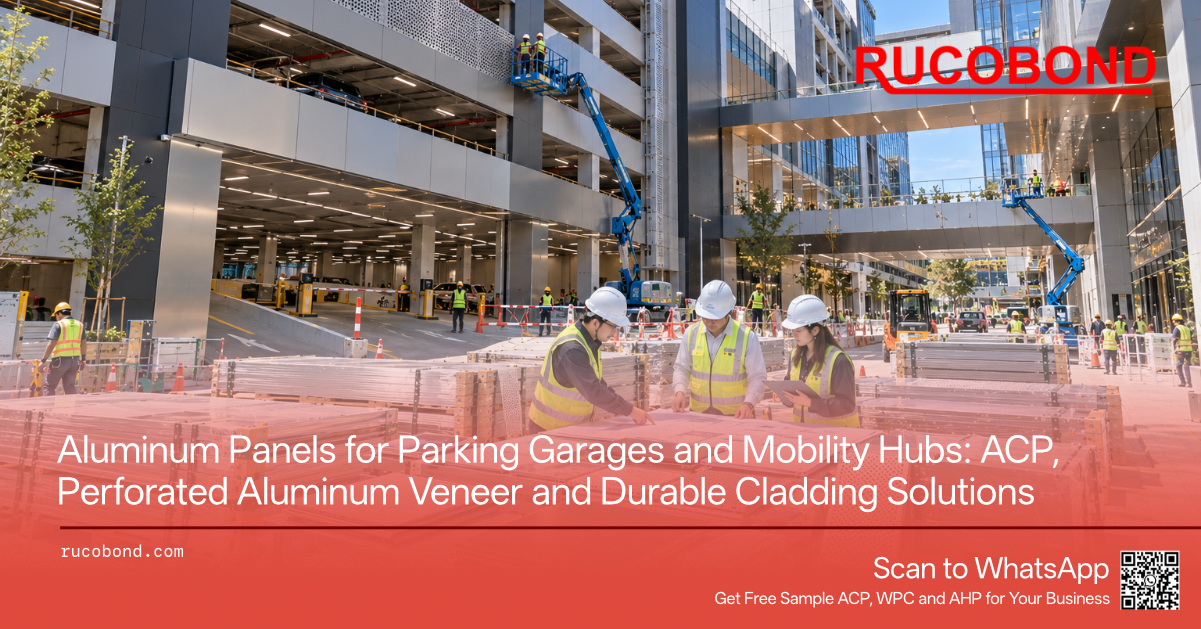
Parking garages rarely receive the same architectural attention as office towers, shopping centers or hotels. Yet they are among the most frequently used parts of large commercial developments. Thousands of vehicles may pass through the same entrances every day, while pedestrians move between parking areas, elevators, retail entrances and public transportation connections. These buildings need to accommodate constant movement, provide practical maintenance access and maintain an acceptable appearance despite exposure to vehicle emissions, dust, moisture and outdoor weather.
For construction contractors, a multi-story parking structure creates a different material selection problem from an ordinary commercial building. Large wall areas may need economical cladding, while naturally ventilated sections require open screens rather than completely enclosed surfaces. Entrances must integrate height restrictions, directional signs and architectural elements. Stairwell connections, elevator lobbies and pedestrian bridges may demand higher-quality finishes because they form part of the customer experience.
A shopping center with several thousand parking spaces provides a useful example. The parking structure may occupy a substantial portion of the property, but the developer does not want its exterior to resemble an unfinished concrete building. Aluminum Composite Panels can provide clean architectural surfaces on suitable solid wall sections, while perforated Aluminum Veneer can create decorative screening where ventilation openings must remain effective. Customized metal components can also improve the appearance of entrances and connections to the main commercial complex.
Founded in Guangzhou, China in 2013, Rucobond manufactures and exports Aluminum Composite Panels, Aluminum Veneer, Aluminum Honeycomb Panels, Aluminum Coils, WPC products and Sintered Stone Slabs. The company supplies architectural materials to construction contractors, building material distributors, importers, decoration companies and international engineering procurement teams.
For parking facilities, the objective is not simply covering concrete with attractive panels. It is selecting materials that support ventilation requirements, installation efficiency, maintenance accessibility and long-term architectural consistency. The right combination can improve the building's appearance without sacrificing the practical functions that keep a parking structure operating.
Parking garages operate in an environment where daily use creates continuous wear. Vehicle movement introduces dust and airborne contaminants, while ramps and entrances experience frequent exposure to rain and sunlight. Some structures are partially enclosed, creating different environmental conditions between the exterior, open parking decks and pedestrian circulation areas. These differences influence which architectural materials should be installed in each location.
One challenge is distinguishing between decorative cladding and functional ventilation openings. Naturally ventilated parking structures rely on adequate airflow to support their intended ventilation strategy. Covering existing openings with solid panels simply to create a cleaner exterior can interfere with that function. Perforated aluminum screens may offer an architectural solution, but their opening size, effective free area and arrangement must be coordinated with the ventilation design. Decorative perforation patterns should never be assumed to satisfy ventilation requirements without engineering verification.
Another challenge is maintaining materials in areas that are difficult to access. Exterior panels on upper parking levels may require lifting equipment for replacement, while screens near ramps can collect dust and debris. If the material has an unusual finish or custom dimensions, future maintenance becomes more complicated when the original product specification is unavailable. Contractors and developers therefore benefit from standardized materials and retained production records.
Safety requirements also influence material selection. Parking structures may be subject to specific building, fire-safety, ventilation and structural regulations depending on their location, height, occupancy and design. Any proposed ACP, Aluminum Veneer or Honeycomb Panel system must be evaluated against the relevant project requirements. Panel selection cannot replace the engineering review of fire performance, wind loads, fixing methods or the complete wall assembly.
Rucobond works with professional buyers to clarify the intended application, project environment, dimensions, coating requirements and technical specifications before manufacturing. Providing drawings and a material schedule early helps distinguish ordinary decorative surfaces from areas requiring specialized engineering approval.
For contractors, this preparation can prevent an expensive problem: selecting materials based on appearance and price, only to discover later that the intended application requires a different panel structure or installation approach.
Aluminum Composite Panels can provide a practical solution for suitable solid wall areas of parking garages, including entrance buildings, stairwell enclosures, administration sections, commercial connections and selected exterior cladding zones. Their relatively low weight, flexible fabrication and variety of finishes allow contractors to create a consistent architectural appearance without relying entirely on heavy decorative materials.
Rucobond supplies ACP in solid matte colors, high-gloss finishes, metallic surfaces, brushed textures, mirror effects, wood grain patterns and stone-inspired designs. For parking structures, practical solid and metallic colors are often the most appropriate choices. Silver, grey, charcoal and white can coordinate with surrounding commercial buildings, while brighter colors may be used selectively around entrances, elevator connections or wayfinding zones.
Consider a multi-story car park attached to a regional shopping center. The developer wants the parking building to share the architectural language of the main retail complex. Silver metallic ACP could be used around suitable enclosed stairwell sections and entrance walls, while dark Aluminum Veneer screens provide a coordinated appearance across naturally ventilated parking levels. The result can feel like one development rather than two unrelated structures.
ACP can be cut, routed and folded into different modules. This allows contractors to align wall panels with structural bays, windows, doors and architectural joints. Large repetitive surfaces may also benefit from standardized panel dimensions, simplifying material calculations and local fabrication.
However, the material specification must match the application. Exterior use may require an appropriate weather-resistant coating, while any core and fire-performance requirements must follow the project's approved technical documentation. ACP should not be selected for an exposed or regulated building location solely because the requested color and thickness are available.
Rucobond can discuss panel thickness, aluminum skin, core specification, coating, color, sheet dimensions and quantity according to project requirements. For large parking developments, buyers should also consider whether materials will be manufactured and delivered in phases.
The main advantage of ACP is economical visual coverage where the product is technically suitable. Custom Aluminum Veneer can then be reserved for ventilation screens, entrances and other areas that require different fabrication characteristics.
Perforated Aluminum Veneer is particularly relevant to multi-story parking structures because it can combine architectural screening with controlled openings. Instead of leaving every concrete deck completely exposed, designers may use perforated aluminum panels to create a more consistent exterior appearance while preserving the ventilation performance required by the engineering design.
These screens can also reduce the visual prominence of parked vehicles, structural elements and service equipment. Depending on the perforation arrangement, they may admit daylight and create varying levels of visual transparency. For parking facilities connected to hotels, offices or shopping centers, this can help the service-oriented parking structure integrate more effectively with the surrounding commercial development.
Rucobond supports drawing-based Aluminum Veneer manufacturing, including customized dimensions, folds, perforations, surface finishes and colors. Buyers can provide technical drawings specifying hole diameter, spacing, pattern arrangement, panel thickness, edge returns and quantities. These details influence both manufacturing and the appearance of the completed installation.
For example, a parking garage may use a repeating arrangement of perforated silver panels across several levels. The architect may want a uniform metallic surface from a distance while retaining visible openings. Different perforation patterns can create different levels of transparency, but the design team must verify that the resulting effective open area remains compatible with the building's ventilation requirements.
Perforated screens also need appropriate structural support. Panel dimensions, fixing details, wind exposure and movement allowances must be considered by the project engineer. The presence of holes does not automatically make a panel suitable for every unsupported span, and decorative screening should not be treated as a substitute for required guardrails or vehicle barriers.
For large orders, panel identification can improve installation efficiency. Components may appear similar but differ in perforation layout, edge conditions or dimensions. Rucobond can discuss labeling according to approved drawings and project zones, helping installers identify the correct panels after delivery.
The value of perforated Aluminum Veneer is its design flexibility. It can improve the architectural character of a parking structure while allowing ventilation and other functional requirements to be incorporated into the approved design.
Parking entrances are operationally important because they concentrate vehicle movement, pedestrian crossings, signs, ticketing equipment and access-control systems within a relatively small area. The architecture must remain understandable even when drivers are unfamiliar with the property.
These locations often require customized metal components. Entrance canopies, folded frames, roof edges, column covers and equipment surrounds may be difficult to manufacture efficiently from standard flat panels. Aluminum Veneer provides greater freedom for these features because it can be fabricated according to technical drawings.
A commercial parking facility may use a wide metal canopy above its entrance lanes. The design needs to coordinate with height-clearance signage, lighting, drainage and access-control equipment. Customized Aluminum Veneer can provide finished edges and architectural cladding around the canopy structure, while the load-bearing components remain separately engineered for their intended function.
Parking structures connected to hotels and shopping centers may also include premium drop-off areas. These spaces often require a stronger architectural identity than the ordinary vehicle decks. Metallic Aluminum Veneer around the entrance, matte ACP on suitable adjacent walls and glass elements around pedestrian connections can create a coordinated appearance.
Rucobond supports customized Aluminum Veneer for folded edges, curved sections, entrance frames, columns and other architectural details. Buyers should provide drawings showing dimensions, thickness, folds, curves, finish, fixing requirements and quantities. Where lighting or signage is integrated into the architectural structure, coordination with the relevant specialist contractors is necessary before fabrication.
Clear drawings are particularly important because parking entrances may contain multiple systems installed by different companies. Access-control equipment, electrical components, signage, drainage and structural supports must fit within the same limited space. Manufacturing custom panels before these interfaces are confirmed can lead to unnecessary modifications during installation.
For contractors, the advantage of drawing-based fabrication is that complex metal components can arrive prepared according to approved dimensions. This can reduce site cutting and improve consistency, especially where construction access is restricted or the parking facility remains partially operational.
Not every part of a parking development is intended for vehicles. Pedestrian bridges, elevator lobbies, commercial connections, covered walkways and premium arrival areas often require a more refined material finish. These locations may be the first spaces visitors experience when entering a shopping center, office complex, airport or hotel from the parking facility.
Aluminum Honeycomb Panels can be considered for selected large ceiling and wall applications where relatively low weight and higher rigidity are valuable. Their internal honeycomb structure helps larger panels maintain a stable surface, making them suitable for certain premium architectural areas subject to the approved support and safety requirements.
A parking garage connected to a major office development provides a useful example. Visitors may leave their vehicles and enter a covered pedestrian walkway leading directly to the main office lobby. The developer may want this transition to share the same clean architectural appearance as the corporate entrance. Aluminum Honeycomb Panels could be considered for a large ceiling surface, while Aluminum Veneer forms custom edge details and ACP covers suitable adjacent wall areas.
For transportation hubs, pedestrian connections can also contain long corridors and large waiting zones. Repeated panel dimensions may help contractors manage manufacturing and installation more efficiently, while larger formats can reduce the number of visible joints in selected locations.
Rucobond supports customized Aluminum Honeycomb Panels according to dimensions, thickness, surface finish, edge structure and project requirements. Technical drawings should identify the installation area and support conditions so the final specification can be reviewed appropriately.
Honeycomb Panels generally involve a different cost structure from standard ACP, so selective use is important. A premium pedestrian lobby may justify larger, more rigid panels, while ordinary service areas can often use simpler finishes or construction materials.
The purpose is not to make every parking level look like a corporate reception hall. It is to provide a better transition between functional parking spaces and the commercial areas people actually visit.
Large parking projects usually require numerous secondary metal components beyond the main wall and screening panels. Roof trims, signage elements, drainage covers, ceiling components and architectural flashings may need to be manufactured according to site dimensions.
Aluminum Coil can support local fabrication because it provides a continuous material form that specialized workshops can process into different components. Rucobond supplies Aluminum Coils according to thickness, width, coating, color and downstream manufacturing requirements.
For a parking structure under construction, this approach can provide flexibility. Finished ACP may be delivered for broad architectural wall areas, and customized Aluminum Veneer may arrive for major screens and entrances. Local fabrication workshops can then process Aluminum Coil into certain smaller components after final measurements have been confirmed.
This can be useful because parking structures often include complicated transitions between concrete slabs, ramps, stairwells and entrance systems. Some dimensions may require adjustment as construction progresses. Producing suitable secondary components locally can reduce the need to import every minor variation as a separate finished product.
For building material distributors, Aluminum Coil also expands the potential customer base. Signage companies, ceiling manufacturers, roofing contractors and general metal-processing workshops may purchase coils independently of large parking construction projects.
Packaging and unloading require special attention because coils concentrate substantial weight into a relatively compact form. Buyers should confirm the availability of appropriate lifting equipment and storage arrangements before delivery. Product specifications should also match the intended forming and fabrication process.
Rucobond can discuss Aluminum Coil alongside ACP, Aluminum Veneer and Honeycomb Panels when professional buyers are sourcing multiple architectural material categories for one development.
For contractors and distributors, combining finished components with suitable locally processed materials can create a more adaptable purchasing strategy without requiring every detail to be resolved through overseas manufacturing.
Parking structures are exposed to environmental conditions that can make visible surfaces difficult to maintain. Vehicle-related dust, road grime, moisture and pollution may accumulate on exterior screens and wall panels. In coastal or tropical environments, high humidity and heavy rainfall create additional considerations for coatings and maintenance.
This makes color and surface selection more than a decorative decision. Very dark finishes may reveal certain types of dust, while very light surfaces can make dirt accumulation more noticeable. Metallic and textured surfaces behave differently under sunlight and artificial lighting. The preferred finish should reflect the architectural design, expected cleaning methods and surrounding environment.
For large parking buildings, practical grey, silver and muted metallic finishes are commonly worth evaluating because they can coordinate with concrete, glass and commercial architecture. Branded colors can be introduced selectively around entrance zones, signs and pedestrian connections without dominating the entire building.
Coating selection should follow exterior exposure and project requirements. Rucobond supplies different ACP and Aluminum Veneer surface finishes, and suitable architectural coating systems can be discussed according to the intended use. Buyers should not assume that two products with the same visible color have identical weather-resistance characteristics.
Maintenance accessibility deserves equal attention. Perforated screens may collect debris around openings, while panels near busy ramps can be exposed to more airborne contaminants. The approved installation design should allow appropriate inspection and cleaning without requiring unnecessary dismantling.
Color consistency becomes important when future replacement materials are required. A parking structure may operate for many years before part of its cladding is damaged or renovated. Retaining original samples and product specifications provides a useful reference for later manufacturing, although newly produced finishes may not appear completely identical to surfaces that have experienced years of environmental exposure.
Rucobond can work from approved references and confirmed specifications for repeat production discussions. Contractors and facility managers should preserve material records, especially for custom colors, perforated panel designs and project-specific dimensions.
The practical objective is to reduce avoidable maintenance work while keeping the building's appearance consistent with the surrounding development.
A multi-story parking structure can contain thousands of square meters of architectural panels. The total quantity may be straightforward to estimate from drawings, but manufacturing and delivery become more complicated when the order includes several products with different dimensions and fabrication requirements.
ACP may be supplied as standard sheets for local processing. Perforated Aluminum Veneer may require individual panel codes because the sizes and edge details differ by elevation. Custom entrance components may need reinforced packaging, while Honeycomb Panels for pedestrian areas require their own handling arrangements.
For example, a commercial development may construct a six-level parking structure alongside a shopping center. The exterior screening could contain repeated perforated panels, while several entrances use custom folded components. The project may require screening materials first, entrance panels later and pedestrian connection materials near final completion.
This type of construction schedule benefits from organized production and shipment planning. Rucobond can discuss staged manufacturing and packaging arrangements according to quantity, product specifications and factory scheduling. Buyers should communicate the full estimated project volume even when orders will be released in separate phases.
Panel identification is particularly useful for customized Aluminum Veneer. Labels can connect manufactured pieces with approved drawings and installation zones. ACP pallets can be organized according to sheet size, finish or project section. Clear packing information helps prevent materials from being moved repeatedly around large construction sites.
Container loading also needs consideration. Standard flat sheets, long entrance components and oversized custom screens require different packaging arrangements. The buyer should provide destination unloading limitations and any important site-storage constraints before confirming the shipment configuration.
For international contractors, the delivery plan should account for factory production, export transportation, destination handling and local fabrication before installation begins. Receiving the correct material at the port is important, but it does not mean the panels are ready for installation the following morning.
A well-organized project shipment should help construction teams locate, handle and install materials efficiently rather than turning the parking garage itself into an expensive temporary warehouse.
Parking garages and mobility hubs require architectural materials that can support both appearance and operational requirements. Contractors need economical solutions for repetitive surfaces, customized components for entrances and screens, suitable coatings for local environmental conditions and organized manufacturing for large project quantities.
Established in 2013 and headquartered in Guangzhou, Guangdong, China, Rucobond supplies Aluminum Composite Panels, Aluminum Veneer, Aluminum Honeycomb Panels, Aluminum Coils, WPC products and Sintered Stone Slabs to international construction markets. The company works with general contractors, architectural metalwork companies, building material distributors, importers, commercial developers and professional procurement teams.
For parking projects, Rucobond's product range allows buyers to consider multiple material types within one purchasing relationship. ACP can be evaluated for suitable solid architectural surfaces, Aluminum Veneer for perforated screens and custom entrance components, Honeycomb Panels for selected large-format pedestrian areas, and Aluminum Coil for local fabrication requirements.
Customization is another important consideration. Parking structures may require panels with specific dimensions, perforation patterns, edge details and coatings. Rucobond supports project-based manufacturing discussions using technical drawings, confirmed specifications and expected quantities.
OEM and ODM services can also support regional distributors developing their own aluminum panel ranges. Private-label protective films, customized packaging, product identification, selected finishes and repeat specifications can be discussed according to order requirements.
Relevant SGS, CE and ISO-related documentation can be reviewed according to the applicable product and certification scope. Buyers must also confirm the specific building, fire-safety, ventilation and structural requirements of their projects with the appropriate engineering and regulatory parties.
Why choose Rucobond? The value lies in combining architectural material manufacturing, multiple aluminum product categories, customized production and international export support for professional construction buyers.
For an accurate quotation, contractors should provide the project type, building drawings, BOQ, panel dimensions, material specifications, coating requirements, colors, estimated quantities, destination and construction schedule. Perforated Aluminum Veneer enquiries should also include the hole pattern, required opening characteristics and approved technical drawings.
Rucobond welcomes bulk enquiries from parking structure contractors, commercial developers, building material importers, distributors and architectural metalwork companies. Send the material schedule and project specifications to discuss suitable products, customization and international supply arrangements.
A successful parking development needs more than a finished exterior. Its materials should support the building's intended function, integrate with surrounding commercial architecture and remain practical to maintain throughout its operating life.
Q: Can Aluminum Composite Panels be used on multi-story parking garages?
A: ACP can be used on suitable solid wall sections, entrances, stairwell enclosures and other architectural areas when the specification and installation system meet the project's requirements. Buyers should verify the applicable fire-safety, structural and local building regulations before selecting a product.
Q: Is perforated Aluminum Veneer suitable for parking garage ventilation screens?
A: Perforated Aluminum Veneer can provide decorative screening while maintaining openings for airflow. However, the effective open area, perforation pattern and installation arrangement must be coordinated with the approved ventilation design. Decorative perforation alone does not establish compliance.
Q: Can Rucobond manufacture custom perforated aluminum panels?
A: Yes. Rucobond supports drawing-based Aluminum Veneer customization, including panel dimensions, thickness, folds, perforation patterns, coatings, colors and project identification. Buyers should provide detailed technical drawings and quantities.
Q: Which aluminum panel finishes are practical for parking structures?
A: Matte solid colors, silver metallic, grey and charcoal finishes are commonly worth considering because they coordinate with commercial architecture and can provide a controlled appearance. The final selection should account for climate, coating performance, cleaning requirements and surrounding materials.
Q: Does Rucobond support bulk orders for parking garage construction projects?
A: Yes. Rucobond welcomes professional bulk orders involving ACP, Aluminum Veneer, Aluminum Honeycomb Panels and Aluminum Coils. Customized manufacturing, OEM, ODM and phased shipment arrangements can be discussed according to product specifications, quantities and construction schedules.
Name: Gina Chen
Mobile:+86-189-2412-4951
Tel:+86-189-2412-4951
Whatsapp:8618924124951
Email:gina@rucobond.com
Add:Room 708, No. 8 Jingang Avenue, Nansha Street, Nansha District, Guangzhou


