
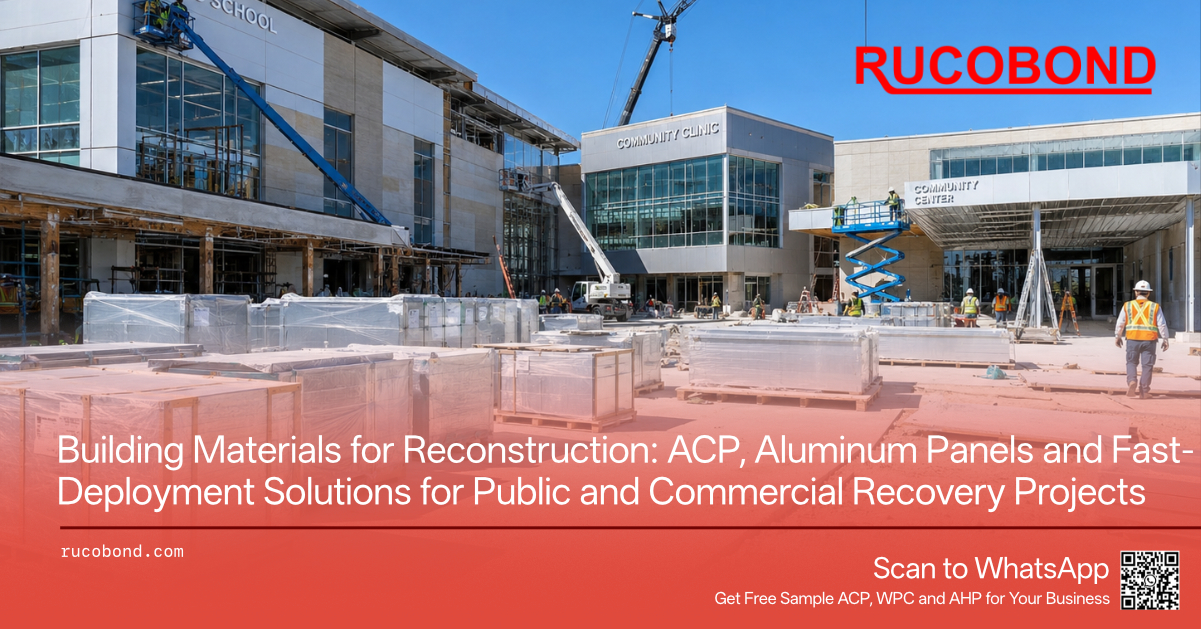
Why Reconstruction Projects Need a Different Material Supply Strategy
A normal construction project usually begins with drawings, tender schedules and months of preparation. Disaster reconstruction begins differently. A flood damages public buildings overnight. An earthquake leaves schools and clinics unusable. A typhoon tears apart roofs, façades and community facilities in a few hours. Suddenly, contractors are asked to rebuild structures that were never supposed to disappear so quickly, and the purchasing department is trying to source materials while engineers are still assessing damage.
This changes the entire supply strategy. Reconstruction projects need materials that are practical, available in large quantities, relatively easy to transport and suitable for fast installation. The buyer may not have the luxury of waiting several months for every customized detail. In many cases, the first goal is restoring function: reopen the school, repair the clinic, rebuild the municipal office, restore the market, make the warehouse usable again.
Founded in Guangzhou, China in 2013, Rucobond supplies architectural and building materials to contractors, building material distributors, project developers and international buyers. The product range includes Aluminum Composite Panels, Aluminum Honeycomb Panels, Aluminum Veneer, Aluminum Coils, WPC products and Sintered Stone Slabs. These materials can support public facility reconstruction, commercial property repair, school and hospital restoration, temporary service buildings and long-term rebuilding programs.
For reconstruction buyers, the value is not only product availability. It is the ability to combine different materials within one supply relationship. ACP can be used for broad exterior wall areas. Aluminum Veneer can restore entrances and roof edges. Honeycomb Panels can support lightweight ceiling and wall systems. Aluminum Coil can be processed locally for trims and roofing details. WPC and Sintered Stone can serve community spaces, clinics and support facilities.
Rucobond welcomes large-volume reconstruction orders and can discuss project-based support according to product type, quantity, urgency and current production capacity. For qualified recovery projects, priority manufacturing schedules, phased delivery and practical packaging arrangements can be discussed to help reduce delays.
Disaster reconstruction is not the place for decorative promises. Contractors need realistic lead times, stable specifications, clear communication and materials that arrive ready to work. That is the supply philosophy Rucobond brings to recovery projects.
The Cost of Delayed Materials After Disasters
In ordinary construction, a two-week delay is expensive. After a disaster, it can be much more serious. A school that remains closed forces families to find temporary education arrangements. A damaged clinic increases pressure on nearby medical facilities. A commercial street that cannot reopen leaves local businesses without income. A warehouse that remains unusable can interrupt food, medicine or equipment distribution.
This is why material availability becomes part of the recovery process.
Consider a coastal town hit by a severe typhoon. Several public buildings lose exterior cladding and roofing. The local hospital needs a damaged entrance repaired. A school requires new wall panels before students can return. A logistics warehouse needs rapid exterior restoration because relief supplies are being stored there. These projects may all require materials within the same short period.
The cheapest supplier is not automatically the most useful supplier. If the price is low but the factory cannot confirm production capacity, the project still waits. If the product arrives without correct packaging, additional replacement materials may be needed. If specifications are unclear, installers lose time making adjustments on site.
Rucobond works with professional buyers to clarify material type, dimensions, application, quantity, coating, color, destination and delivery expectations before production. For urgent projects, this information helps the factory identify which items can be standardized and produced quickly and which require more engineering or customization.
Standardization can save time. A reconstruction program involving several schools or clinics may use the same ACP color, panel size and coating across multiple buildings. This makes repeated production easier and can simplify site installation. Custom Aluminum Veneer can then be reserved for entrances, canopies and special areas where standard panels are not suitable.
Phased delivery may also improve recovery speed. Instead of waiting for the entire project package, the most urgent façade or public service materials can be prioritized according to construction needs. Later shipments can include secondary decorative or support materials.
Time matters because every day of delay has a real human and commercial cost. Reconstruction supply should therefore focus on practical execution rather than optimistic quotations that look excellent until somebody asks when the materials will actually leave the factory.
Aluminum Composite Panels for Fast Façade and Facility Recovery
Aluminum Composite Panels are particularly useful in reconstruction because they provide a combination of low weight, flexible fabrication and efficient coverage across large wall areas. They can be used for schools, clinics, public offices, markets, warehouses, temporary service buildings and commercial properties that require exterior restoration.
Rucobond supplies ACP in solid matte colors, glossy finishes, metallic surfaces, wood grain, brushed finishes, mirror styles and stone-inspired patterns. For reconstruction projects, however, standard solid and metallic colors are often the most practical because they can be produced and matched more easily across multiple buildings.
A damaged school, for example, may not need a highly customized decorative façade. It needs a clean, durable exterior that can be installed quickly and maintained easily. ACP can help create that result while keeping structural weight lower than many heavy traditional cladding materials.
The panels can also be cut, routed and folded according to site requirements. This gives contractors flexibility when existing structures are damaged or dimensions have changed after repairs. Window edges, entrance frames and wall corners can be adapted without requiring a completely different material system.
For exterior applications, buyers should provide the project environment. Coastal reconstruction may require stronger attention to humidity, salt air and coating selection. Tropical regions may face intense sunlight and heavy rainfall. Dry climates may prioritize UV exposure and dust.
Rucobond can discuss panel thickness, aluminum skin, coating, color, size, quantity and protective film according to the project.
For large reconstruction programs, repeatability is especially valuable. If ten schools or several public buildings use the same specification, production can be planned more efficiently. The contractor also benefits because installation teams become familiar with the same panel system across multiple sites.
This reduces training, fabrication and material management complexity.
ACP is not a magical emergency product. Its value is more practical than that. It is lightweight, scalable, flexible to process and available in many standard finishes. In reconstruction work, those ordinary characteristics can become extremely useful when time and logistics are under pressure.
Aluminum Veneer for Entrances, Canopies and Damaged Architectural Areas
Not every damaged area can be repaired with flat panels. Entrances, canopies, columns, roof edges and irregular architectural details often require customized metal components.
Aluminum Veneer is suitable for these areas because it can be manufactured according to drawings and site measurements. Panels can be folded, curved, perforated and formed into different shapes depending on the project requirement.
After a severe storm, for example, the main wall of a municipal building may remain structurally sound while the entrance canopy and roof edge are badly damaged. Rebuilding the entire façade would be unnecessary. Customized Aluminum Veneer can be used to replace the damaged architectural elements while keeping the existing structure.
Hospitals and clinics may also need canopy repairs around ambulance entrances and drop-off areas. Schools may require new covered walkways. Markets and community centers may need stronger entrance frames and roof-edge details.
Rucobond supports drawing-based Aluminum Veneer production for professional projects. Buyers should provide dimensions, thickness, folds, curves, perforations, coating, color, panel codes and quantities.
In reconstruction work, accurate site measurements are especially important because the original building may no longer match the old drawings. Structural repairs can change dimensions, and damaged sections may need to be rebuilt slightly differently.
For large orders, panel identification and organized packaging can help installers work more efficiently. Each piece can be matched to drawing codes or building zones according to agreed project requirements.
This matters when several sites are receiving custom parts at the same time. A mislabeled pallet in a normal project is annoying. In a reconstruction program involving multiple clinics or schools, it can send an entire installation team to the wrong site with the wrong components. Human beings have created enough chaos already without helping logistics participate.
Aluminum Veneer provides flexibility where standard panels stop being practical. It should be used selectively around the areas where shape, durability and custom fabrication justify the additional processing.
Aluminum Honeycomb Panels for Lightweight Public Building Reconstruction
Some reconstruction projects involve larger public buildings where low weight and panel rigidity are both important. Transportation terminals, hospitals, civic centers, large schools and community halls may contain wide ceilings, interior walls or entrance areas that require more stable large-format panels.
Aluminum Honeycomb Panels can support these applications.
The internal honeycomb structure creates a rigid panel while keeping overall weight relatively low. This makes the material useful in situations where larger dimensions are needed but the project team wants to avoid unnecessary structural load.
Consider a hospital entrance hall damaged by water and wind. The existing ceiling needs complete replacement, but the main supporting structure remains usable. Large Honeycomb Panels can provide a cleaner, more stable surface without introducing the weight of many solid materials.
The same solution may be used in public halls, temporary transport buildings, civic centers and education facilities.
Rucobond supports customized Aluminum Honeycomb Panels according to dimensions, thickness, surface finish, color, edges and installation requirements. For reconstruction projects, drawings should reflect the repaired structure rather than simply copying the original design.
The advantage of Honeycomb Panels is strongest when panel size and stability matter. They are generally more expensive than standard ACP, so they should be placed where their technical benefits are useful.
A public reconstruction project might therefore use ACP across broad exterior walls, Aluminum Veneer around damaged entrances and Honeycomb Panels for large ceiling areas. This combination controls costs while giving different parts of the building materials suited to their actual job.
Lightweight materials can also help transportation and installation logistics. Reconstruction sites may have limited lifting equipment, restricted access or damaged roads. Lower panel weight can reduce some handling pressure, although all proper engineering and lifting procedures still apply.
For contractors working under urgent schedules, fewer unnecessary complications can make a meaningful difference.
Aluminum Coils for Local Fabrication and Emergency Site Adjustments
Reconstruction work rarely follows perfect drawings. Damaged walls are opened. Roof sections are repaired. New supports are installed. Final dimensions change. Contractors frequently discover small metal components that need to be produced quickly.
Aluminum Coils can support local fabrication in these situations.
Rucobond supplies Aluminum Coil according to thickness, width, coating, color, quantity and downstream application. Local factories or workshops can process the material into roofing components, ceiling products, gutters, trims, signage and other building elements.
This model gives reconstruction teams flexibility.
A project may import finished ACP for large wall areas and custom Aluminum Veneer for important architectural details, while local manufacturers use Aluminum Coil to create smaller components according to final site dimensions.
If a repaired roof edge turns out to be 40 mm wider than the original drawing, the local fabricator can adjust the trim without waiting for another international shipment. This can save valuable time.
For relief supply companies and regional building material distributors, Aluminum Coil also provides a versatile product that can support several construction categories. Local roofing firms, signage manufacturers and ceiling factories may all use the material.
Packaging must be carefully designed because coils contain concentrated weight. Stable supports, moisture protection and suitable unloading equipment are essential.
Reconstruction destinations may have limited warehouse infrastructure, so buyers should explain how the coil will be unloaded and stored. A technically perfect shipment is not particularly helpful if the receiving site has no safe way to move it.
Local fabrication is not a replacement for factory manufacturing. It is a complement. Finished products solve the large standardized parts of the project, while coils give local teams flexibility around smaller and changing details.
WPC and Sintered Stone for Community, Healthcare and Support Facilities
Reconstruction is not finished when exterior walls are standing again. Schools need courtyards, clinics need counters and washrooms, community centers need public spaces and commercial areas need places where people can actually use the building again.
WPC and Sintered Stone can support these secondary but important areas.
WPC can be used for outdoor decking, walkways, wall decoration, community terraces and landscaped public spaces. It offers a wood-like appearance with improved resistance to moisture and insects compared with many untreated timber products.
In flood-prone or humid regions, this can be useful for outdoor public facilities where maintenance resources may be limited.
A rebuilt community center may use WPC around shaded gathering areas. A school may use it for outdoor paths or seating platforms. A clinic may use it in a small garden where patients and families can rest.
Sintered Stone is suitable for interior counters, walls, kitchens, bathrooms, reception areas and other high-contact spaces. It offers stone-inspired appearance with practical resistance to heat, scratches, stains and routine wear depending on the product and application.
Healthcare facilities in particular need surfaces that can be cleaned frequently and remain presentable under daily use. Reception counters, food service areas and washrooms all benefit from materials selected for practicality rather than only appearance.
Rucobond can discuss these products as part of a broader reconstruction package. A contractor may need ACP for exterior walls, Aluminum Veneer for entrances, WPC for outdoor areas and Sintered Stone for clinic or community interiors.
The goal is not to turn a recovery project into a luxury renovation. It is to provide suitable options across the different zones that need rebuilding.
For regional distributors and construction suppliers, these additional categories can also help support longer-term recovery work after the urgent first phase is complete.
Quality Control, Packaging and Phased Delivery for Reconstruction Orders
Reconstruction projects create pressure to move quickly, but speed without control can create new problems. Materials still need to match specifications, arrive safely and be organized for installation.
Before production, Rucobond works with buyers to confirm product type, dimensions, coating, color, quantity, packaging and application. For custom items, drawings and panel codes should be approved before fabrication.
Quality control can include surface checking, dimensional review, color comparison, packaging inspection and shipment confirmation depending on the product and project requirement.
Products are supported by SGS, CE and ISO-related certifications and quality systems according to category and project needs. These documents can assist contractors, procurement teams and public organizations with project review.
Packaging becomes especially important in reconstruction because transport routes may be more difficult than normal. Goods may travel through temporary warehouses, damaged roads or regional transfer points before reaching the final site.
ACP needs flat support and surface protection. Aluminum Veneer may need individual labeling and corner protection. Honeycomb Panels require careful stacking. Sintered Stone requires stable frames. Aluminum Coils need secure supports designed for concentrated weight.
For multi-site projects, shipment organization can also include building names, zones or project codes. This helps prevent materials intended for one school or clinic from being delivered to another location.
Phased delivery is often more practical than sending everything at once.
The first phase may include urgent exterior materials that allow buildings to close weather-damaged walls. The second phase may include entrances and ceilings. Interior and outdoor decorative materials can follow later.
Rucobond can discuss staged production and shipping according to order size, product type and urgency. This allows reconstruction teams to focus resources on the facilities that need to reopen first.
Speed matters. Organization matters too. A fast shipment sent to the wrong place is technically impressive and operationally useless.
OEM, ODM and Large-Volume Support for Contractors and Relief Supply Companies
Reconstruction programs are often managed by large contractors, building material distributors, government suppliers, NGOs, engineering organizations and regional relief supply companies. These buyers may need standardized products across many sites.
Rucobond supports OEM and ODM cooperation for professional buyers, including private-label protective film, customized packaging, project codes, selected colors, standardized dimensions and other repeat-order requirements.
A relief supplier working across several regions may need a standard ACP specification that can be used for schools and clinics. A government contractor may want consistent colors and panel sizes across multiple public buildings. A regional distributor may need branded packaging because materials will be resold to local contractors.
Standardization can reduce procurement complexity.
If several rebuilding projects use the same material specification, the buyer can simplify quotation, storage, installation training and repeat ordering. The factory can also plan production more efficiently.
Rucobond mainly serves professional buyers requiring bulk orders, project supply and long-term cooperation. Large reconstruction orders are welcome, and project support can be discussed according to quantity, urgency and available production capacity.
For qualified recovery projects, Rucobond is open to discussing priority production, staged delivery and practical customization that helps contractors move faster.
The value of OEM in reconstruction is not primarily branding. It is organization. Clear product codes, repeat specifications and consistent packaging help large programs remain manageable when several projects are moving at once.
A construction team dealing with emergency recovery does not need more mystery. It needs boxes, pallets and specifications that mean exactly what they say.
Preparing a Faster and More Accurate Reconstruction Material Inquiry
A fast quotation still requires clear information.
Buyers should begin by explaining the type of reconstruction project. Is it a school, clinic, public office, warehouse, commercial building or community facility? Is the structure partially damaged or being completely rebuilt? Which materials are needed first?
For Aluminum Composite Panels, provide total thickness, aluminum skin, coating, color, finish, panel size, quantity and exterior or interior application. If several buildings can use the same specification, state the total estimated volume.
For Aluminum Veneer, provide updated drawings, dimensions, folds, curves, perforations, coating, color and quantities. If old drawings no longer match the repaired building, send new measurements.
For Aluminum Honeycomb Panels, provide panel dimensions, thickness, surface material, finish, edges and installation area. For Aluminum Coil, provide width, thickness, coating, color, total quantity and downstream use.
For WPC and Sintered Stone, provide dimensions, application, color or pattern and quantity.
The destination is critical. Buyers should provide country, city or region, nearest practical port and any known transport limitations. If the project area has damaged infrastructure or limited unloading equipment, mention this early so packaging and shipment planning can be discussed realistically.
The schedule should also be prioritized. Identify which buildings need to reopen first and which materials are most urgent. If phased production is acceptable, explain the desired order of delivery.
Photographs are extremely useful in reconstruction work. Images of damaged façades, entrances, roof edges and existing structures can help the supplier understand conditions that drawings alone may not show.
Rucobond welcomes inquiries from reconstruction contractors, engineering companies, public procurement suppliers, relief organizations, building material distributors and infrastructure developers. Samples, OEM, ODM, bulk manufacturing and staged export supply can be discussed according to project requirements.
Send the project description, drawings, photos, quantities, destination and expected schedule. In reconstruction procurement, clarity saves time, and time is usually the one resource the project has already lost too much of.
Q: Can Rucobond support large disaster reconstruction orders?
A: Yes. Rucobond welcomes bulk orders from reconstruction contractors, engineering companies, public procurement suppliers and professional building material distributors. Priority production or phased delivery can be discussed according to quantity, urgency, product type and current manufacturing capacity.
Q: Which Rucobond products are suitable for rebuilding schools and clinics?
A: Aluminum Composite Panels can be used for broad façade and wall areas, Aluminum Veneer for entrances and canopies, Aluminum Honeycomb Panels for large lightweight ceilings, WPC for outdoor public areas and Sintered Stone for counters, kitchens and interior support spaces.
Q: Can standardized materials be used across several reconstruction sites?
A: Yes. Standardized panel sizes, colors, coatings and specifications can help simplify production, installation and repeat ordering across multiple schools, clinics or public buildings. Buyers should provide the full program quantity where possible.
Q: Can Rucobond provide materials in several urgent shipment phases?
A: Phased production and shipment can be discussed according to the project priority, material availability, quantity and factory schedule. Buyers should identify the most urgent buildings and materials during the initial inquiry.
Q: What information should a reconstruction buyer provide for a quotation?
A: Buyers should provide project type, damage or rebuilding scope, product specifications, dimensions, quantities, drawings or site photos, destination, required certifications and expected delivery schedule. Clear priority information helps the factory prepare a more practical supply plan.
Name: Gina Chen
Mobile:+86-189-2412-4951
Tel:+86-189-2412-4951
Whatsapp:8618924124951
Email:gina@rucobond.com
Add:Room 708, No. 8 Jingang Avenue, Nansha Street, Nansha District, Guangzhou


