
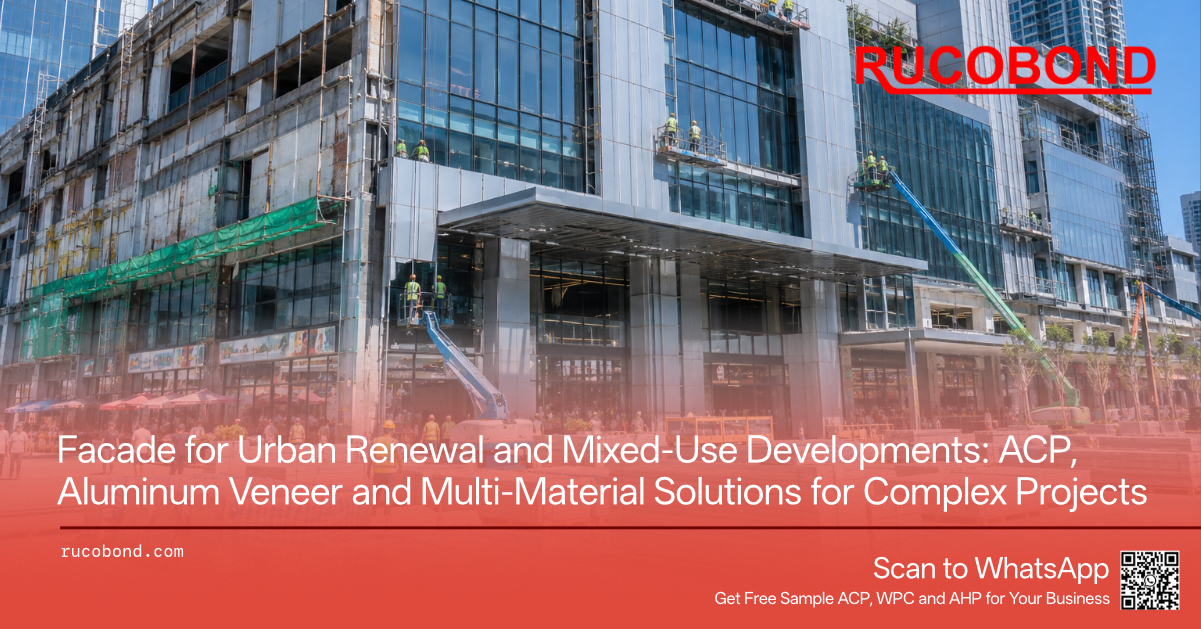
Why Urban Renewal Projects Create More Complicated Material Decisions
Urban renewal sounds simple in planning presentations: upgrade old buildings, improve public space, introduce new commercial functions and give the district a more modern appearance. On an actual construction site, the situation is less tidy. A forty-year-old concrete building may have been repaired several times, balconies may no longer match original drawings, existing shops may need to remain open, residents may still be living upstairs, and the contractor may only be allowed to close part of the street at a time. The material supplier therefore becomes part of a much larger coordination problem.
Mixed-use developments create similar pressure. A single project may contain retail at street level, offices above, residential towers behind, underground parking and public terraces connecting everything together. These zones do not use the same materials or face the same level of traffic. The retail podium may need stronger visual branding. Office entrances may require cleaner metal finishes. Residential sections may prioritize cost control and long-term maintenance. Shared terraces need outdoor materials that can handle rain and foot traffic.
Founded in Guangzhou, China in 2013, Rucobond supplies architectural materials to international contractors, façade engineering companies, building material distributors, importers and decoration businesses. The product range includes Aluminum Composite Panels, Aluminum Honeycomb Panels, Aluminum Veneer, Aluminum Coils, WPC products and Sintered Stone Slabs. This allows buyers to combine different materials according to the function of each building zone instead of forcing one solution across the entire project.
For urban renewal, this flexibility matters because existing buildings rarely behave like new structures. A broad wall may work well with ACP, while the redesigned entrance needs custom Aluminum Veneer. A premium lobby may justify Honeycomb Panels, and the rooftop terrace may use WPC. Local fabricators can use Aluminum Coil for smaller trims discovered after old cladding is removed. Sintered Stone can support reception counters, retail interiors and other high-contact spaces.
The real procurement goal is not simply replacing old materials with new ones. It is creating a supply plan that fits the structure, schedule, budget and actual use of the renewed district.
Managing Existing Structures, Phased Construction and Active Commercial Areas
One of the biggest challenges in urban renewal is that the project often cannot stop normal life around it. Shops remain open. Office workers continue entering the building. Residents still need access to elevators and parking. Restaurants may only accept loud construction during certain hours. Contractors therefore work in phases, sometimes one façade, one block or even one entrance at a time.
This makes timing and packaging much more important than in a simple new-build project. If all materials arrive at once, the site may have nowhere to store them. If they arrive too late, rented scaffolding and lifts sit idle. If custom panels are packed without clear zone identification, installation crews can waste hours opening pallets to find the right pieces.
Imagine a mixed-use complex being renovated block by block. The first phase covers the retail podium and south elevation. The second phase upgrades the office entrance. The third phase handles residential common areas and rooftop terraces. Each stage requires different materials and may begin months apart. A supplier who can discuss staged production and repeat orders becomes more useful than one who only offers a single large shipment.
Rucobond can work with buyers to separate products by building, façade, floor or project phase according to agreed requirements. Color references, panel codes, packaging labels and shipment schedules can be coordinated before production. For repeat orders, keeping specifications organized helps improve consistency across later batches.
This is especially important for urban renewal because replacement pieces are common. Old walls may reveal unexpected conditions. A structural edge may require an additional cover panel. A late tenant request may add another entrance or signage zone. If the supplier can reproduce the same finish and specification, the project team avoids creating visible patches across the renewed building.
Phased construction is not glamorous. It is mostly logistics, labels, drawings and people trying not to block each other. Unfortunately, that boring coordination is exactly what makes a complicated city project work.
Aluminum Composite Panels for Large-Scale Facade Renewal
Aluminum Composite Panels are often selected for urban renewal because they can cover large exterior surfaces efficiently while giving designers a wide range of colors and finishes. Old office blocks, shopping streets, community commercial buildings and mixed-use podiums can all benefit from a new cladding system that improves appearance without adding the weight of many traditional materials.
Rucobond supplies ACP in solid matte colors, glossy solid colors, metallic finishes, mirror surfaces, wood grain patterns, brushed silver, brushed gold and stone-inspired styles. For renovation projects, neutral metallic, white, grey and darker commercial colors are often practical, while wood grain and brushed finishes can be used to create warmer or more premium zones.
Consider an aging commercial street with concrete façades from the early 2000s. The original buildings may have faded paint, inconsistent signs and exposed service equipment. A renovation contractor can use ACP to create cleaner wall surfaces, reorganize signage zones and introduce a consistent architectural language across several shop units. This can significantly change the visual identity of the street without rebuilding every structure.
ACP also provides fabrication flexibility. Panels can be cut, routed and folded to fit existing openings, columns, parapets and façade edges. During renovation, this is valuable because real dimensions often differ from the drawings. The ability to adjust fabrication reduces the need for completely new systems when site conditions change.
For exterior use, the correct coating and panel specification should match the location and exposure. Projects in Southeast Asia may face high humidity, strong sunlight and heavy rain. Middle Eastern projects may face heat, dust and intense UV. Coastal developments may require additional attention to the local environment.
Rucobond works with buyers to confirm panel thickness, aluminum skin, coating, color, finish, size, quantity and packaging before production. For large projects completed over several stages, approved color references and product records can support more stable repeat production.
The main advantage of ACP in urban renewal is not luxury. It is adaptability. It allows contractors to renew large areas quickly, control visual consistency and keep project costs more manageable.
Aluminum Veneer for Entrances, Corners, Canopies and Irregular Building Details
The broad wall is rarely the hardest part of a renovation. The real trouble usually appears around entrances, corners, roof edges, columns, balconies and canopies. Existing structures are full of awkward dimensions, previous repairs and architectural details that refuse to fit standard panel sizes.
Aluminum Veneer is useful in these areas because it can be fabricated according to project drawings. Panels can be folded, curved, perforated and produced in custom shapes depending on the design and technical requirements.
Rucobond Aluminum Veneer can be used for retail entrances, office canopies, column covers, roof edges, balconies, decorative screens and irregular façade features. In mixed-use developments, it often becomes the material that connects different architectural zones together.
For example, a commercial podium may use ACP across large wall areas but require custom Aluminum Veneer around the main entrance and corners. The veneer can form deeper frames, sharper folds and more complex geometry, helping the building create a stronger identity without using custom metalwork everywhere.
Urban renewal projects also benefit from factory processing. When panels are fabricated according to updated site measurements, contractors can reduce complicated cutting and forming on crowded city sites. This matters where work areas are narrow, pedestrian routes remain open and noise or dust restrictions limit what can be done on location.
Clear drawings are essential. Buyers should provide dimensions, folds, curves, perforations, panel codes, coating, color and quantities. In existing buildings, updated measurements should take priority over old drawings because earlier repairs may have changed the structure.
For multi-phase projects, panel labeling can help separate pieces by building or zone. A properly labeled shipment is not exciting, but it prevents workers from spending the morning turning pallets into a metal-panel treasure hunt.
Aluminum Honeycomb Panels for Premium Public and Shared Spaces
Mixed-use developments often contain large shared areas that need a more refined architectural finish. Office lobbies, shopping center atriums, public corridors, elevator halls and covered walkways may require larger panels with better rigidity and flatter surfaces.
Aluminum Honeycomb Panels can support these applications because their internal honeycomb structure provides strength while keeping overall panel weight relatively low. This makes them suitable for large ceilings, wall panels and other broad architectural surfaces.
A renovated office lobby provides a useful example. The original ceiling may use many small panels and visible joints. During the upgrade, the designer may want larger modules and cleaner lines. Honeycomb Panels can provide the stability needed for these larger formats while reducing the amount of visible segmentation.
In a mixed-use project, Honeycomb Panels may be used selectively in premium shared areas while ACP remains the more economical solution for general façade work. This creates a better balance between cost and visual quality.
Rucobond supports customized Honeycomb Panel production according to dimensions, thickness, surface finish, color and edge requirements. Technical drawings help the factory understand the installation area and panel layout.
The material generally costs more than standard ACP, so using it where the benefit is visible makes more commercial sense. A premium office lobby, flagship retail entrance or large shared ceiling may justify it. A hidden service corridor probably does not need to participate in the architectural arms race.
For distributors, Honeycomb Panels also create access to higher-value projects beyond routine cladding. Customers may include premium interior contractors, transportation projects, elevator companies and façade engineering firms.
Aluminum Coils for Local Fabrication and Last-Minute Site Adjustments
Urban renewal always produces last-minute adjustments. Old roof edges do not match the survey. Shopfront dimensions change after demolition. Drainage details need revision. New signage requires additional metal trims. Waiting for every small component to be manufactured overseas can slow the project unnecessarily.
Aluminum Coil provides flexibility because local fabrication companies can process it into trims, ceiling components, roof details, signs and other supporting products according to final measurements.
Rucobond supplies Aluminum Coil based on thickness, width, coating, color, surface finish, quantity and downstream application. Regional distributors can supply the material to local roofing, signage, ceiling and fabrication businesses.
For a mixed-use renovation, the supply strategy may therefore include finished ACP for broad walls, custom Aluminum Veneer for major entrances and locally processed Aluminum Coil for smaller details. This combination allows the project to use factory-made precision where necessary and local flexibility where site conditions remain uncertain.
Local fabrication is particularly useful in dense urban projects because delivery access may be limited. Smaller components can be made near the site rather than transported across long distances in finished form.
Packaging and handling still require careful planning. Coils carry concentrated weight and need secure support, moisture protection and suitable unloading equipment. The receiving warehouse should understand the cargo before the truck arrives, which sounds obvious until someone discovers their forklift has been assigned a philosophical rather than mechanical role.
For building material distributors, Aluminum Coil also broadens the customer base beyond façade contractors. It can serve local manufacturers and fabrication workshops, creating more repeat business from the same supplier relationship.
WPC and Sintered Stone for Podiums, Terraces and Commercial Interiors
Urban renewal often begins with the façade and then expands into the spaces people actually use. Once the exterior looks new, the old terrace, lobby counter or retail corridor suddenly looks even older by comparison. This is how a “simple façade renovation” quietly develops additional chapters.
WPC products can support outdoor terraces, podium decks, rooftop leisure areas, pedestrian paths and decorative wall applications. They provide a wood-like appearance with improved resistance to moisture and insects compared with many untreated timber products.
This is useful for mixed-use developments where public terraces, restaurant zones and rooftop spaces need a warmer material than metal or concrete. A renovated shopping podium may use WPC around outdoor dining areas while ACP and Aluminum Veneer define the building façade.
Sintered Stone Slabs can support interior retail and public areas such as reception counters, commercial walls, restaurant surfaces, bathrooms and premium lobby features. Their stone-inspired appearance provides a more controlled visual option compared with many natural stone products, while practical durability supports high-contact commercial use.
A single urban renewal project might therefore use ACP on the exterior, Aluminum Veneer around entrances, Honeycomb Panels in shared ceilings, WPC on a terrace and Sintered Stone around interior counters. The advantage is not forcing every material into one order. It is having options available when the project scope naturally expands.
For contractors, this can reduce the number of unrelated suppliers. For distributors, it creates opportunities across façade, landscape and interior customer groups.
The correct approach is still selective. A project should not become a materials showroom simply because the supplier has a thick catalog. Each product needs a reason to be there.
Quality Control, Color Matching and Packaging for Multi-Phase Projects
Multi-phase urban renewal creates a particular quality problem: time. The first façade may be installed months before the last one. Replacement panels may be ordered after tenants move in. Additional buildings may join the renovation program later.
Color and finish consistency therefore become critical.
Rucobond encourages buyers to approve physical samples or clear color references before production, especially for metallic, brushed, wood grain and decorative finishes. Product specifications should remain organized across each project phase.
For repeat production, panel thickness, coating, color, gloss level, finish, protective film and dimensions should be matched to the original confirmed standard whenever possible. This helps reduce visible differences between earlier and later installations.
Packaging also needs to reflect the urban construction environment. Large city sites may have limited storage space and narrow loading zones. Pallet size, labeling and installation sequence can therefore matter as much as basic transport protection.
Custom Aluminum Veneer can be labeled by drawing code. ACP pallets can be marked by color, size or building zone. Materials for different phases can be separated according to agreed shipment plans.
Rucobond products are supported by SGS, CE and ISO-related certifications and quality systems according to product category and project requirements. Quality control can include specification confirmation, surface inspection, dimensional review, color comparison, packaging checks and shipment coordination.
The purpose of all this organization is extremely unromantic: when installers need a panel, they should know where it is and what it is. Construction productivity often rests on achievements this modest.
OEM, ODM and Bulk Supply for Urban Renewal Contractors and Distributors
Urban renewal creates long-term demand because cities rarely renovate only one building. A successful commercial street upgrade may lead to nearby blocks following the same direction. Property groups may renovate several office or retail assets using similar materials. Regional distributors may serve different contractors working under the same municipal renewal program.
Rucobond supports OEM and ODM cooperation for professional buyers that want standardized products, private-label packaging or repeat-order specifications.
Customization may include branded protective film, packaging, labels, colors, dimensions, finishes and project-specific requirements. A distributor can develop an ACP range focused on commercial renovation, using practical neutral colors for broad demand and decorative finishes for higher-value projects.
Contractors working across several buildings can also standardize common materials while customizing only the difficult zones. This helps simplify procurement and gives installation teams more familiar products to work with across phases.
For distributors, the benefit of OEM is stronger local positioning. Instead of selling anonymous panels, the company can build a recognizable product range supported by repeat factory supply.
Rucobond mainly serves contractors, façade engineering companies, importers, wholesalers, decoration businesses and building material distributors requiring bulk orders, customized production and long-term cooperation.
For large urban renewal programs, staged production and delivery can be discussed according to product type, quantity and schedule. Early communication helps the factory plan capacity around the project rather than receiving urgent messages halfway through installation asking whether another container can somehow materialize next Tuesday.
Preparing a More Accurate Material Plan Before the First Building Is Opened
The best time to solve renovation problems is before demolition begins.
Buyers should start by identifying the project type, building age, existing façade condition, target appearance, construction phases and whether the property will remain occupied during work.
For Aluminum Composite Panels, provide total panel thickness, aluminum skin, coating type, color, finish, size, quantity and exterior or interior use. For Aluminum Veneer, provide updated drawings, folds, curves, perforations, panel codes, coating and quantities. For Honeycomb Panels, provide panel dimensions, thickness, surface finish, edge details and application area.
For Aluminum Coil, include thickness, width, coating, color and intended local fabrication use. WPC and Sintered Stone inquiries should include dimensions, application, pattern or color and estimated quantity.
Photographs are particularly useful for urban renewal. Send images of existing entrances, balconies, columns, roof edges, old cladding and surrounding site conditions. These details help reveal issues that may not appear in architectural drawings.
The construction sequence should also be clear. Which façade begins first? Which buildings remain occupied? Is the retail podium completed before the office tower? Are materials delivered directly to each building or consolidated at a regional warehouse?
Rucobond welcomes inquiries from urban renewal contractors, façade engineering companies, property developers, commercial renovation firms, building material importers and distributors. OEM, ODM, samples, customized manufacturing and bulk international supply can be discussed according to actual requirements.
Send the drawings, BOQ, photographs, material list, quantity, destination and project schedule. A precise inquiry at the beginning is usually cheaper than discovering the truth after the old wall has already been removed.
Q: Is ACP suitable for renovating old commercial and mixed-use buildings?
A: Yes. Aluminum Composite Panels are commonly used for façade renovation because they are relatively lightweight, flexible to fabricate and available in many colors and finishes. The correct panel specification and coating should be selected according to the existing structure, climate and project requirements.
Q: Can Rucobond support a renovation project completed in several phases?
A: Yes. Staged production and shipment can be discussed according to quantities, construction phases and factory scheduling. Buyers should provide the full project plan early so color references, packaging and delivery priorities can be coordinated more effectively.
Q: Can custom Aluminum Veneer fit irregular existing structures?
A: Yes. Aluminum Veneer can be manufactured according to updated technical drawings for canopies, columns, corners, roof edges, curved areas and other irregular details. Accurate site measurements are especially important for renovation projects.
Q: Can Rucobond reproduce the same finish for replacement panels later?
A: Rucobond can work from approved samples, confirmed specifications and production references to support repeat orders. Buyers should communicate expected future requirements and keep the same product specification where appearance consistency is important.
Q: Does Rucobond support OEM products for urban renewal material distributors?
A: Yes. OEM and ODM services can include private-label protective film, customized packaging, product labels, selected colors, dimensions, finishes and other requirements for professional importers, distributors and construction material companies.
Name: Gina Chen
Mobile:+86-189-2412-4951
Tel:+86-189-2412-4951
Whatsapp:8618924124951
Email:gina@rucobond.com
Add:Room 708, No. 8 Jingang Avenue, Nansha Street, Nansha District, Guangzhou


