
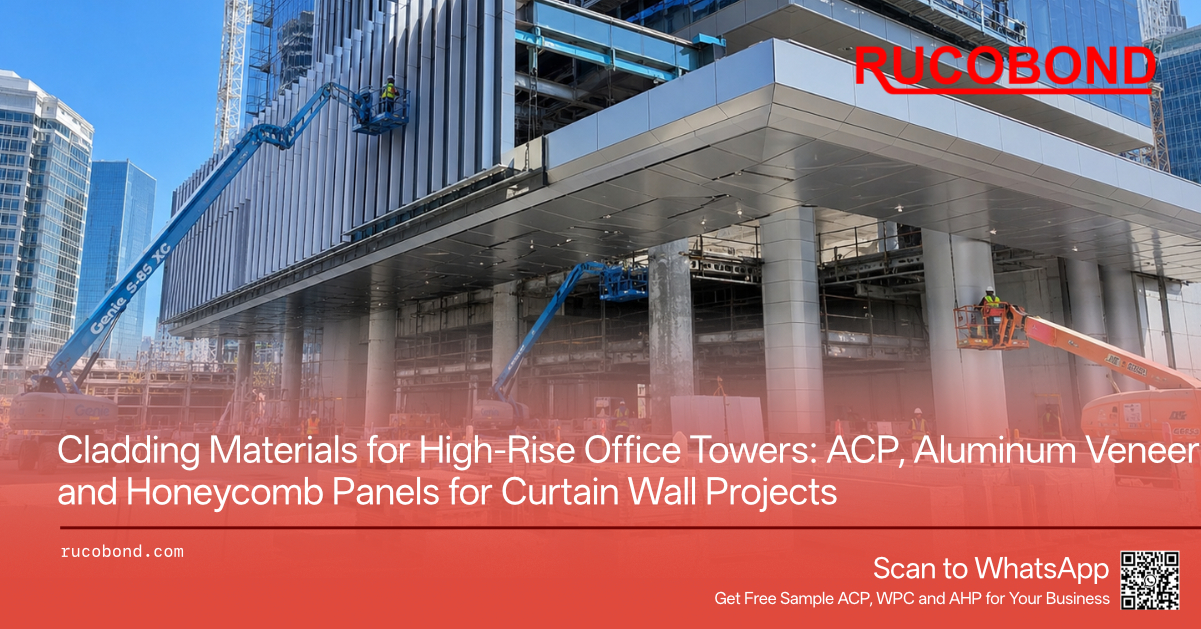
Why High-Rise Façade Projects Demand More from Material Suppliers
A high-rise office tower can contain tens of thousands of square meters of exterior surface. Once the façade begins going up, small material mistakes stop being small. A slight color difference repeated across twenty floors becomes visible from the street. A panel arriving late can delay an entire elevation because suspended platforms, cranes and installation crews are already scheduled. A damaged batch may require materials to be lifted hundreds of meters again after replacement arrives. On a tall building, every mistake acquires altitude and, somehow, a larger invoice.
This is why façade contractors and project developers evaluate suppliers differently for high-rise construction. They need more than a competitive square-meter price. They need stable production, repeatable finishes, suitable packaging, clear technical communication and the ability to support several delivery phases without losing control of specifications.
Founded in Guangzhou, China in 2013, Rucobond manufactures and exports Aluminum Composite Panels, Aluminum Honeycomb Panels, Aluminum Veneer, Aluminum Coils, WPC products and Sintered Stone Slabs for international construction markets. The company works with façade engineering contractors, curtain wall companies, building material distributors, importers, decoration companies and developers across Southeast Asia, Europe, the Middle East, North America and other regions.
High-rise projects usually combine several façade systems. Glass curtain walls may dominate the office elevations, while Aluminum Composite Panels are used around solid wall zones, mechanical floors or podium areas. Aluminum Veneer may form columns, roof edges, canopies and deep architectural frames. Aluminum Honeycomb Panels can support larger feature surfaces or interior ceiling areas. Aluminum Coil may be processed locally by curtain wall workshops for trims and secondary components.
The useful part is not simply having six product categories in a catalog. It is being able to discuss where each material belongs within one architectural system. That helps contractors balance cost, weight, appearance and fabrication instead of trying to force one material across every detail.
For high-rise buyers, supply stability matters throughout the construction cycle. The first approved sample may be produced months before the last elevation is installed. Rucobond supports project-based manufacturing, OEM and ODM requirements, repeat orders and staged delivery according to actual quantity and production planning.
Coordinating Aluminum Panels with Glass Curtain Wall Systems
Modern office towers often combine large glass curtain walls with opaque aluminum zones. The glass provides daylight and transparency, while metal panels cover slabs, columns, mechanical spaces, roof structures and architectural features. The challenge is making these different systems look intentional rather than as though two subcontractors met for the first time on installation day.
Color, module size, joint lines and surface reflectivity all affect the relationship between glass and metal. A cool silver ACP panel may work well with blue-grey curtain wall glass, while a warm metallic finish may clash badly. Dark Aluminum Veneer can frame glass elevations and create depth. Brushed surfaces may reduce excessive reflection around entrances and podiums.
Rucobond supports different finishes including solid matte colors, high-gloss solid colors, metallic surfaces, mirror finishes, wood grain patterns, brushed silver, brushed gold and stone-inspired designs. For high-rise office projects, metallic grey, silver, charcoal and white remain common because they integrate easily with modern glazing systems, but project-specific colors can also be developed according to requirements.
Physical sample approval is important. Curtain wall glass changes appearance throughout the day depending on sunlight, sky condition and viewing angle. Aluminum surfaces do the same. A material combination that looks balanced under indoor lighting may behave differently on a south-facing façade at noon.
For this reason, contractors should compare real samples under exterior light whenever possible. Large mock-up sections are especially valuable for premium towers because they allow architects and owners to review joints, colors, reflections and fixing details before full production begins.
Rucobond can work with project drawings, color references, panel schedules and BOQ documents to support material selection. For Aluminum Veneer and Honeycomb Panel areas, detailed drawings help confirm dimensions, folds and edge requirements. For ACP, panel size, thickness, aluminum skin, coating and finish should be clearly specified.
The advantage of coordinating these materials early is not merely visual. It also helps installation planning. Curtain wall contractors can understand which products arrive finished, which require local fabrication and how different components interface around windows, slab edges and structural zones.
A façade is one system when the building is finished, even if procurement departments insist on dividing it into seventeen spreadsheets.
Aluminum Composite Panels for Large Office Tower Façades
Aluminum Composite Panels remain one of the most practical materials for large office and commercial buildings because they provide broad surface coverage with relatively low weight and flexible fabrication. ACP can be used on podiums, mechanical floors, parapets, solid wall zones, entrance areas, parking structures and renovation sections connected to a glass curtain wall system.
Rucobond supplies ACP in multiple finishes and specifications according to project needs. On high-rise projects, solid and metallic colors are commonly selected because they create clean, repetitive surfaces that work well with glass and steel. Dark charcoal panels can visually hide mechanical floors, while silver or light grey panels can make podium levels feel more open and contemporary.
Fabrication flexibility is another advantage. ACP can be cut, routed and folded into cassette panels, allowing façade contractors to create regular modules and align joints with glazing grids. This is especially useful where opaque panel zones need to follow the same architectural rhythm as the curtain wall.
For cost control, ACP can also be used selectively. A tower may use higher-cost Aluminum Veneer on complex corners and feature elements while ACP handles larger flat areas. This mixed approach gives architects the visual result they want without applying the most expensive material to every square meter.
Batch consistency is critical. A twenty- or thirty-story building exposes panel differences far more clearly than a small storefront. If one production batch has a different gloss level or metallic tone, the change may appear as a visible band across several floors.
Rucobond works from approved specifications and color references to support bulk production. Buyers should provide total thickness, aluminum skin, coating, color, gloss level, size, quantity and intended application. For phased projects, expected future quantities should also be communicated early.
Packaging must match the installation sequence. Panels destined for upper floors may be delivered according to elevation or zone, while podium materials may arrive earlier. Clear pallet identification helps reduce unnecessary handling and protects materials from being moved repeatedly around the site.
For façade contractors, the real value of ACP is straightforward: broad coverage, flexible processing, manageable weight and a wide decorative range. It does not need dramatic marketing language. A product that helps cover ten thousand square meters without creating ten thousand problems is already doing useful work.
Aluminum Veneer for Columns, Spandrels, Canopies and Complex Details
High-rise towers rarely consist of perfectly flat rectangles. Architects add vertical fins, deep frames, folded corners, roof crowns, entrance canopies and podium features to give the building identity. These details often require more fabrication freedom than standard flat panels can provide.
Aluminum Veneer is suitable for these applications because it can be manufactured according to technical drawings. Panels can be folded, curved, perforated and shaped into customized architectural components depending on project requirements.
On a glass office tower, Aluminum Veneer may be used around columns, slab edges, spandrels, entrance frames, roof parapets and mechanical screens. A large headquarters building may use deep aluminum fins to create shade and vertical rhythm. A commercial podium may use folded veneer around entrances to form strong geometric frames.
Rucobond supports customized Aluminum Veneer production based on dimensions, thickness, folds, curves, perforations, coating, color and panel codes. For complex façade projects, drawing accuracy is essential because every piece must coordinate with the curtain wall support system.
Factory fabrication can reduce difficult work on site. Instead of cutting and folding large panels beside a busy high-rise project, contractors can receive components prepared according to approved drawings. This can improve consistency and reduce installation waste.
Panel identification is particularly important. A tower may contain hundreds or thousands of custom pieces that look similar but belong to different elevations. Labels linked to shop drawings help installation teams find the correct panel without turning the storage area into a metal version of a jigsaw puzzle.
Surface treatment should also reflect the building environment. Exterior Aluminum Veneer may face strong UV, rain, pollution and wind-driven dust. Coastal high-rises require additional attention to the local environment. Buyers should provide project location and exposure information during the specification stage.
The strongest advantage of Aluminum Veneer is design freedom. It allows architects to create deeper, sharper and more customized façade features while keeping the material relatively lightweight. Used together with ACP and glass curtain walls, it can give an office tower a more distinctive identity without turning the entire façade into a custom fabrication exercise.
Aluminum Honeycomb Panels for Large-Format Architectural Surfaces
Some high-rise projects require larger, flatter panels with higher rigidity. Premium headquarters, sky lobbies, large entrance ceilings and commercial podiums may use Aluminum Honeycomb Panels where surface stability and lower weight are important.
The internal honeycomb core creates a rigid structure while keeping the overall panel relatively lightweight. This allows larger panel formats to maintain better flatness and can reduce the number of visible joints in important architectural areas.
A corporate headquarters entrance is a good example. The canopy or ceiling may extend across a large vehicle drop-off zone. If small panels are used, the surface can become visually busy. Larger Honeycomb Panels can create cleaner modules and a more refined appearance.
Inside the building, Honeycomb Panels may also be used in elevator halls, large ceilings, conference areas and feature walls. These locations are highly visible and often form part of the building’s premium public image.
Rucobond supports customized Honeycomb Panels according to dimensions, thickness, surface finish, color and edge requirements. Technical drawings are recommended because panel size, support details and installation method influence production.
Honeycomb Panels generally cost more than standard ACP, so selective use makes sense. A tower may reserve them for the main entrance, sky lobby or large interior ceilings, while ACP and Aluminum Veneer handle more routine façade areas.
This is a more rational approach than using premium specifications everywhere just because the project brochure contains the word “landmark.” Buildings remain expensive even without helping them.
For façade contractors and distributors, Honeycomb Panels also create access to higher-value applications where standard cladding cannot provide the required rigidity or format size. Supplying ACP, Veneer and Honeycomb Panels together gives project buyers more flexibility when dividing the façade into different performance zones.
Aluminum Coils for Curtain Wall Fabricators and Local Processing
Curtain wall contractors often operate their own fabrication workshops or cooperate with local metal processors. These companies may need Aluminum Coil for trims, ceiling systems, signage, roof details and supporting façade components.
Rucobond supplies Aluminum Coil according to thickness, width, coating, color, surface finish, quantity and downstream application. This allows local workshops to fabricate secondary parts closer to the project site.
Local processing can be especially valuable on high-rise projects because final site conditions sometimes change after structural work progresses. Small trims around roof edges, window interfaces or mechanical openings may need dimensional adjustment. Producing every secondary component overseas can slow the project unnecessarily.
A mixed supply strategy therefore works well. Finished ACP arrives for large wall modules. Custom Aluminum Veneer is produced for major architectural features. Aluminum Coil remains available locally for smaller components and adjustments.
For regional distributors, Aluminum Coil also expands the customer base. Curtain wall fabricators, roofing manufacturers, ceiling companies and signage workshops may all need coated aluminum materials even when they do not purchase finished ACP.
Providing the final application helps Rucobond understand the buyer’s priorities. Decorative ceiling products may require stronger surface consistency, while secondary trims may focus more on fabrication performance and coating suitability.
Packaging and unloading must be planned carefully because coils carry concentrated weight. Strong supports, moisture protection and appropriate handling equipment are important during international transport. A thirty-story façade project can survive many engineering calculations and still be defeated temporarily by a warehouse that forgot to check forklift capacity. Physics has a very stable quality-control system.
Material Selection for Podiums, Lobbies and Shared Commercial Areas
High-rise office towers are more than vertical façades. The lower podium, lobby, retail spaces, terraces and shared amenities often use a broader mix of materials to create a more welcoming environment.
WPC products can be used on outdoor terraces, rooftop leisure zones and landscaped podium areas where a wood-like appearance is desired with improved resistance to moisture and insects compared with many untreated timber products.
Sintered Stone Slabs can support lobby counters, interior feature walls, café areas, bathrooms and premium commercial surfaces. Their controlled stone-inspired appearance allows designers to create refined interiors while maintaining practical durability for high-contact areas.
A headquarters project may therefore combine metallic ACP on the upper podium façade, Aluminum Veneer around the entrance canopy, Honeycomb Panels on the lobby ceiling, WPC on an outdoor employee terrace and Sintered Stone at the reception desk.
Each material solves a different problem.
For contractors, having these options under one broader supplier relationship can reduce coordination work. For building material distributors, the product range reaches several customer groups beyond the façade contractor alone.
The important part is not using every category simply because it exists. A good material schedule allocates products according to use, exposure, maintenance and budget. The lobby deserves a different strategy from the mechanical floor. The rooftop terrace should not be specified like the façade. This sounds deeply reasonable, which is why construction documents occasionally need several meetings to rediscover it.
Rucobond can discuss these materials according to project drawings, BOQ requirements and application areas, helping buyers create a more complete supply plan for the tower and podium rather than treating every zone as an unrelated order.
Color Consistency, Packaging and Phased Supply for Tall Buildings
High-rise construction is almost always phased. The podium may begin first. One elevation may progress faster than another. Mechanical floors may require panels before the roof crown. Interior public spaces may not need materials until much later.
This creates challenges for color consistency and delivery planning.
Rucobond encourages buyers to approve physical samples and maintain clear product records before bulk production. Metallic colors, brushed finishes and darker tones can be especially sensitive to viewing angle and batch variation, so consistent references are important.
For repeat production, panel thickness, coating, finish, gloss level and color should remain aligned with the approved specification wherever possible. Buyers planning a long construction period should communicate estimated total quantities early so production and sample records can be managed accordingly.
Packaging should match project zones. ACP pallets can be labeled by elevation or floor range. Aluminum Veneer can use panel codes linked to shop drawings. Honeycomb Panels can be grouped according to installation area. This makes the warehouse and site logistics more efficient.
Tall buildings also create lifting challenges. Once materials reach the site, they may need to move through hoists, cranes or suspended platforms before installation. Packaging should protect the panels during these additional handling stages without becoming unnecessarily difficult to open.
Rucobond products are supported by SGS, CE and ISO-related certifications and quality systems according to product category and project requirements. Quality control can include surface inspection, dimensional checks, color comparison, specification verification and packaging review.
The goal is simple: when a pallet is lifted to the twentieth floor, everyone should be reasonably confident that the correct panels are inside. Discovering otherwise at that altitude is an unnecessarily scenic procurement problem.
OEM, ODM and Bulk Manufacturing for Façade Contractors and Distributors
High-rise projects often create repeat opportunities for curtain wall companies and regional building material distributors. A façade contractor may work on several office towers under the same developer. A distributor may supply common ACP and Aluminum Veneer finishes to different commercial projects throughout the year.
Rucobond supports OEM and ODM cooperation for these professional buyers.
Customization can include private-label protective films, branded packaging, product labels, selected colors, dimensions, surface finishes and project-specific requirements. This allows distributors to create their own architectural panel ranges while relying on factory production behind the brand.
A regional façade supplier may develop a standard commercial collection with silver, charcoal, white and metallic grey ACP. Premium brushed and mirror finishes can serve entrances or retail podiums. Aluminum Honeycomb Panels and custom Veneer can then support more demanding projects.
For façade contractors, OEM may be less about retail branding and more about standardization. Repeated developers or office projects may use the same coating system, finish and panel specification across several buildings. Maintaining these standards can simplify future procurement.
Rucobond mainly serves contractors, façade engineering companies, importers, wholesalers, decoration companies and building material distributors requiring bulk production and repeat supply.
Large high-rise projects can also be discussed in phases. Production capacity, delivery sequence and packaging can be planned around the construction schedule where practical.
The value of a long-term supplier relationship is predictability. A professional buyer does not want each new order to feel like a first date. It wants the factory to remember the product, understand the standards and produce the same thing again without unnecessary theater.
Preparing a More Accurate Inquiry for a High-Rise Cladding Project
A useful high-rise quotation begins with clear project information. Start with the building type, total height, façade system, project location and current construction stage.
For Aluminum Composite Panels, provide total thickness, aluminum skin, coating type, color, gloss level, finish, panel size and estimated quantity. If the panels are intended to coordinate with curtain wall glass, include glass color or façade renderings where possible.
For Aluminum Veneer, provide technical drawings showing dimensions, folds, curves, perforations, fixing edges, coating, color and panel quantities. Shop drawings are especially valuable for columns, fins, canopies and roof structures.
For Aluminum Honeycomb Panels, provide panel dimensions, thickness, surface material, finish, edge details and installation area. For Aluminum Coil, provide thickness, width, coating, color, quantity and downstream use.
Buyers should also explain the shipment plan. Will materials go directly to the construction site or to a façade fabrication workshop? Is delivery required by elevation, floor or construction phase? Are there limitations on pallet size or unloading equipment?
Physical color samples, BOQ files, façade drawings and panel schedules can all improve quotation accuracy.
Rucobond welcomes inquiries from curtain wall contractors, façade engineering firms, office tower developers, building material importers, regional distributors and decoration companies. OEM, ODM, customized production, samples and bulk export supply can be discussed according to project requirements.
Send the façade drawings, material specification, quantities, destination and expected construction schedule. High-rise procurement already involves enough complexity. A clear inquiry at the beginning helps ensure the material supplier does not add another floor to it.
Q: Can Rucobond supply ACP for high-rise office tower façades?
A: Yes. Rucobond supplies Aluminum Composite Panels for commercial and high-rise façade applications. Buyers should provide panel thickness, aluminum skin, coating, color, size, quantity and project location so suitable specifications can be discussed.
Q: Can Aluminum Veneer be customized to match curtain wall drawings?
A: Yes. Rucobond supports drawing-based Aluminum Veneer production for columns, canopies, spandrels, fins, roof edges and other architectural features. Accurate technical drawings and panel codes are recommended.
Q: Are Aluminum Honeycomb Panels suitable for large office tower entrances?
A: Aluminum Honeycomb Panels can be considered for large entrance ceilings, feature walls and premium public areas where rigidity, panel size and relatively low weight are important. The final specification depends on drawings and engineering requirements.
Q: Can Rucobond support phased deliveries for a high-rise project?
A: Yes. Staged production and shipment can be discussed according to total quantity, construction sequence and factory schedule. Buyers should provide expected delivery phases early so packaging and production planning can be coordinated.
Q: Does Rucobond provide OEM materials for façade distributors?
A: Yes. OEM and ODM services may include private-label protective films, branded packaging, selected colors, product labels, dimensions and market-specific specifications for professional distributors, importers and façade material companies.
Name: Gina Chen
Mobile:+86-189-2412-4951
Tel:+86-189-2412-4951
Whatsapp:8618924124951
Email:gina@rucobond.com
Add:Room 708, No. 8 Jingang Avenue, Nansha Street, Nansha District, Guangzhou


