
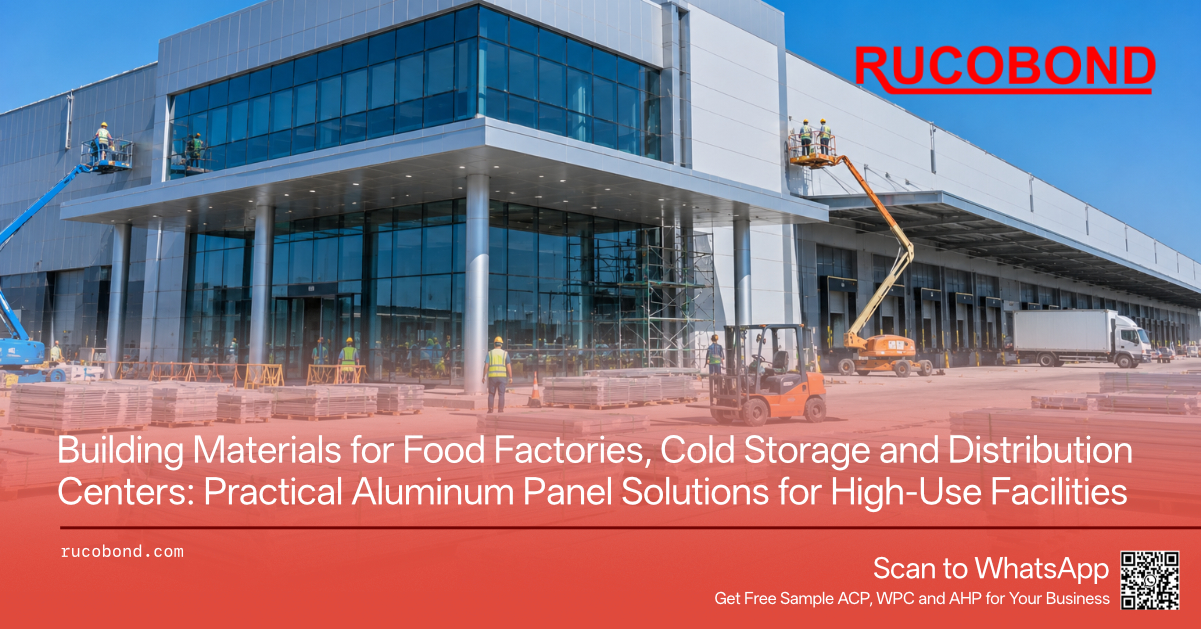
Why Food and Cold-Chain Facilities Need More Practical Building Materials
A food processing plant, central kitchen, cold-chain warehouse or grocery distribution center is not a normal commercial building. People, forklifts, delivery vehicles, pallets, cleaning equipment and packaging materials move through the site every day. Floors are washed, walls are touched, loading areas take abuse, and maintenance teams care much more about whether something is practical than whether it wins an architecture award.
That changes how building materials should be selected. A decorative surface that looks excellent in a showroom but becomes difficult to clean after six months is not a strong choice. A panel that requires complicated replacement can create operational disruption later. A supplier that cannot maintain the same specification across several expansion phases can make a large industrial campus look inconsistent and increase procurement work.
Food and logistics projects also tend to grow in stages. A company may open one processing building first, add a new warehouse two years later, then expand office, loading and staff facilities as business grows. The material supplier therefore needs to support not only the first order but also repeat production, color consistency and later replacement demand.
Founded in Guangzhou, China in 2013, Rucobond manufactures and exports Aluminum Composite Panels, Aluminum Honeycomb Panels, Aluminum Veneer, Aluminum Coils, WPC products and Sintered Stone Slabs for international construction projects. The company works with contractors, building material distributors, importers, decoration companies and project developers across Southeast Asia, Europe, the Middle East, North America and other markets.
For food factories and cold-chain facilities, the useful approach is usually a combination of materials. ACP can support broad exterior walls, factory offices and service areas. Aluminum Veneer can be used around entrances, canopies and loading-zone structures. Honeycomb Panels can support large ceiling or lightweight architectural areas. Aluminum Coil can serve roofing, trims and locally fabricated components. WPC and Sintered Stone can be used in staff areas, dining spaces, showrooms and customer-facing zones.
The goal is not to make an industrial building look like a luxury hotel. The goal is to give each part of the facility a material that suits its actual use, while keeping procurement, installation and future expansion manageable.
Moisture, Cleaning and Daily Wear Change the Material Decision
Food-related buildings usually experience more cleaning, moisture and daily contact than ordinary offices. Central kitchens, processing facilities and distribution centers often operate for long hours, and the building envelope has to coexist with wash-down routines, humidity, dust, packaging debris and constant movement.
This means the buyer should consider maintenance from the beginning. A façade near loading docks may collect dirt more quickly. An entrance used by hundreds of employees every shift needs durable finishes. Staff dining areas require surfaces that can be cleaned frequently. A warehouse office may need to remain presentable while sitting next to a busy industrial environment.
Climate adds another layer. A cold-chain facility in Thailand or the Philippines may face high outdoor humidity and intense rainfall. A warehouse in Saudi Arabia may deal with heat and dust. A food factory near the coast may also experience salt in the air. Exterior coatings, panel specifications and installation systems should reflect these conditions rather than relying on one generic product description.
Rucobond works with professional buyers to clarify where the material will be used, whether it is exterior or interior, the project location, expected quantity, surface finish and installation area. This helps the factory discuss a more suitable specification before production.
The benefit is practical. A buyer can avoid over-specifying hidden areas while using stronger or more suitable materials where exposure and cleaning are more demanding. That keeps the budget under control without treating every square meter as though it lives the same life.
A loading canopy, an office lobby and a staff cafeteria are part of the same facility, but they are not the same material problem. Procurement works better when that obvious fact survives the quotation stage.
Aluminum Composite Panels for Factory Offices, Facades and Support Areas
Aluminum Composite Panels are widely used in industrial and commercial projects because they provide a lightweight, flexible and cost-conscious way to cover large wall areas. In food and cold-chain projects, ACP can be used on administration buildings, exterior façades, office entrances, service corridors, signage zones and supporting commercial areas.
Rucobond supplies solid matte colors, glossy solid colors, metallic finishes, wood grain patterns, brushed surfaces, mirror styles and stone-inspired designs. For industrial projects, practical solid and metallic colors are often the most useful. White, silver, grey and charcoal can create a clean professional appearance, while brighter corporate colors can be used around entrances and signage.
A large grocery distribution center may use neutral ACP across the office and warehouse frontage, then add a strong brand color around the main entrance. A food factory may use brushed or metallic panels in the reception area while keeping the production-facing exterior more economical. A central kitchen serving restaurant chains may use ACP around offices and delivery entrances to create a cleaner visual identity than painted concrete alone.
ACP also provides fabrication flexibility. Panels can be cut, routed and folded around windows, doors, columns and other building details. This is useful when factories expand in stages and new buildings need to match older sections.
For repeat orders, color consistency matters. A logistics company may expand the warehouse two years after the first phase. If the new façade uses a visibly different grey, the entire site can look like two unrelated projects forced into the same property.
Rucobond works from approved specifications and color references to support repeat production. Buyers should provide panel thickness, aluminum skin, coating type, color, finish, dimensions, quantity and project location. For long-term programs, expected future requirements should be communicated early.
For contractors, ACP offers efficient coverage and flexible processing. For building owners, it helps create a professional facility without introducing excessive material weight. For distributors, it remains a repeatable product category with demand across industrial, commercial and public projects.
Aluminum Honeycomb Panels for Large Ceilings and Lightweight Interior Systems
Food factories and cold-chain developments often include larger administrative halls, visitor centers, staff areas and technical buildings where broad ceilings or wall panels are required. Aluminum Honeycomb Panels can provide additional rigidity while maintaining relatively low weight.
The honeycomb structure helps larger panels stay flatter and more stable than many basic sheet materials. This can be useful in reception halls, control centers, corporate visitor areas, laboratories and other spaces where the facility needs a cleaner architectural finish.
A large food manufacturer may operate a production campus that receives retail clients, inspectors and international buyers. The main production building is functional, but the reception and presentation areas need to communicate quality. Large Honeycomb Panels can be used in ceilings or feature walls to create a more controlled and refined environment.
The material may also be suitable for certain technical interiors where low weight and stable panel dimensions are valuable. The final application should always be reviewed according to engineering requirements rather than assumed from a brochure.
Rucobond supports customized Honeycomb Panel production according to dimensions, thickness, surface finish, color and edge requirements. Technical drawings help clarify installation zones and panel sizes before manufacturing.
Because Honeycomb Panels generally cost more than standard ACP, selective use usually makes the most commercial sense. A premium reception hall may justify them. A basic warehouse corridor probably does not. This is one of those rare construction decisions where restraint is allowed.
For distributors, Honeycomb Panels expand the product range beyond routine cladding and create opportunities with industrial headquarters, transportation projects, elevator companies and premium commercial interiors.
Aluminum Veneer for Entrances, Canopies and Loading-Zone Architecture
Food factories and distribution centers often have large canopies, truck entrances, employee access points and roof edges that require customized metal fabrication. These areas are functional, but they also affect how the entire site looks and operates.
Aluminum Veneer is useful because it can be manufactured according to technical drawings. Custom folds, curves, perforations and panel shapes can be produced for entrances, canopies, columns, roof edges, equipment screens and other architectural details.
A cold-chain warehouse may require a wide canopy above loading doors to protect goods and workers from rain. A food factory may use a large entrance frame around the administration building. A corporate visitor center may need custom aluminum fins or perforated screens to create shade and visual identity.
Rucobond supports drawing-based Aluminum Veneer manufacturing. Buyers can provide dimensions, thickness, folds, curves, perforations, coating, color, panel codes and quantities. For projects with many custom components, organized labeling can help installers identify the correct pieces more efficiently.
This becomes especially important around loading zones, where construction space may be limited and operations may begin before every surrounding building is complete. Installation teams need to work quickly and avoid blocking truck routes longer than necessary.
Factory fabrication reduces the amount of complicated forming work required on site. Components can arrive prepared according to approved drawings, helping contractors improve consistency and reduce waste.
For exterior applications, project location and climate should be considered. Canopies and roof edges face direct sun, rain, dust and sometimes coastal air. Surface specification should reflect the actual environment.
Aluminum Veneer works best when used where customization matters. ACP can handle broad flat areas economically, while Veneer deals with the details that make standard panels start complaining.
Aluminum Coils for Local Fabrication, Roofing and Supporting Metal Work
Food and logistics projects frequently involve local metal fabrication. Roofing contractors, ceiling manufacturers, signage companies and workshops may prefer Aluminum Coil because it can be processed into the specific components required on site.
Rucobond supplies Aluminum Coil according to thickness, width, coating, color, surface finish, quantity and final application. Local manufacturers can use it for roofing parts, trims, ceilings, gutters, signs and other supporting elements.
This gives contractors more flexibility during industrial construction. Final measurements often change once equipment, refrigeration systems or loading structures are installed. Producing smaller components locally can reduce waiting time and allow faster adjustment.
A cold storage project, for example, may use finished ACP on the office frontage, custom Aluminum Veneer around truck entrances and locally processed Aluminum Coil for roof edges, trims and drainage components. Each product is supplied in the form that makes the most sense for the job.
For distributors, Aluminum Coil also creates access to additional customers. Roofing companies, signage shops and metal fabrication businesses may purchase coils even when they do not need finished panels.
Packaging requires careful planning because coils carry concentrated weight. Strong supports, moisture protection and suitable unloading equipment are essential. The destination warehouse should know what is arriving before the truck appears. Discovering a handling problem beside a several-ton coil is a very efficient way to make everyone suddenly interested in logistics planning.
WPC and Sintered Stone for Staff, Dining and Customer-Facing Areas
Industrial facilities still contain human spaces. Employees eat, rest, meet visitors and use outdoor areas. Large food companies may also include showrooms, demonstration kitchens, training centers and client reception zones.
WPC can be used for outdoor terraces, staff rest areas, garden paths and decorative wall applications where a wood-like appearance is desired with lower maintenance than many untreated timber products.
This can be practical in humid regions where natural wood may require frequent treatment. A food factory campus may use WPC in a shaded employee courtyard. A distribution center may use it around an outdoor café or staff lounge. A visitor center may combine it with metal cladding to create a warmer entrance environment.
Sintered Stone Slabs are suitable for reception counters, staff dining areas, demonstration kitchens, washrooms, meeting spaces and commercial interiors. Their stone-inspired appearance can create a more refined surface while supporting frequent cleaning and daily use.
A food brand headquarters may use Sintered Stone in a customer demonstration kitchen or presentation space. A distribution center may use it around the reception desk and dining counters. These are small parts of the total project, but they affect how staff and visitors experience the facility.
For contractors, sourcing these materials alongside exterior aluminum products can simplify procurement. For distributors, it broadens the customer base across industrial, interior and landscape applications.
The point is not to decorate the warehouse until forklifts begin feeling underdressed. It is to give the people-facing parts of the facility materials that suit their use.
Quality Control, Packaging and Batch Consistency for Large Facility Projects
Food and cold-chain projects often require large quantities and repeated deliveries. A factory campus may include several buildings. A logistics company may construct multiple warehouses over several years. A distributor may serve the same client across different locations.
This makes consistency one of the most important quality factors.
Rucobond works with buyers to confirm specifications before production. Depending on the product, quality checks can include surface appearance, dimensions, color comparison, packaging condition and order details.
Products are supported by SGS, CE and ISO-related certifications and quality systems according to product category and project requirements. These documents help professional buyers communicate with contractors, consultants and project owners.
Packaging should match both international transport and industrial site conditions. ACP requires flat support and surface protection. Custom Aluminum Veneer may need individual labels and reinforced corners. Honeycomb Panels need careful stacking. Sintered Stone requires stable frames, while Aluminum Coils need strong supports.
Industrial sites can be rough environments. Forklifts move constantly, temporary storage may sit near construction materials, and dust can reach finished surfaces. Buyers should plan a protected storage area before goods arrive.
For phased projects, pallets can be separated according to building, zone or installation stage where agreed. This helps reduce unnecessary handling and makes it easier for contractors to move the correct materials to the correct work area.
Batch consistency is especially important when the same facility expands later. Approved samples, color references and product specifications should be retained where possible so later production can follow the same standard.
A successful industrial shipment is usually boring. The goods arrive, the labels make sense, nothing is damaged and installation continues. That absence of excitement is a surprisingly valuable product feature.
OEM, ODM and Bulk Supply for Contractors and Building Material Distributors
Food factories, cold-chain warehouses and logistics centers create long-term demand for regional building material suppliers. A distributor may serve several warehouse developers or industrial contractors within the same market. A construction company may build facilities for one corporate client across multiple cities.
Rucobond supports OEM and ODM cooperation for professional buyers who need customized protective films, private-label packaging, product labels, selected colors, dimensions and repeat specifications.
A regional distributor may develop a practical industrial ACP collection with white, silver, grey and darker metallic colors. Brushed and wood grain finishes can serve office or reception areas. Aluminum Veneer and Honeycomb Panels can then support higher-value projects.
For contractors, standardization may be more important than branding. If the same logistics company uses one façade color across several warehouses, keeping the product specification stable makes future projects easier to manage.
Rucobond mainly serves contractors, engineering companies, importers, wholesalers, decoration businesses and building material distributors requiring bulk production, customized manufacturing and repeat supply.
Large facility projects can also be discussed in phases. Exterior cladding may be required first, office and visitor areas later, and expansion buildings in future orders. Early communication allows production and packaging to follow the actual project sequence more closely.
The value of OEM and ODM is not the logo alone. It is creating a product system that the buyer can reorder without starting the entire conversation from zero each time. Procurement departments have enough repetitive work already.
Preparing a Clear Material Inquiry for Food and Cold-Chain Construction
A useful quotation begins with the facility type and application. Buyers should explain whether the project is a food factory, central kitchen, cold storage warehouse, grocery distribution center, processing plant or complete industrial campus.
For Aluminum Composite Panels, provide total thickness, aluminum skin, coating type, color, finish, panel size, quantity and exterior or interior use. For Aluminum Veneer, provide technical drawings, dimensions, folds, curves, perforations, coating, color and panel quantities. For Honeycomb Panels, provide dimensions, thickness, surface finish, edge requirements and installation area.
For Aluminum Coil, include thickness, width, coating, color, quantity and downstream fabrication use. WPC and Sintered Stone inquiries should include dimensions, color or pattern, application and estimated quantity.
Project location is important because climate affects exterior material recommendations. Buyers should also explain whether the facility is close to the coast, exposed to high humidity or located in a hot and dusty environment.
The construction schedule should be included. Is the warehouse needed before peak season? Will the processing line begin operation before the office building is complete? Are materials required in several shipment phases?
Drawings, BOQ files, renderings and project photographs can all improve quotation accuracy. For expansions, photos of the existing building help the factory understand the finish and architectural language that new materials need to match.
Rucobond welcomes inquiries from industrial contractors, cold-chain developers, food manufacturing companies, logistics companies, building material importers and regional distributors. OEM, ODM, samples, customized production and large-volume export supply can be discussed according to project requirements.
Send the project type, material list, drawings, quantities, destination and expected schedule. Clear information at the beginning helps the supplier give a useful quotation rather than an impressively precise number built on guesswork.
Q: What Rucobond materials can be used for food factories and cold-chain facilities?
A: Rucobond supplies Aluminum Composite Panels, Aluminum Honeycomb Panels, Aluminum Veneer, Aluminum Coils, WPC products and Sintered Stone Slabs. These materials can support façades, offices, entrances, canopies, staff areas, reception spaces and supporting architectural applications.
Q: Can Aluminum Composite Panels be used on large warehouse and factory façades?
A: Yes. ACP can be suitable for large industrial façade areas because it is relatively lightweight, flexible to fabricate and available in practical solid and metallic finishes. The final specification should match the climate, exterior exposure and project requirements.
Q: Can Rucobond supply custom Aluminum Veneer for loading canopies and entrances?
A: Yes. Rucobond supports drawing-based Aluminum Veneer production for canopies, columns, roof edges, entrance frames, screens and other customized architectural details.
Q: Can the same material specification be repeated for future warehouse expansion?
A: Rucobond can work from approved samples, confirmed colors and product specifications to support repeat production. Buyers planning future phases should communicate the expected expansion program early and retain approved material references.
Q: Does Rucobond support OEM and bulk orders for industrial building material distributors?
A: Yes. OEM and ODM options may include private-label protective film, customized packaging, selected colors, product labels, dimensions and repeat specifications for professional distributors, importers and contractors.
Name: Gina Chen
Mobile:+86-189-2412-4951
Tel:+86-189-2412-4951
Whatsapp:8618924124951
Email:gina@rucobond.com
Add:Room 708, No. 8 Jingang Avenue, Nansha Street, Nansha District, Guangzhou


