
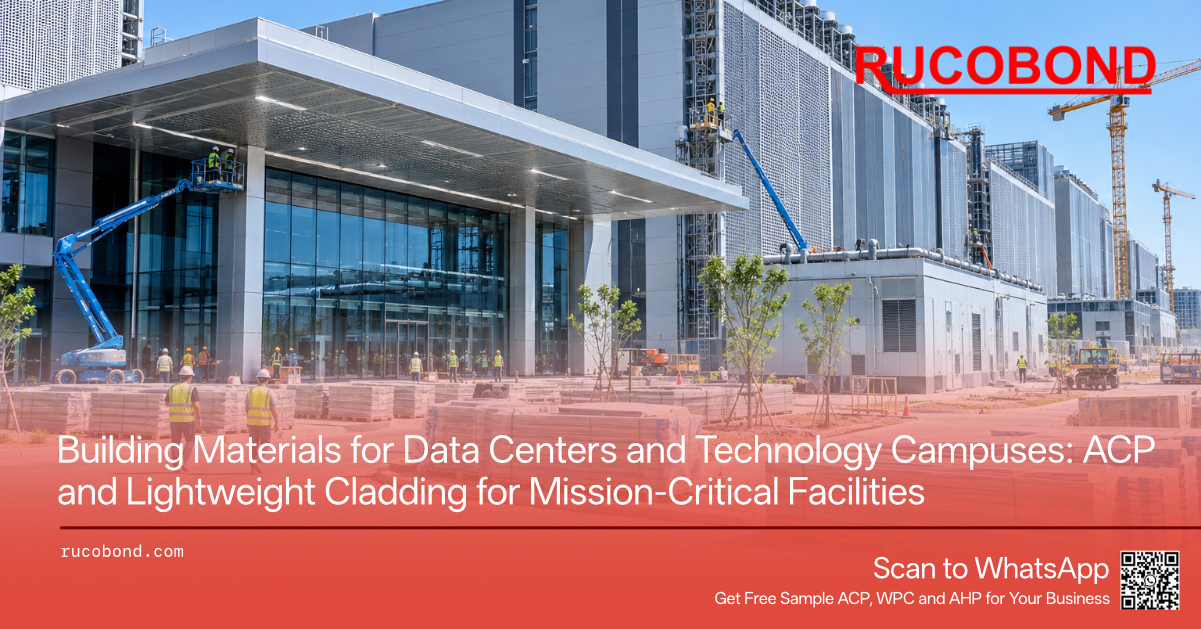
Why Data Centers and Technology Campuses Need a Different Material Supply Strategy
A data center may look simple from the road: a large rectangular building, a controlled entrance, some mechanical equipment and very few windows. Behind that quiet exterior, however, the facility may support financial services, cloud platforms, e-commerce systems, AI computing, telecommunications or corporate infrastructure that is expected to operate continuously. Construction decisions therefore tend to be less forgiving than those of an ordinary commercial property. A delay around the façade may interfere with commissioning work, unfinished equipment screens can affect other contractors, and a poorly coordinated material shipment can occupy valuable site space while electrical and mechanical teams are already fighting over access.
Technology campuses create another layer of complexity because they often combine several building types within one development. The data halls themselves are highly functional. Administration buildings and visitor centers need a more corporate appearance. Energy or mechanical areas may require screens and custom metal components. Staff facilities, outdoor terraces and reception spaces use completely different materials. A single campus can therefore require practical industrial cladding and premium architectural finishes within a few hundred meters of each other.
Founded in Guangzhou, China in 2013, Rucobond manufactures and exports Aluminum Composite Panels, Aluminum Honeycomb Panels, Aluminum Veneer, Aluminum Coils, WPC products and Sintered Stone Slabs for international construction markets. The company serves contractors, façade engineering companies, building material distributors, importers, decoration companies and project developers across Southeast Asia, Europe, the Middle East, North America and other regions.
For data centers and technology campuses, the advantage of a multi-product supplier is coordination. ACP can provide economical coverage across administration and supporting façades. Aluminum Veneer can form equipment screens, entrance canopies and irregular details. Honeycomb Panels can be selected for large premium ceiling or wall areas. Aluminum Coil supports local fabrication when secondary metal components need to be adjusted according to final site conditions. WPC and Sintered Stone can complete staff, visitor and commercial zones without creating an entirely separate procurement chain.
The goal is not to make a mission-critical facility look unnecessarily theatrical. It is to use architectural materials where they improve durability, installation efficiency, appearance and future expansion while keeping the supply plan manageable.
Expansion Schedules and Operational Continuity Change the Procurement Decision
Many data center campuses are not completed in one final construction phase. Capacity grows as customer demand increases. One data hall may begin operation while another building is still under construction. A second phase may start one or two years later using almost the same corporate design. Technology companies may also add office buildings, energy facilities or visitor centers as the campus expands.
This makes repeat production unusually important. The buyer may need the same charcoal metallic ACP, the same Aluminum Veneer finish or the same entrance detail long after the first shipment was completed. If the later material looks noticeably different, the campus starts showing its construction history directly on the façade.
Imagine a cloud infrastructure operator completing Phase 1 with three large data halls. Two years later, Phase 2 adds another pair of buildings beside them. The architecture is intentionally repetitive because the company wants one consistent campus identity. If the new aluminum panels have a slightly different gloss level or metallic tone, the difference can become obvious under strong daylight even though the color name on the invoice is technically identical.
For this reason, project specifications, approved samples and color references should be maintained carefully. Rucobond can work from confirmed material information to support later production and repeat orders. Buyers planning a multi-year development should communicate the expected program early, even if the full volume will not be ordered at once.
Operational continuity also affects delivery. Once part of the campus is live, construction traffic may be restricted around active facilities. Materials may need to arrive according to building zone or installation phase instead of filling one general storage area. Packaging and pallet identification therefore become part of project efficiency.
A supplier that understands staged construction can help the contractor separate materials by building, elevation or phase according to agreed requirements. This does not sound exciting, and that is exactly the point. Nobody responsible for a live data center wants additional excitement from pallets of façade material.
Aluminum Composite Panels for Data Center Facades and Administration Buildings
Aluminum Composite Panels can provide a practical cladding option for technology campuses because they combine relatively low weight, flexible fabrication and a wide range of finishes. They can be used on administration buildings, entrance zones, office façades, service buildings, parking structures and selected parts of data center exteriors.
Rucobond supplies solid matte colors, glossy finishes, metallic surfaces, brushed silver, brushed gold, mirror styles, wood grain patterns and stone-inspired designs. Technology projects often favor restrained architectural palettes such as white, silver, cool grey, charcoal and metallic tones. These finishes can work well with glass entrances, exposed concrete and darker equipment screens, creating a clean corporate identity without making the facility look like it accidentally became a shopping mall.
ACP is also easy to fabricate through cutting, routing and folding. This allows contractors to create cassette panels, entrance frames, wall modules and signage backgrounds according to project dimensions. For campus projects where several buildings share the same design language, standardized panel modules can simplify procurement and installation.
An administration building, for example, may use silver metallic ACP around glass curtain walls, while darker panels identify service or technical areas. Corporate colors can be introduced around entrances or signs without changing the entire façade system. This provides architects with enough flexibility to create hierarchy between functional and visitor-facing spaces.
For exterior applications, coating and panel specifications should match the environment. A data center in Southeast Asia may face strong sunlight, high humidity and heavy rainfall. A Middle Eastern technology campus may deal with extreme heat, dust and intense UV exposure. Buyers should provide the project location, exterior or interior use, panel thickness, aluminum skin, coating, color, size and quantity before production.
Large flat buildings also make color consistency very visible. A long data hall elevation can extend for a substantial distance, so even a modest batch variation may appear as a clear change in tone. Rucobond works with approved specifications and color references to support more stable bulk production.
For contractors, ACP provides a useful balance between design control and cost. Premium custom materials can then be reserved for entrances, canopies or architectural features where their additional value is easier to justify.
Aluminum Veneer for Equipment Screens, Canopies and Custom Architectural Details
Technology campuses contain plenty of architectural elements that standard flat panels cannot handle efficiently. Mechanical equipment needs screening. Large generators or cooling systems may sit close to the main building. Roof edges, entrance canopies, columns and ventilation areas often require customized metal components.
Aluminum Veneer is well suited to these applications because it can be manufactured according to technical drawings. Panels can be folded, curved or perforated and fabricated into screens, canopies, column covers, roof edges and other custom shapes depending on project requirements.
Equipment screens are particularly relevant for data centers. The mechanical infrastructure surrounding these facilities can be substantial, and architects often use perforated or shaped metal elements to reduce its visual impact while maintaining ventilation requirements. The exact design needs engineering review, but Aluminum Veneer gives project teams greater fabrication freedom than basic flat cladding.
A corporate entrance may use another type of custom detail. The visitor lobby could include a large canopy connected to a glass façade, with folded aluminum edges and integrated lighting. These components need accurate dimensions and clean joint lines because they form the first impression of the facility.
Rucobond supports drawing-based Aluminum Veneer manufacturing. Buyers can provide thickness, dimensions, folds, curves, perforations, coating, color, panel codes and quantities. For complex projects, organized identification can help the installation team match panels to the correct elevations or building zones.
This becomes especially useful when several similar data halls are constructed at the same time. A panel for Building A may look almost identical to one for Building C but have a different fixing detail. Clear labeling prevents the installation crew from discovering this difference after carrying the material halfway across the site, which is the sort of operational comedy nobody requested.
Factory fabrication can also reduce the amount of cutting and forming required on site. This helps contractors maintain cleaner installation environments and improves repeatability across several buildings.
Aluminum Honeycomb Panels for Large Entrances and Premium Technology Spaces
Data centers themselves are primarily functional, but technology campuses increasingly include visitor centers, customer briefing rooms, executive offices, research buildings and large entrance halls. These spaces often need a more refined architectural finish because they represent the company to clients, investors and partners.
Aluminum Honeycomb Panels can be used in large ceilings, feature walls, entrance areas and other applications where lower weight and improved rigidity are valuable. Their internal honeycomb structure helps larger panels maintain a flatter surface, allowing designers to create broader modules with fewer visible joints.
A technology headquarters entrance provides a good example. The ceiling may extend across a large drop-off area and continue into a double-height lobby. Smaller panels could create a busy grid, while larger Honeycomb Panels may provide a cleaner architectural result. The same material can be considered in visitor galleries, conference spaces or premium corridors where surface quality is highly visible.
Rucobond supports customized Aluminum Honeycomb Panels according to dimensions, thickness, surface finish, color and edge requirements. Technical drawings are recommended because large panel sizes and installation details influence manufacturing.
Honeycomb Panels are normally more expensive than standard ACP, so selective use is the sensible strategy. A main reception hall may justify them. A rear service room almost certainly does not, unless someone has finally invented a server rack that appreciates ceiling aesthetics.
For contractors, selective use helps balance project budget and architectural impact. For distributors, the material provides a higher-value product category that can serve data centers, airports, office towers, elevator companies and premium interior projects.
By combining Honeycomb Panels with ACP and Aluminum Veneer, a technology campus can use each material according to the level of performance and visual importance required in that particular zone.
Aluminum Coils for Local Fabrication and Supporting Metal Systems
Technology construction projects often rely on local fabrication workshops. Secondary trims, roof components, ceiling products, signage and metal details may need to be adjusted quickly according to final site measurements. Aluminum Coil can support these downstream manufacturing requirements.
Rucobond supplies Aluminum Coil according to thickness, width, coating, color, surface finish, quantity and intended application. Local processors can then fabricate supporting products close to the project.
This can be valuable during phased construction. A finished façade panel may be ordered from the factory according to established drawings, while smaller trims are produced locally after equipment penetrations and final interfaces are confirmed.
Data center buildings contain many mechanical and electrical systems, and those systems have an impressive ability to generate late design coordination. A ventilation opening moves, a cable route changes, or a secondary roof detail needs modification. Local fabrication gives contractors another way to respond without waiting for every minor component to cross an ocean.
For distributors, Aluminum Coil also reaches customer groups beyond façade companies. Local roofing manufacturers, ceiling factories, signage companies and metal workshops may all become repeat buyers.
Packaging must reflect the weight and form of the product. Coils need secure support, moisture protection and suitable unloading equipment. Buyers should confirm warehouse handling conditions before shipment. Discovering that the receiving facility cannot safely move the coil is a remarkably avoidable way to introduce downtime into a project built around avoiding downtime.
A mixed supply model often makes commercial sense: finished ACP for broad areas, custom Aluminum Veneer for special details and Aluminum Coil for flexible local processing.
WPC and Sintered Stone for Offices, Visitor Centers and Staff Areas
Technology campuses are not entirely machines and cooling equipment. Employees work there, customers visit, meetings happen, people eat lunch, and someone eventually decides the outdoor terrace needs to look less like the back of a utility building.
WPC products can support outdoor terraces, pedestrian areas, staff rest zones and decorative wall applications where a wood-like appearance is desired. Compared with many untreated timber products, WPC offers improved resistance to moisture and insects, making it useful in suitable outdoor commercial environments.
A technology campus in a humid region may use WPC around a staff courtyard or visitor terrace. The material can provide visual warmth beside glass and aluminum architecture without introducing the maintenance routine associated with some natural wood applications.
Sintered Stone Slabs can be used in reception counters, meeting areas, cafés, washrooms and customer briefing centers. Their controlled stone-inspired appearance can help create a more premium interior while supporting repeated cleaning and daily use.
A data center operator may invest heavily in a customer experience center because enterprise clients visit the site before signing long-term contracts. The technical building behind the lobby may be brutally functional, but the reception area still needs to communicate competence and permanence. Sintered Stone, Aluminum Honeycomb Panels and carefully selected metal finishes can support that environment.
For contractors, these additional material categories allow one broader procurement relationship to cover both industrial and people-facing zones. For distributors, they create additional customer opportunities across interior, landscape and commercial projects.
The important part is not turning a data center into a lifestyle resort. It is recognizing that different spaces within the campus have different material needs and budgeting accordingly.
Quality Control, Color Consistency and Packaging for Multi-Phase Projects
Multi-phase technology projects make manufacturing consistency especially important. The same building design may be repeated over several years, and replacement materials may be required long after the first installation is complete.
Rucobond works with buyers to confirm specifications before production. Depending on the product, quality control can include surface appearance, dimensional checking, color comparison, packaging review and verification against order requirements.
Products are supported by SGS, CE and ISO-related certifications and quality systems according to product category and project needs. These provide professional buyers with additional documentation for contractor, consultant and project review.
Color control should be treated carefully. Metallic, brushed and darker finishes can react strongly to lighting and viewing angle. Physical sample approval is therefore useful where exact appearance matters. For repeated phases, retaining approved samples and specification records helps later manufacturing follow the same reference.
Packaging should also reflect installation planning. ACP can be separated by building or elevation. Custom Aluminum Veneer can use panel codes linked to shop drawings. Honeycomb Panels can be grouped according to installation zone. This reduces unnecessary movement after materials reach the site.
Data center sites often have strict access and safety procedures, so disorganized deliveries are particularly inconvenient. A pallet that blocks a controlled route or arrives for the wrong building may need to be moved several times before anyone can use it.
The best supply chain does not attract attention. Materials arrive in the correct sequence, labels are readable, surfaces remain protected and installation proceeds. It is boring in precisely the way mission-critical construction should be boring.
OEM, ODM and Bulk Supply for Contractors and Regional Material Distributors
Technology construction can create repeat business for façade contractors and regional building material companies. One contractor may build multiple data centers for the same operator. A distributor may supply commercial and industrial projects across several technology parks. Standardized materials can therefore become more valuable than one-off customization.
Rucobond supports OEM and ODM cooperation for professional buyers, including private-label protective films, customized packaging, product labels, selected colors, dimensions and repeat specifications.
A regional distributor may develop a technology and industrial ACP range centered on white, silver, charcoal and metallic grey. Brushed finishes can serve administration buildings, while Aluminum Veneer and Honeycomb Panels support higher-value entrances and public areas.
For contractors, standardized project specifications can simplify future phases. If the same data center operator requires an identical façade across several cities, maintaining common material references reduces repeated approval work.
Rucobond mainly serves façade contractors, engineering companies, importers, wholesalers, decoration businesses and building material distributors requiring bulk manufacturing, repeat supply and customized production.
Staged supply can also be discussed according to actual construction schedules. One building may require façade materials now, while another phase begins later. Early communication helps production planning and reduces the temptation to send increasingly desperate messages shortly before installation begins.
OEM and ODM are useful when they create consistency, not simply because a logo can be printed somewhere. The strongest B2B supply relationship is one where the buyer can reorder a known product without reopening every technical question from the beginning.
Preparing a Better Material Inquiry for a Data Center or Technology Campus
A useful quotation starts with understanding the facility. Buyers should explain whether the project is a standalone data center, hyperscale campus, telecommunications facility, technology headquarters, research building or mixed development containing several functions.
For Aluminum Composite Panels, provide total thickness, aluminum skin, coating, color, gloss level, surface finish, dimensions, quantity and exterior or interior application. If the project includes several identical buildings, provide the estimated total program quantity even if production will be released in stages.
For Aluminum Veneer, provide technical drawings showing dimensions, folds, curves, perforations, fixing edges, coating, color and panel quantities. Equipment screens and entrance structures should include enough information for the factory to understand the intended geometry.
For Aluminum Honeycomb Panels, provide panel dimensions, thickness, finish, edge details and installation area. For Aluminum Coil, include thickness, width, coating, color, quantity and downstream fabrication use. WPC and Sintered Stone inquiries should include application, dimensions, finish or pattern and estimated quantity.
Project location matters. Exterior materials in Singapore, Thailand or the Philippines face different environmental conditions from facilities in Saudi Arabia, Europe or the United States. Buyers should mention coastal exposure, high humidity, extreme heat or other relevant conditions.
The delivery sequence is equally important. Will goods arrive at a façade contractor’s workshop or directly at the site? Are materials needed by building, elevation or phase? Does the active campus impose limits on delivery hours or pallet size?
Rucobond welcomes inquiries from data center contractors, technology campus developers, façade engineering companies, building material importers, regional distributors and professional decoration companies. OEM, ODM, samples, customized production and bulk international supply can be discussed according to project needs.
Send the drawings, BOQ, material specification, estimated quantity, destination and schedule. The clearer the first inquiry, the less time everyone spends later translating “urgent” into information that could have been provided before production.
Q: What Rucobond materials can be used for data center and technology campus projects?
A: Rucobond supplies Aluminum Composite Panels, Aluminum Honeycomb Panels, Aluminum Veneer, Aluminum Coils, WPC products and Sintered Stone Slabs. These materials can support façades, administration buildings, entrances, equipment screens, visitor centers, staff areas and other architectural zones.
Q: Can Rucobond repeat the same aluminum panel finish for future data center phases?
A: Rucobond can work from approved samples, confirmed specifications and color references to support repeat production. Buyers planning multi-phase developments should communicate expected future quantities early and retain approved material references where appearance consistency is important.
Q: Can Aluminum Veneer be customized for equipment screens and data center canopies?
A: Yes. Rucobond supports drawing-based Aluminum Veneer production for equipment screens, canopies, columns, roof edges, entrance frames and other custom architectural details. Buyers should provide dimensions, perforations, folds, coating, color and quantity.
Q: Are Aluminum Honeycomb Panels suitable for technology headquarters and visitor centers?
A: Aluminum Honeycomb Panels can be considered for large ceilings, feature walls, entrance areas and premium public spaces where relatively low weight, rigidity and larger panel formats are valuable. The final specification depends on the project drawings and engineering requirements.
Q: Does Rucobond support OEM and bulk orders for technology project material suppliers?
A: Yes. OEM and ODM services may include private-label protective films, customized packaging, product labels, selected colors, dimensions and repeat project specifications for professional distributors, importers, contractors and façade companies.
Name: Gina Chen
Mobile:+86-189-2412-4951
Tel:+86-189-2412-4951
Whatsapp:8618924124951
Email:gina@rucobond.com
Add:Room 708, No. 8 Jingang Avenue, Nansha Street, Nansha District, Guangzhou


