
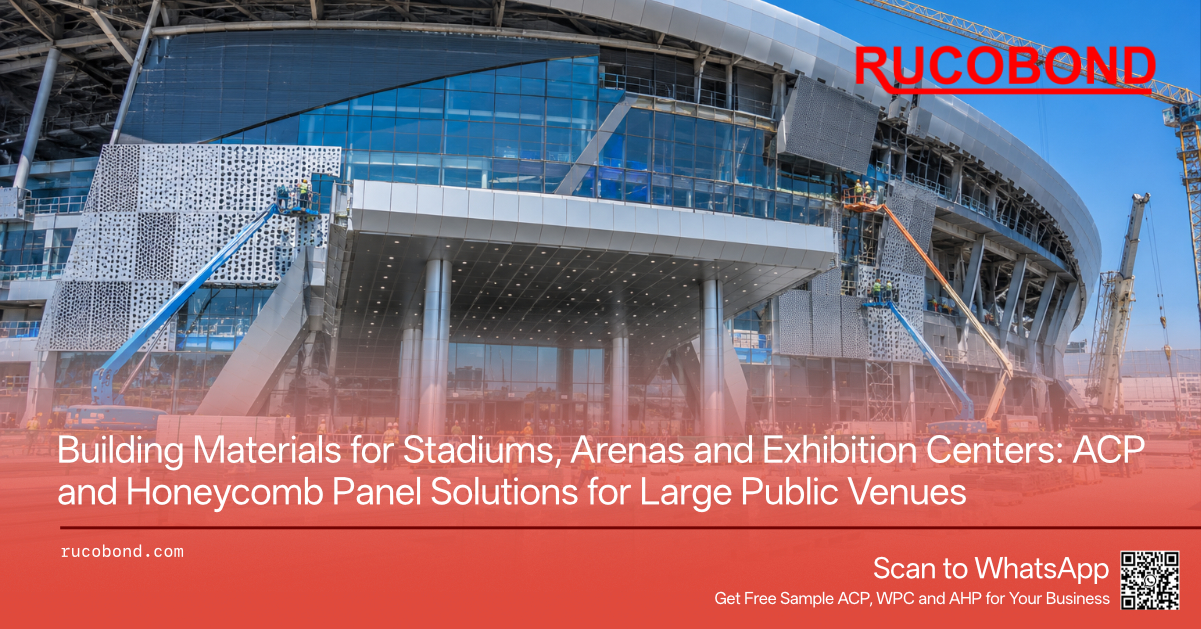
Why Stadium and Exhibition Projects Put More Pressure on Material Supply
A stadium, arena or exhibition center is not just a large building. It is a building designed around movement: thousands of visitors arriving within a short period, wide entrances opening at the same time, large roof edges exposed to weather, signage visible from long distances, and public areas that need to remain presentable after repeated events. For contractors, this creates a procurement problem that is very different from a small office or retail project. Large public venues use huge quantities of material, but they also contain many custom zones where standard dimensions stop being useful.
The exterior may require thousands of square meters of Aluminum Composite Panels, while the main entrance needs customized Aluminum Veneer. Large concourse ceilings may benefit from Aluminum Honeycomb Panels. Local fabricators may use Aluminum Coil for signage, trims and secondary metal components. VIP lounges, hospitality areas and food service zones may require WPC or Sintered Stone. One venue can therefore contain several material systems that all need to arrive according to the same construction schedule.
Founded in Guangzhou, China in 2013, Rucobond manufactures and exports Aluminum Composite Panels, Aluminum Honeycomb Panels, Aluminum Veneer, Aluminum Coils, WPC products and Sintered Stone Slabs for international construction markets. The company works with contractors, façade engineering companies, importers, building material distributors, decoration companies and project developers across Southeast Asia, Europe, the Middle East, North America and other regions.
For large venues, the supplier’s value is not simply product variety. It is the ability to maintain consistency across bulk orders, respond to technical drawings, support customized production and organize shipping by construction stage. A stadium façade may be installed over several months. An exhibition hall may open in phases. A venue extension may require the same finish years later. Keeping specifications, color references and packaging organized becomes part of the project itself.
The best material plan therefore begins with the actual venue workflow. Which areas are broad and repetitive? Which areas need custom shapes? Which parts are highly visible? Which materials must arrive first? Once those questions are answered, the project can use each material where it creates the most value instead of treating the entire venue as one giant decorative surface.
Event Deadlines Make Construction Delays More Expensive
A normal commercial project may have some flexibility in its opening date. A stadium hosting an international tournament, a convention center preparing for a trade fair or an arena scheduled for a major concert often does not. Tickets may already be sold. Exhibitors may already have contracts. Broadcast teams, sponsors, security operators and hospitality vendors may all be working toward the same fixed date. The building cannot politely explain that the façade panels are arriving next month.
This changes procurement behavior. Contractors need realistic manufacturing schedules and materials that can be delivered in phases according to installation priority. A delay around a decorative entrance may seem minor during early construction, but if that same entrance includes ticketing, security screening and sponsor signage, it quickly becomes a critical path issue.
Consider an exhibition center preparing for its first international event. The main hall structure is complete, but the entrance canopy, exterior ACP and interior ceiling panels are still being installed. If custom Aluminum Veneer arrives without proper panel identification, workers may lose days sorting components. If a later ACP batch shows a visibly different metallic tone, replacement work may be required just before opening. If damaged panels are discovered after shipping, cranes and elevated platforms may need to be retained longer than planned.
For this reason, experienced venue contractors evaluate more than unit price. They ask whether the factory can follow approved drawings, maintain color references, manage repeat production and package materials for practical site handling. Rucobond works with buyers to confirm product specifications, quantities, finishes, drawings and delivery priorities before manufacturing.
Phased shipment can also be discussed according to project requirements. Exterior wall materials may be needed first, entrance components later, and hospitality interior products closer to final completion. This reduces site storage pressure and allows contractors to concentrate resources on the areas that matter most at each stage.
Large venue construction is already full of deadlines imposed by people who will never personally install a panel. The supplier’s job is to remove uncertainty from that schedule, not add another reason for the project manager to start making phone calls at midnight.
Aluminum Composite Panels for Large Venue Facades and Public Areas
Stadiums and exhibition centers often contain enormous exterior wall areas. Using heavy decorative materials across every surface would increase cost, structural load and installation complexity. Aluminum Composite Panels provide a practical alternative because they combine relatively low weight, flexible fabrication and a broad selection of finishes.
Rucobond supplies ACP in solid matte colors, glossy solid colors, metallic finishes, mirror surfaces, wood grain patterns, brushed silver, brushed gold and stone-inspired designs. Large public venues often use solid and metallic tones because they create clear visual zones and remain easy to coordinate with glass, concrete, steel and lighting systems.
A football stadium may use silver or grey ACP around general concourse façades, then introduce stronger team or sponsor colors around major entrances. An exhibition center may use white and metallic panels across large hall elevations, while darker ACP identifies service areas. An indoor arena may use glossy or brushed finishes around VIP entrances and premium commercial zones.
ACP can be cut, routed and folded into different modules, making it useful for ticketing areas, wall cassettes, signage backgrounds, columns and public corridors. The same fabrication flexibility also helps contractors handle large repetitive surfaces without depending on one fixed standard dimension.
For venue projects, panel orientation and color consistency deserve particular attention. A metallic finish may reflect daylight differently depending on installation direction. Protective film markings can help fabricators maintain the correct orientation. Approved samples and production references help reduce visible batch differences across long façades.
Rucobond works with buyers to confirm panel thickness, aluminum skin, coating, color, gloss level, size, quantity and application. Exterior use should be identified clearly because climate conditions differ significantly between a tropical stadium in Southeast Asia, a hot Middle Eastern arena and a European exhibition center.
For contractors, ACP delivers broad coverage and manageable installation. For venue developers, it helps create a consistent architectural identity. For distributors, it remains a versatile category that can serve public buildings, commercial developments and industrial projects beyond the venue itself.
Aluminum Veneer for Entrances, Roof Edges and Custom Architectural Forms
Large public venues are rarely simple boxes. Architects use sweeping roof edges, curved entrances, deep canopies, perforated screens and large structural frames to make stadiums and exhibition centers recognizable from a distance. These forms are often the most memorable parts of the building and, conveniently, the least likely to fit a standard flat panel.
Aluminum Veneer is well suited to these applications because it can be fabricated according to technical drawings. Rucobond can support folded panels, curved elements, perforated screens, column covers, roof-edge details, entrance frames and other customized architectural components.
A stadium entrance may require a large canopy extending over security and ticketing lanes. The design could include integrated lighting, drainage and structural joints. An exhibition hall may use perforated aluminum screens across service elevations to hide mechanical equipment while maintaining ventilation. An arena may use folded metal frames around VIP entrances or media access points.
Factory fabrication can reduce complicated forming work on site. When components are produced according to approved drawings, contractors can focus more on assembly and alignment rather than improvising large metal shapes beside an active construction zone.
Accurate drawings remain essential. Buyers should provide panel dimensions, thickness, folds, curves, perforations, coating, color, fixing edges and quantities. For complex venue projects, panel codes can be coordinated with shop drawings and packaging labels.
That identification matters. A stadium may contain hundreds of custom panels that look similar from ground level but belong to different entrances or roof sections. Without clear labels, the installation team eventually develops a system based on opening pallets and hoping. It is not a system anyone should deliberately specify.
Aluminum Veneer works best when used where shape and architectural impact matter. ACP can handle broad flat surfaces economically, while Veneer takes care of the areas that define the venue’s identity.
Aluminum Honeycomb Panels for Wide Ceilings and Premium Public Spaces
Stadiums, arenas and convention centers contain some of the largest public interior spaces in commercial architecture. Main entrances, VIP lounges, press centers, conference halls and concourses may require wide ceilings or large-format wall panels where surface flatness becomes highly visible.
Aluminum Honeycomb Panels can provide a useful solution because their internal honeycomb structure offers strong rigidity while keeping overall weight relatively low. This allows larger panel formats to maintain cleaner surfaces with fewer visible joints.
A premium stadium hospitality entrance, for example, may use Honeycomb Panels across a broad ceiling connecting the exterior canopy with the indoor reception zone. A convention center may use them in a high lobby where visitors arrive from several halls. An arena may specify larger panels in corporate lounges or media areas where finish quality forms part of the premium experience.
Rucobond supports customized Aluminum Honeycomb Panels according to dimensions, thickness, surface finish, color and edge requirements. Technical drawings are recommended because panel size, support method and installation position influence manufacturing.
The material generally costs more than standard ACP, so selective use is usually the smarter strategy. General concourse walls may use economical ACP, while Honeycomb Panels are reserved for large premium spaces where their rigidity and larger format create a visible improvement.
This approach helps venue developers balance budget and architectural quality. Spending more in the areas where sponsors, media, VIP guests and corporate customers actually spend time makes more sense than applying the same premium specification behind a maintenance corridor simply because somebody copied a line in the BOQ.
For distributors and contractors, Honeycomb Panels also create opportunities beyond sports venues. Airports, office towers, transportation hubs and premium commercial interiors often require similar large-format lightweight solutions.
Aluminum Coils for Local Fabrication, Signage and Supporting Metal Work
Stadium and exhibition projects include enormous quantities of secondary metal work. Signs, trims, ceiling components, roof details, fascia elements and service-zone panels may all need local fabrication. Aluminum Coil can support these requirements by giving local workshops a material that can be processed according to final site dimensions.
Rucobond supplies Aluminum Coil according to thickness, width, coating, color, surface finish, quantity and downstream application. Local manufacturers can use the material for roofing components, ceiling systems, signage, gutters, trims and other architectural products.
Signage is particularly important in large venues. Visitors need clear directions to gates, seating blocks, parking areas, concessions, restrooms and emergency exits. Some signage structures and backing panels may be manufactured locally because dimensions change according to final wayfinding plans.
Local fabrication also helps when site details evolve. Stadium construction contains many interfaces between structural steel, mechanical systems, lighting, façade supports and signage. A small trim dimension can change after another contractor modifies an adjacent component. Producing minor pieces locally may be faster than ordering every adjustment internationally.
A mixed supply strategy therefore works well: ACP for large façade areas, custom Aluminum Veneer for major architectural details and Aluminum Coil for flexible local processing.
For distributors, Aluminum Coil expands the customer base beyond the venue contractor. Signage companies, roofing manufacturers, ceiling factories and local metal workshops may all become repeat buyers.
Packaging and unloading should be planned carefully because coils carry concentrated weight. Stable supports, moisture protection and appropriate handling equipment are necessary. A several-ton coil arriving at a venue site without the correct unloading equipment is a very physical reminder that logistics is part of engineering.
WPC and Sintered Stone for Fan Zones, Hospitality Areas and Commercial Spaces
Modern stadiums and arenas increasingly operate like mixed-use commercial destinations. They contain restaurants, fan zones, VIP hospitality areas, retail stores, terraces, lounges and event spaces that remain active outside game days. Exhibition centers also include cafés, conference rooms, registration counters and outdoor gathering zones.
WPC products can be used in suitable outdoor terraces, fan areas, pedestrian zones and decorative wall applications where a wood-like appearance is desired. Compared with many untreated timber products, WPC provides improved resistance to moisture and insects, making it useful for suitable outdoor commercial environments.
A stadium may use WPC around an outdoor hospitality terrace overlooking a public plaza. An exhibition center may use it in café seating areas or landscaped pedestrian zones. These spaces benefit from warmer visual materials because endless metal and concrete can make even the most enthusiastic visitor feel as though they have entered a very large loading dock.
Sintered Stone Slabs can support hospitality counters, food service areas, reception desks, premium walls, bathrooms and commercial interiors. Their stone-inspired appearance provides a more controlled visual finish while supporting high-contact use and repeated cleaning.
A VIP lounge may combine Sintered Stone counters with Honeycomb Panel ceilings and brushed aluminum details. General public food areas may use practical stone-inspired surfaces around counters, while WPC appears in outdoor zones.
For contractors, these materials allow one supply relationship to cover more of the venue beyond the main façade. For distributors, they expand sales opportunities into interior and landscape projects.
The correct approach remains selective. A stadium does not need luxury finishes at every turnstile. Materials should follow the function of the area, expected traffic, maintenance needs and commercial importance.
Quality Control, Color Consistency and Packaging for Large-Volume Projects
Large venues magnify quality differences. A small color variation becomes obvious across a long façade. One damaged custom panel can delay an entrance section. Poor pallet labeling creates unnecessary movement around a site already crowded with steel, seating, lighting and mechanical equipment.
Rucobond works with professional buyers to confirm specifications before production. Depending on product category and project requirements, quality control can include surface inspection, dimensional checking, color comparison, order verification and packaging review.
Products are supported by SGS, CE and ISO-related certifications and quality systems according to project and material requirements. These documents can assist contractors, consultants and procurement teams during project review.
Physical samples are valuable for venue projects because colors and metallic finishes may appear different under daylight compared with office lighting. Large mock-ups can also help owners and architects review the relationship between ACP, glass, Aluminum Veneer and structural elements before mass production.
Packaging should match the installation sequence. ACP pallets can be separated by elevation, façade zone or color. Custom Aluminum Veneer can use panel codes linked to shop drawings. Honeycomb Panels can be grouped according to ceiling or lobby area.
This organization can reduce unnecessary movement around the site and help installation teams find the correct material faster. In a venue project covering several hectares, sending a panel to the wrong entrance is not a tiny mistake. Someone eventually has to move it back.
For phased construction, maintaining approved specifications and color references helps later production stay aligned with earlier batches. Buyers expecting additional venues or future extensions should communicate this early so records can be kept more systematically.
OEM, ODM and Bulk Supply for Contractors, Distributors and Venue Developers
Large venue projects often create repeat business. A contractor may build several arenas or convention centers. A regional distributor may supply multiple public projects. A sports organization may use similar architectural finishes across training centers, retail stores and stadium facilities.
Rucobond supports OEM and ODM cooperation for professional buyers requiring private-label protective films, customized packaging, selected colors, dimensions, product labels and repeat specifications.
For distributors, a public-project product range may include practical silver, white, grey and metallic ACP alongside higher-value brushed surfaces, Aluminum Veneer and Honeycomb Panels. This provides options for different project budgets while keeping the brand and supply relationship consistent.
For contractors, standardization can simplify repeat venue projects. If the same developer or operator uses a common façade finish across several facilities, maintaining a known specification reduces repeated approval work.
Rucobond mainly serves contractors, façade engineering companies, importers, wholesalers, decoration businesses and building material distributors requiring bulk production and long-term supply.
Large project quantities and phased deliveries can be discussed according to product type, manufacturing schedule and construction sequence. Early communication is valuable because an event deadline has very little sympathy for an urgent purchase order sent three weeks before opening.
The real value of OEM and ODM is creating repeatability. A buyer should be able to reorder a known product, understand how it will be packed and know what standard the local customer will receive. Predictable supply may not make a good stadium chant, but it makes a very good business model.
Preparing a Practical Material Inquiry for Stadium and Exhibition Construction
A useful quotation begins with clear project information. Buyers should identify whether the project is a stadium, indoor arena, convention center, exhibition hall, sports complex or multi-purpose public venue. Explain whether the project is new construction, renovation or expansion.
For Aluminum Composite Panels, provide total panel thickness, aluminum skin, coating type, color, gloss level, finish, dimensions, quantity and application. For Aluminum Veneer, provide technical drawings showing folds, curves, perforations, fixing edges, thickness, color and panel quantities.
For Aluminum Honeycomb Panels, provide dimensions, thickness, surface finish, edge requirements and installation area. For Aluminum Coil, include thickness, width, coating, color, total quantity and downstream use. WPC and Sintered Stone inquiries should include dimensions, finish, application and estimated quantity.
Project location matters because exterior materials may face different climates. Buyers should mention coastal exposure, high humidity, extreme heat or other environmental conditions where relevant.
The construction schedule is particularly important for venues. If the building must open before a tournament, exhibition or scheduled event, provide the key dates early. Identify which materials are needed first and whether phased shipment is acceptable.
BOQ files, façade drawings, renderings, panel schedules and physical color references can all improve quotation accuracy. For renovation projects, photographs of existing entrances, roof edges and façade conditions are also useful.
Rucobond welcomes inquiries from stadium contractors, exhibition center developers, façade engineering firms, venue operators, building material importers, regional distributors and decoration companies. OEM, ODM, customized production, samples and bulk international supply can be discussed according to project requirements.
Send the drawings, material list, quantities, destination and expected schedule. A clear inquiry gives the factory something useful to work with. “Need stadium panels, best price urgently” gives everyone mostly adrenaline.
Q: What Rucobond materials can be used for stadium and exhibition center projects?
A: Rucobond supplies Aluminum Composite Panels, Aluminum Honeycomb Panels, Aluminum Veneer, Aluminum Coils, WPC products and Sintered Stone Slabs. These materials can support façades, entrances, canopies, ceilings, hospitality areas, commercial spaces and other architectural zones.
Q: Can Rucobond customize Aluminum Veneer for stadium entrances and roof edges?
A: Yes. Rucobond supports drawing-based Aluminum Veneer production for canopies, curved entrances, roof edges, perforated screens, columns and other custom architectural details. Buyers should provide technical drawings, dimensions, surface finish and quantities.
Q: Are Aluminum Honeycomb Panels suitable for large arena ceilings?
A: Aluminum Honeycomb Panels can be considered for large ceilings and premium public areas where larger panel formats, rigidity and relatively low weight are valuable. The final specification depends on the support system, panel dimensions and engineering requirements.
Q: Can Rucobond support phased deliveries before a fixed venue opening date?
A: Phased production and shipment can be discussed according to order quantity, product category, construction sequence and factory schedule. Buyers should provide the event or opening deadline as early as possible so priority materials can be evaluated realistically.
Q: Does Rucobond support OEM materials for public-project distributors?
A: Yes. OEM and ODM options may include private-label protective films, customized packaging, product labels, selected colors, dimensions and repeat specifications for professional contractors, importers and building material distributors.
Name: Gina Chen
Mobile:+86-189-2412-4951
Tel:+86-189-2412-4951
Whatsapp:8618924124951
Email:gina@rucobond.com
Add:Room 708, No. 8 Jingang Avenue, Nansha Street, Nansha District, Guangzhou


