
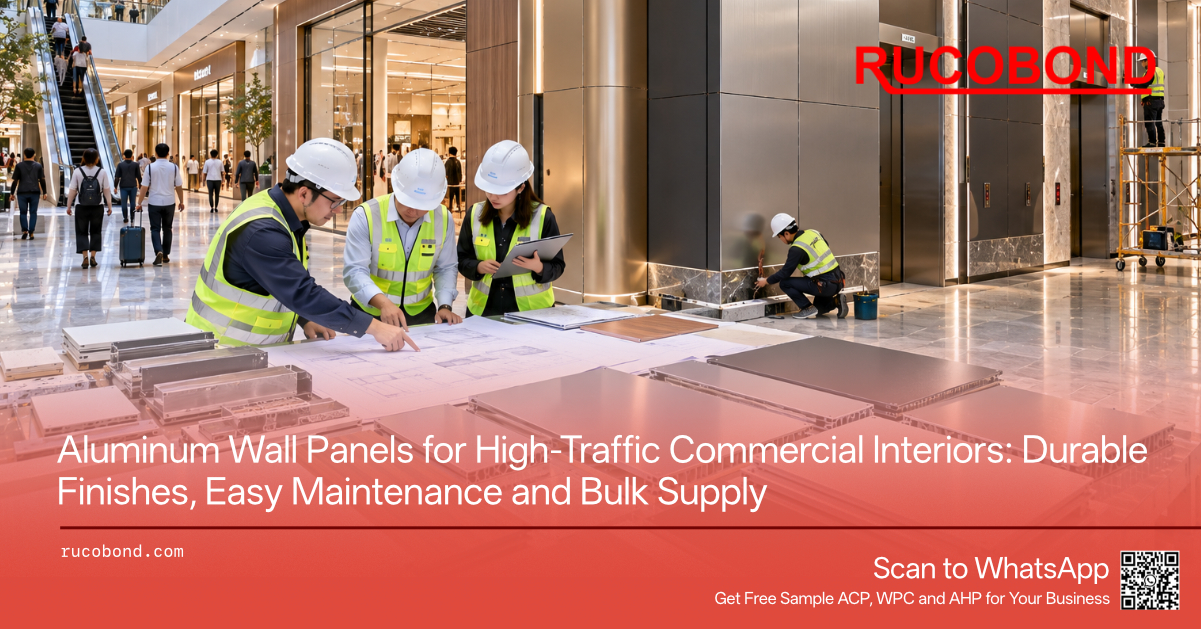
A commercial interior can look impressive on opening day and begin showing signs of wear within months. Shopping mall corridors experience constant pedestrian movement, hotel elevator lobbies accommodate luggage and cleaning equipment, and transportation facilities handle thousands of passengers carrying bags, suitcases and other personal belongings. These environments expose wall finishes to a level of daily contact that is rarely represented in architectural renderings.
For interior fit-out contractors, the difficulty is selecting materials that balance appearance, fabrication cost, maintenance and expected service conditions. A highly reflective panel may create an attractive reception area, but the same finish can become difficult to maintain beside a busy escalator. A decorative wood-inspired surface may work well behind a hotel reception desk, while a more impact-resistant lower-wall treatment may be preferable along a corridor where luggage regularly contacts the walls.
These decisions matter because the initial material price represents only part of the cost. Cleaning requirements, surface damage, access for repairs and replacement availability all affect the long-term operating expense of a commercial property. When a project contains hundreds of similar wall modules, poor material selection can multiply maintenance problems across the building.
Founded in Guangzhou, China in 2013, Rucobond manufactures and exports Aluminum Composite Panels, Aluminum Veneer, Aluminum Honeycomb Panels, Aluminum Coils, WPC products and Sintered Stone Slabs. The company works with interior decoration contractors, commercial developers, architectural metalwork companies, building material distributors and international procurement teams requiring customized finishes and bulk production.
For professional buyers, the objective is not simply finding a product described as durable. It is understanding where the panel will be installed, what kinds of contact it will experience and how the finished surface will be maintained. A wall panel installed behind a decorative display faces different requirements from one beside a heavily used elevator entrance, even when both belong to the same building.
Aluminum Composite Panels offer a practical combination of relatively low weight, smooth surface appearance and fabrication flexibility for suitable commercial interior applications. They can be cut, routed and folded into wall sections, column covers, decorative features and other nonstructural components according to the intended design and applicable requirements.
Shopping centers frequently need extensive interior wall coverage across corridors, retail entrances and shared public areas. Hotels may use aluminum panels around reception zones, elevator lobbies and circulation spaces. Office developments can incorporate ACP into entrance halls and common areas where a consistent finish is required across multiple floors.
Rucobond supplies a range of finishes including solid matte colors, high-gloss surfaces, metallic effects, brushed textures, mirror finishes, wood grain patterns and stone-inspired designs. This variety allows contractors to establish different visual identities while remaining within the same general material category. A corporate office may use matte charcoal and brushed silver, while a hospitality project may prefer warmer wood-inspired panels combined with champagne metallic details.
However, decorative appearance should not be confused with suitability for direct impact or abrasion. ACP performance depends on its full construction, including aluminum skin thickness, core specification, coating and installation method. A standard decorative panel should not automatically be assumed appropriate for locations subject to repeated trolley collisions or heavy mechanical contact.
For large projects, a useful approach is dividing the interior into exposure zones. Higher decorative walls may use standard architectural finishes, while lower sections close to floor level may require additional protection or a different material. Entrance corners, service corridors and delivery routes may also need separate treatment rather than using the same panel everywhere.
Rucobond can discuss ACP thickness, aluminum skin, surface finish, dimensions and quantity according to the intended interior application. Providing the expected use and location allows the material selection to reflect actual operating conditions instead of relying entirely on the visual design.
Scratch resistance is one of the most misunderstood qualities in commercial interior materials. Buyers often describe a required surface as scratch-proof, although no ordinary decorative aluminum finish should be assumed immune to sharp objects, abrasive particles or repeated contact with heavy equipment.
The type of wear matters. Fine abrasion from cleaning materials is different from luggage wheels striking a wall corner. A shopping trolley contacting a lower wall panel creates a different problem from someone brushing against a reception feature with a handbag. These situations require different decisions about coating, panel positioning and protective details.
For commercial corridors, the most effective strategy may involve reducing exposure rather than depending entirely on the coating. Protective lower-wall elements, separate kick plates, durable corner details and carefully designed transitions can prevent frequently used areas from damaging the decorative panels above them.
An airport-adjacent hotel provides a useful example. Guests regularly move large suitcases through the entrance hall and elevator lobby. Decorative aluminum panels may be suitable for the upper wall surfaces, but the areas directly beside luggage routes may benefit from robust edge protection and suitable impact-resistant detailing. This preserves the overall appearance while reducing the number of visible repairs.
Surface selection can also influence how wear is perceived. Certain matte or textured finishes may make fine visual marks less obvious under some lighting conditions, while highly reflective surfaces can reveal scratches more clearly. This does not necessarily mean that one coating is mechanically stronger than another. Actual abrasion performance should be assessed using relevant product information or agreed testing where necessary.
Rucobond supplies multiple ACP and Aluminum Veneer finishes for commercial applications. Buyers with demanding durability requirements should explain the expected exposure and request appropriate technical information before approving the product.
For purchasing teams, defining the anticipated damage mechanism is more useful than simply asking for a heavy-duty wall panel. A supplier can evaluate a specific abrasion or impact requirement. A vague promise that a product will withstand everything is not a meaningful engineering specification.
Lighting has a major influence on the appearance and usability of commercial interiors. Shopping malls, office lobbies and hotel corridors often contain extensive artificial lighting, polished floors, glass partitions and reflective decorative materials. Adding highly reflective wall panels can create additional glare or distracting reflections, particularly in spaces with strong directional lighting.
Low-gloss and matte aluminum finishes can provide a more controlled appearance where visual comfort is important. Rather than producing sharp reflections of surrounding lights, these surfaces generally distribute reflected light more diffusely. They can be particularly useful along long corridors, around circulation areas and in entrance spaces where designers want a clean appearance without excessive visual activity.
Consider a modern office elevator lobby with polished flooring and bright linear ceiling lights. Mirror ACP may produce a striking decorative feature on a limited wall section, but covering every wall with the same reflective material could create an overly busy environment. A matte charcoal finish combined with selected brushed metal details may provide a more balanced result.
Brushed aluminum finishes offer another option. Their directional texture creates a metallic appearance without necessarily producing the same reflection characteristics as a mirror surface. However, the result depends on the specific finish and viewing conditions. Brushed patterns also require consistent orientation during cutting and installation.
Rucobond supplies matte solid, metallic, brushed and mirror-style ACP for appropriate commercial interior applications. Buyers can compare physical samples under the intended lighting conditions before approving a large order.
For project procurement teams, gloss level should be considered part of the material specification rather than an informal aesthetic preference. Two panels with similar colors but different gloss levels may appear substantially different after installation. Recording approved samples and finish references can reduce inconsistencies across construction phases.
Where low glare is an explicit design requirement, the architect or consultant should define an appropriate evaluation method. Descriptions such as non-reflective or comfortable-looking are useful design intentions, but they do not establish measurable acceptance criteria on their own.
A commercial wall finish may be cleaned hundreds of times during its service life. For property managers, cleaning practicality can therefore matter as much as the original appearance. Materials that look attractive in a sample room may become expensive to maintain if they require specialized cleaning methods or show visible marks after routine use.
Aluminum panel surfaces can be practical for certain interior applications because many coated finishes can be cleaned using manufacturer-approved methods. However, cleaning performance varies according to coating chemistry, surface texture and the substances encountered. It should not be assumed that every ACP finish tolerates the same detergents, solvents or abrasive equipment.
A smooth matte ACP wall in an office corridor may have relatively straightforward cleaning requirements. A brushed surface could require additional attention to wiping direction, while a highly reflective finish may make fingerprints and streaks more visible. Wood grain and stone-inspired finishes may have their own care requirements depending on the decorative coating system.
This becomes especially relevant in shopping malls and hotels, where cleaning teams may use the same general equipment across different surfaces. Strong alkaline cleaners, abrasive pads or unsuitable chemicals can damage certain coatings. Professional buyers should request relevant maintenance guidance and ensure the building operator understands any limitations before selecting a finish.
Rucobond can discuss finish options and available product maintenance information according to the intended application. For projects where frequent cleaning is expected, buyers should identify the cleaning environment during the procurement stage instead of treating maintenance as a problem to be solved after handover.
The wall design itself also influences cleaning efficiency. Narrow recesses, exposed horizontal ledges and complicated decorative joints can accumulate dust. Simpler panel arrangements may reduce maintenance effort, especially across extensive public corridors.
For a large commercial building, a small reduction in cleaning complexity can have long-term value. Procurement teams should therefore evaluate finish, panel layout and cleaning method together rather than selecting the material solely by its sample-book appearance.
High-traffic commercial interiors are not uniformly dry. Food courts, washrooms, service entrances and certain back-of-house areas experience more frequent moisture, splashes, cleaning activity and temperature variation than ordinary office corridors.
This changes the material selection process. A decorative aluminum panel suitable for a dry reception area should not automatically be specified for a wet wall or a location exposed to regular water penetration. The complete wall assembly, including substrate, joints, edges and fixing method, must be considered.
In a shopping mall food court, for example, aluminum panels may be used for decorative columns, overhead details or suitable wall areas away from persistent direct water exposure. Nearby cleaning stations and service routes may require additional consideration of moisture, chemical contact and mechanical wear.
Washroom entrance areas present similar challenges. Decorative ACP or Aluminum Veneer can provide a coordinated finish around suitable dry-zone walls, but the material should not be treated as a waterproofing system. The underlying construction must include whatever moisture protection is required by the design.
Edges and joints deserve particular attention. Cut edges, penetrations and poorly detailed connections can allow moisture to reach areas where it was not intended. The project engineer or installation contractor should establish appropriate detailing according to the panel construction and exposure conditions.
Rucobond supports project-based material specification discussions, including coating, core, panel dimensions and intended applications. Buyers should identify whether the installation is in a normal dry interior, intermittently damp location or more demanding environment.
For interior fit-out contractors, separating moisture-exposed areas from ordinary decorative zones helps avoid overusing one product specification across an entire development. The correct solution may involve multiple materials rather than expecting a single aluminum panel to perform every function.
Commercial interiors often contain architectural elements that are difficult to cover using ordinary flat sheets. Rounded columns, irregular corners, folded entrance frames, decorative fins and recessed wall features may require precise fabrication to achieve the desired appearance.
Aluminum Veneer can be valuable in these applications because solid aluminum sheets can be manufactured into customized shapes according to approved drawings. Folds, curves, perforations and edge details allow contractors to produce architectural components that integrate with surrounding walls and ceilings.
A shopping center may use customized Aluminum Veneer around large entrance columns and escalator openings. A corporate headquarters may specify curved metal panels around a reception area. A hotel may incorporate brushed metallic Veneer into elevator surrounds and lobby features.
These locations are often visually prominent, so fabrication accuracy matters. Uneven joints, incorrect return depths or poorly aligned curves can become noticeable under interior lighting. Buyers should provide detailed shop drawings showing finished dimensions, folds, curves, fixing details and expected quantities.
For high-traffic areas, edge design also deserves attention. Exposed sharp corners should be avoided where occupants may come into contact with the finished installation. Rounded or appropriately protected details can improve the practicality of certain architectural features, subject to the approved design.
Rucobond supports drawing-based Aluminum Veneer manufacturing for customized architectural components. The company can discuss panel thickness, coating, color, perforations and dimensions according to the project requirements.
Aluminum Veneer may involve higher fabrication and material costs than standard ACP, so selective use is often sensible. A commercial building can use economical ACP across repetitive wall surfaces while reserving customized Aluminum Veneer for columns, entrance frames and details where its fabrication flexibility provides clear value.
This approach maintains the intended architectural character without applying complex manufacturing methods to areas that do not require them.
Large public interiors sometimes require broad wall and ceiling panels with fewer visible joints. Corporate lobbies, transportation connections, convention centers and premium commercial entrances may all use oversized architectural modules to create cleaner visual surfaces.
Aluminum Honeycomb Panels can be considered in these applications because their internal cellular structure provides relatively high rigidity at low weight compared with many solid panel constructions. This makes them useful where larger formats and surface stability are important, subject to the specific product design.
An office headquarters lobby, for example, may feature a tall decorative wall with broad metallic panels. Using too many narrow sections could interrupt the intended appearance, while a properly designed large-format panel system can create fewer visible joints. Aluminum Honeycomb Panels may offer one manufacturing option for this type of application.
The same principle applies to entrance ceilings, pedestrian connections and selected interior feature walls. However, Honeycomb Panels are not automatically the most economical choice for every commercial surface. Their structure, edge construction and fabrication requirements can make them more expensive than standard ACP.
For this reason, the procurement team should identify where higher rigidity or larger dimensions provide real value. Ordinary secondary corridors may not require the same panel structure as a premium entrance hall.
Rucobond supplies customized Aluminum Honeycomb Panels according to panel dimensions, total thickness, surface finish and edge details. Buyers should provide drawings showing the installation area and applicable support requirements.
Fire performance, attachment details and the suitability of the complete wall or ceiling assembly must still follow the applicable project requirements. Honeycomb construction alone does not establish a particular fire classification or guarantee compliance with every interior building standard.
For large commercial developments, combining ACP, Aluminum Veneer and Honeycomb Panels can provide a more efficient balance between cost, appearance and fabrication requirements than selecting one material for the entire interior.
Even carefully selected commercial interior materials can eventually require replacement. Retail tenants change, signage is removed, luggage damages decorative panels, and property owners renovate public areas to maintain a consistent image.
For contractors and facility managers, replacement becomes easier when the original material was selected with long-term availability and documentation in mind. Common finishes, repeatable panel dimensions and organized product records can reduce uncertainty during later procurement.
A shopping mall may use the same matte grey ACP across several floors. If one panel is damaged, retaining its original specification gives the maintenance team a useful reference for replacement. If every zone uses a different customized finish, the building may require more complicated sourcing whenever repair work becomes necessary.
Rucobond can work from approved samples, confirmed specifications and previous order information when discussing repeat manufacturing. However, buyers should understand that newly manufactured material may not visually match an installed surface perfectly after years of environmental exposure, cleaning and normal aging.
Panel placement can also affect future replacement cost. A small decorative panel accessible from floor level is easier to replace than a large component requiring specialized lifting equipment or disruption to an operating commercial entrance. Contractors should consider access and installation details during the original design process.
For high-traffic projects, modularity offers another advantage. Repeated panel dimensions and clear identification records can allow individual sections to be removed and replaced without unnecessarily disturbing larger areas, provided the approved fixing system supports that approach.
For regional building material distributors, maintaining an organized range of common commercial interior finishes can create repeat business beyond initial construction orders. Decoration contractors may require the same products for additional stores, refurbishment projects or later phases of a development.
The lowest initial material price is therefore not always the lowest lifecycle cost. A slightly more suitable finish, a standardized panel module or a better replacement strategy may produce greater value across years of operation.
Commercial interior projects require materials that satisfy visual expectations while remaining practical for fabrication, cleaning and long-term maintenance. For contractors and distributors, the strongest purchasing approach begins with identifying different application zones and selecting appropriate panel specifications for each.
Established in 2013 and headquartered in Guangzhou, Guangdong, China, Rucobond supplies Aluminum Composite Panels, Aluminum Veneer, Aluminum Honeycomb Panels, Aluminum Coils, WPC products and Sintered Stone Slabs for international commercial construction and decoration markets.
This product range supports coordinated material selection across different interior applications. ACP can be evaluated for repetitive wall sections and decorative commercial surfaces. Aluminum Veneer can be used for customized columns, entrance surrounds and folded architectural details. Aluminum Honeycomb Panels can be considered for selected large-format walls and ceilings where their rigidity offers an advantage.
Rucobond supplies a variety of finishes, including matte solid colors, glossy surfaces, metallic effects, brushed textures, mirror styles, wood grain patterns and stone-inspired designs. For interior projects requiring controlled reflection, easier visual maintenance or repeated branding, buyers can discuss suitable finishes and approved samples before bulk production.
OEM and ODM cooperation can include customized protective film, private-label packaging, selected colors, product identification and repeat specifications according to order requirements. Relevant SGS, CE and ISO-related documentation can be reviewed according to the applicable product, certification scope and project needs. Buyers should also confirm local fire-safety and interior material requirements before final approval.
Why choose Rucobond? The company provides multiple architectural material categories, customized manufacturing options and international export support for contractors and distributors managing commercial interior projects.
For an accurate quotation, professional buyers should provide the intended application, panel dimensions, total thickness, aluminum skin or face-sheet requirements, core specification, coating, finish, estimated quantity and destination. If the project includes curved columns, large ceilings or other customized elements, fabrication drawings should also be included.
Maintenance expectations are equally useful. If the panels will be installed in busy public corridors, hotel elevator lobbies or locations exposed to frequent cleaning, buyers should identify these conditions during the initial enquiry. Clear information helps the supplier and project team evaluate a more appropriate specification.
Rucobond welcomes bulk enquiries from interior decoration contractors, hotel and shopping mall developers, architectural metalwork companies, building material importers, distributors and commercial project procurement teams. Send the drawings, BOQ, finish references, quantities and destination to discuss product selection, customization and export supply.
A successful commercial interior should remain attractive after the opening ceremony, through daily operation and during future renovation. Selecting aluminum panels according to real usage conditions is one practical way to make that possible.
Q: Are Aluminum Composite Panels suitable for high-traffic commercial interiors?
A: ACP can be suitable for shopping mall corridors, hotel lobbies, retail areas and office interiors when the product specification and installation system match the application. Areas exposed to frequent impacts may require additional protection or alternative materials.
Q: Which aluminum panel finishes are better for low-glare commercial interiors?
A: Matte and other low-gloss finishes can help reduce strong reflections compared with highly reflective surfaces. The final result depends on the coating, surrounding lighting and viewing conditions. Physical sample evaluation is recommended for projects with specific visual requirements.
Q: Are aluminum wall panels scratch-proof and resistant to all cleaning chemicals?
A: No. Scratch and chemical resistance depend on the particular coating and product specification. Buyers should confirm expected contact, cleaning methods and any required performance criteria rather than assuming every decorative finish provides the same durability.
Q: When should Aluminum Veneer or Honeycomb Panels be selected instead of ACP?
A: Aluminum Veneer can be useful for curved columns, folded entrance details and customized architectural elements. Aluminum Honeycomb Panels may be preferable for certain larger-format walls and ceilings where rigidity and relatively low weight are important. Material selection should follow the project design and technical requirements.
Q: Can Rucobond supply customized aluminum interior panels for bulk commercial projects?
A: Yes. Rucobond supports bulk and customized production discussions for ACP, Aluminum Veneer and Aluminum Honeycomb Panels. Buyers should provide drawings, dimensions, product specifications, finish references, quantities and destination so suitable manufacturing options can be evaluated.
Name: Gina Chen
Mobile:+86-189-2412-4951
Tel:+86-189-2412-4951
Whatsapp:8618924124951
Email:gina@rucobond.com
Add:Room 708, No. 8 Jingang Avenue, Nansha Street, Nansha District, Guangzhou


