
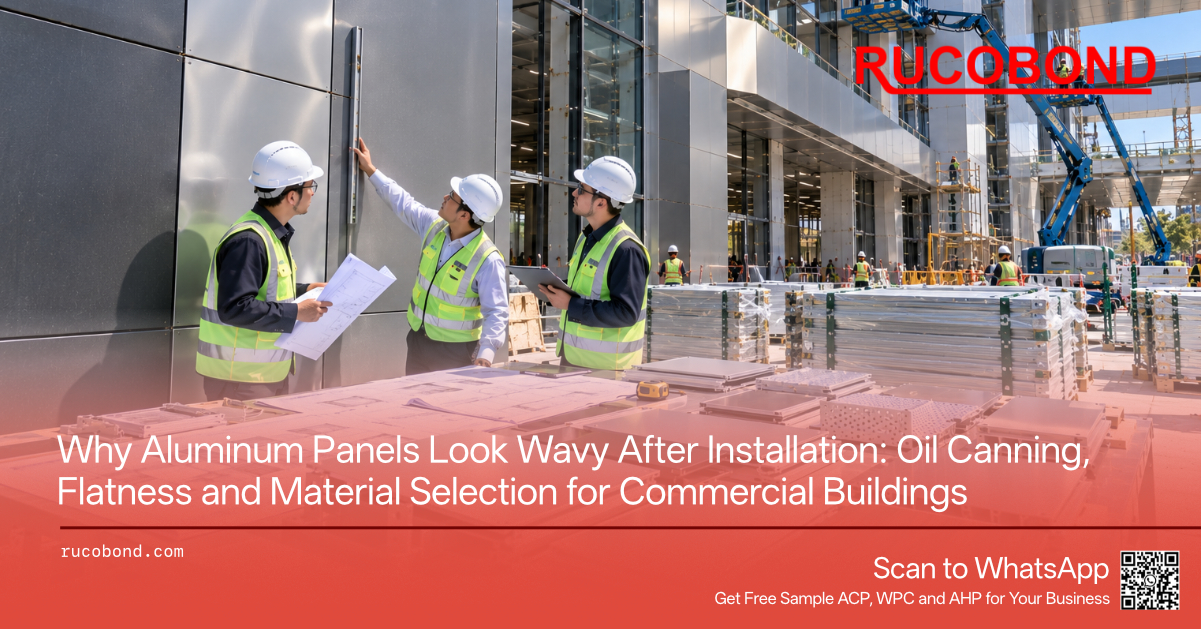
A commercial building may use thousands of square meters of aluminum panels across its exterior walls, entrance structures and decorative architectural features. Before installation, the sheets appear smooth and consistent inside the fabrication workshop. Once the panels are mounted on the building, however, certain areas may begin to show visible waves, uneven reflections or slight surface distortion. The problem often becomes more noticeable when sunlight reaches the wall from a particular direction.
For developers and construction contractors, this can lead to disagreement about material quality. The building owner may believe the aluminum panels are defective, while the supplier argues that the products met the agreed manufacturing specifications. Meanwhile, the installation contractor may point to the support structure or architectural design. Without a clear understanding of the causes, identifying responsibility can become difficult.
Visible waviness can develop through several different mechanisms. Residual stress from metal processing, panel dimensions, fabrication methods, uneven supporting structures, installation restraint and temperature movement can all influence the final appearance. Surface finishes also affect how strongly these variations are perceived. A dark reflective panel may reveal subtle distortion that would be much less noticeable on a matte surface.
This is why panel flatness should be considered before material procurement rather than discussed only after installation. The project team needs to coordinate material structure, panel dimensions, surface finish, support design and visual expectations.
Founded in Guangzhou, China in 2013, Rucobond manufactures and exports Aluminum Composite Panels, Aluminum Veneer, Aluminum Honeycomb Panels, Aluminum Coils and other architectural materials for international construction projects. The company works with contractors, building material distributors, importers and engineering procurement teams requiring bulk production and customized specifications.
For professional buyers, understanding panel flatness helps reduce unnecessary replacement costs, improve material selection and prevent disputes between manufacturing and installation teams. The objective is not to promise perfectly flat surfaces under every possible lighting condition, but to select appropriate materials and manage the factors that influence the finished appearance.
Oil canning is a term used in architectural metal construction to describe visible waviness across relatively flat metal surfaces. The effect may appear as shallow ripples, broad waves or irregular reflections, particularly when the surface is viewed at an angle under directional lighting.
The Metal Construction Association identifies oil canning as a condition associated with elastic buckling or stress wrinkling in metal panels. Its technical guidance also emphasizes that several factors can contribute to the phenomenon and that complete prevention cannot be guaranteed for every project. metalconstruction.org
For aluminum construction projects, an important distinction is that visible waviness does not automatically establish a manufacturing defect or structural failure. Some metal systems can exhibit minor visual variations while continuing to meet their specified performance requirements. However, pronounced distortion, local damage, unexpected movement or changes that may affect panel attachment should still be investigated by the responsible professionals.
Consider a corporate office building using large silver metallic panels. During the morning, the wall may appear relatively uniform. In the afternoon, sunlight reflects across the surface at a different angle, revealing waves that were previously difficult to see. The panels have not necessarily changed significantly during the day. Instead, the lighting has made existing surface variations more apparent.
This creates an important procurement issue. A material that looks acceptable when inspected horizontally inside a warehouse may produce a different visual impression after installation on a large vertical surface.
Contractors should therefore establish realistic appearance requirements before bulk production. Where flatness is particularly important, approved samples, full-size mock-ups and agreed inspection conditions can help define the expected result.
Understanding oil canning also helps avoid unnecessary corrective work. Replacing panels without identifying the original cause may reproduce the same appearance if the underlying support structure, module dimensions or fixing details remain unchanged.
The flatness of many aluminum panel products begins with the raw metal used in manufacturing. Aluminum Coils pass through rolling, coating and other processing operations before becoming finished architectural materials. Conditions introduced during these stages can influence how the metal behaves during later fabrication.
Residual stresses may remain within flat-rolled metal. When the material is slit, cut, folded or otherwise processed, the distribution of those stresses can change. Under certain conditions, this can contribute to visible waviness in the finished component.
Coil flatness, material thickness, alloy characteristics and processing controls are therefore relevant to architectural applications where surface appearance matters. For thin single-skin aluminum panels, the condition of the original material can be particularly important because the finished component has less inherent rigidity than some composite structures.
However, raw-material quality is only one part of the issue. A properly manufactured sheet can still become distorted during handling, fabrication or installation. Conversely, selecting a thicker sheet does not automatically resolve all flatness concerns if the finished panel is forced into an uneven supporting structure.
For professional contractors, this means that supplier evaluation should consider the complete manufacturing specification rather than relying on general claims about aluminum quality. The required panel thickness, intended fabrication process, finished dimensions and surface appearance should be identified clearly.
Rucobond supplies Aluminum Coils for professional fabrication and manufacturing applications, together with finished ACP, Aluminum Veneer and Aluminum Honeycomb Panels. Buyers can discuss material thickness, width, coating and intended downstream processing according to their requirements.
For distributors supplying metal-processing workshops, consistent specifications are particularly important. A workshop producing repeated architectural components needs predictable materials, while a contractor purchasing finished panels needs assurance that the requested product structure has been clearly defined.
The quality of the original aluminum matters, but the finished appearance is ultimately determined by the entire manufacturing and installation process.
Not all aluminum architectural panels achieve rigidity in the same way. Aluminum Composite Panels, solid Aluminum Veneer and Aluminum Honeycomb Panels have different internal structures, fabrication characteristics and typical applications. Understanding these differences can help contractors select a more suitable material when flatness is a major concern.
Aluminum Composite Panel (ACP) typically consists of two aluminum skins bonded to a core. This composite structure provides useful rigidity relative to its weight and makes ACP a practical choice for many commercial wall applications. Because the skins are supported by the core, ACP can offer a comparatively uniform surface when properly manufactured, fabricated and installed.
Nevertheless, ACP is not immune to visible distortion. Large panel modules, unsuitable specifications, fabrication stress, uneven framing or restrictive fixing methods can influence the installed appearance. Buyers should therefore assess panel thickness, aluminum skin thickness, core requirements and the intended installation system together.
Aluminum Veneer is manufactured from solid aluminum sheet and offers considerable flexibility for customized folds, curves, perforations and architectural details. It is often selected for building entrances, columns, canopies, roof edges and decorative screens. However, broad uninterrupted flat areas may require careful consideration of panel thickness, return edges, reinforcement and support design to achieve the expected appearance.
Aluminum Honeycomb Panel uses a cellular core between face sheets, creating a structure with relatively low weight and high rigidity. This can make it attractive for large-format surfaces where flatness is particularly important, such as commercial entrance ceilings, corporate lobbies and selected architectural wall areas.
For example, a premium office building might use ACP across conventional exterior wall modules, customized Aluminum Veneer around its entrance structure and Aluminum Honeycomb Panels beneath a large canopy. The materials are not competing for the same function. Each addresses different dimensional, fabrication and visual requirements.
Rucobond manufactures and exports all three product categories, allowing professional buyers to discuss material selection according to project drawings, dimensions, quantities and appearance requirements.
The strongest approach is not assuming that the most expensive panel must be the best solution. It is matching the material structure to the actual architectural application.
Panel dimensions are a major consideration when evaluating visible waviness. Large architectural modules can create a cleaner appearance because fewer joints interrupt the surface. However, larger flat areas can also make surface variations more noticeable and may require additional attention to rigidity and support.
For example, an architect may prefer a wide uninterrupted metallic panel around a commercial entrance. The design looks attractive in a rendering, but the finished component must still maintain an acceptable appearance under real environmental conditions. If the panel is particularly wide relative to its thickness and support arrangement, the risk of visible distortion may increase.
This does not mean large panels should always be avoided. Larger dimensions can work successfully when the material structure, thickness, reinforcement and installation system are suitable. The key is evaluating these variables together before manufacturing.
Aluminum thickness can influence resistance to bending and surface deformation, but total thickness should not be considered in isolation. For ACP, both the overall panel thickness and aluminum skin thickness matter. For Aluminum Veneer, the solid sheet thickness, panel geometry and reinforcement details are relevant. For Honeycomb Panels, the total thickness, core structure, face sheets and edge construction must be considered.
A contractor may therefore discover that dividing one oversized panel into two smaller modules creates a more manageable solution. Alternatively, the design may benefit from a different aluminum material category that supports the required dimensions more effectively.
Rucobond can discuss customized dimensions and material specifications according to manufacturing capability and project requirements. Buyers should provide the intended finished panel dimensions, fabrication drawings, surface finish and estimated quantity rather than requesting the largest possible sheet without further context.
Panel size also affects packaging, transportation and installation. Larger components may require additional handling equipment, more protective packaging and different installation procedures. A specification that improves appearance should remain practical throughout the supply chain.
For construction procurement, the ideal panel dimension is therefore not necessarily the largest available. It is the dimension that balances architectural appearance, material performance, fabrication efficiency and installation requirements.
An aluminum panel can leave the factory in acceptable condition and still appear distorted after installation. This is possible because the finished surface depends not only on the panel itself but also on the alignment and behavior of the supporting structure.
Commercial aluminum cladding systems typically rely on brackets, rails, framing members or other engineered fixing arrangements. If these components are not aligned correctly, installers may unintentionally force a panel into an uneven plane. The resulting stress can influence the visible surface, especially across larger or more reflective panels.
For example, a contractor may install ACP cassettes onto a supporting framework with inconsistent alignment. Instead of correcting the framework, the installation team attempts to pull each cassette into position through its fasteners. The panels may fit the intended grid, but localized stress or distortion can become visible across the finished wall.
This illustrates why material quality and installation quality must be assessed separately. Replacing the panel alone may not solve a problem caused by the supporting structure.
Fixing methods require similar attention. Connections should follow the approved system design and permit the intended movement without creating unnecessary restraint. Excessive tightening, inappropriate fixing positions or forcing panels into misaligned openings can influence the surface appearance.
For Aluminum Veneer, the geometry of folded edges and any reinforcement also affects how the component behaves after attachment. Larger fabricated pieces should be reviewed in relation to the support spacing and relevant structural requirements.
Rucobond supports drawing-based manufacturing for customized Aluminum Veneer and can discuss ACP and Honeycomb Panel specifications according to supplied project information. The final framing, fixing and structural design must be established and verified by the responsible project professionals.
Before installation begins, contractors should confirm that the supporting framework meets the approved tolerances. A representative installed section can help identify potential issues before the same installation method is repeated across thousands of square meters.
Correctly manufactured panels cannot compensate indefinitely for poorly aligned construction beneath them.
Aluminum expands when heated and contracts when cooled. This behavior is particularly relevant to exterior architectural panels because their surface temperatures can change substantially throughout the day.
A dark metal panel exposed to direct sunlight may experience different temperature conditions from a nearby shaded panel. As the material expands, the installation system must accommodate the resulting movement according to its approved design.
If thermal movement is excessively restricted, stresses may develop within the panel or its connections. Depending on the panel system, this can contribute to deformation, visible surface changes or problems at joints and fixing points.
Consider a large metallic panel installed on a commercial building in a hot climate. During the morning, part of the wall remains shaded. Later, the entire surface receives direct sunlight. If the installation system does not accommodate the expected movement, the panel may experience additional restraint as its temperature changes.
This is one reason why panel joints, clearances and fixing details matter. A design intended for exterior exposure should account for thermal expansion and contraction rather than treating aluminum as a dimensionally fixed material.
Rucobond supplies architectural aluminum products for international projects, including markets with tropical, coastal and hot-weather environments. Buyers should communicate the destination, application and expected exposure conditions when discussing product specifications.
However, selecting an appropriate coating or panel thickness does not replace proper thermal-movement detailing. Material procurement and installation engineering must work together.
For contractors evaluating a project where waviness appears or changes under sunlight, temperature-related movement may be one factor worth investigating. Any diagnosis should consider the complete installation system instead of automatically attributing the appearance to the factory.
Surface finish influences how easily people notice imperfections in aluminum panels. Two panels with similar physical flatness can produce noticeably different visual effects when one uses a matte finish and the other has a highly reflective surface.
Matte solid colors generally create more diffuse reflections, which can make minor surface variations less visually prominent under certain lighting conditions. This is one reason matte white, grey and charcoal finishes are often practical for broad commercial wall areas where a controlled appearance is desired.
Metallic finishes respond more strongly to changing light and viewing direction. A silver metallic wall may appear smooth when observed directly but reveal irregular reflections when sunlight reaches it at a shallow angle. This does not necessarily mean the material has changed. The reflective finish simply makes existing variations easier to detect.
Mirror-style panels are even more sensitive to visual distortion because the surrounding environment is reflected in the surface. Minor unevenness can change the reflected image, making the effect immediately noticeable. For this reason, mirror ACP is often more suitable for selected decorative applications where panel dimensions, installation conditions and appearance can be controlled.
Brushed finishes introduce directional texture. In addition to physical flatness, installers must consider the orientation of the brushing pattern. Reversing a panel can create a noticeable change in appearance even if the sheet itself is dimensionally acceptable.
Rucobond supplies matte solid, high-gloss, metallic, brushed, mirror, wood grain and stone-inspired ACP finishes. For appearance-sensitive projects, buyers should review samples under lighting conditions similar to the intended installation environment.
A corporate entrance using large dark metallic panels may need more careful mock-up evaluation than a service-area wall using a light matte finish. The two applications may share similar basic material specifications but produce different visual expectations.
Choosing a less reflective finish can reduce the visibility of certain surface variations, but it should not be used to conceal significant manufacturing or installation problems. Surface finish is one part of the design strategy, not a substitute for suitable materials and workmanship.
Flatness disputes are easier to manage when the project establishes clear expectations before bulk production and installation. Without agreed visual requirements, the developer, contractor and supplier may evaluate the same completed wall using completely different standards.
A practical approval process begins with the material specification. Buyers should confirm panel type, thickness, aluminum skin or face-sheet requirements, coating, finish, dimensions and intended application. Customized Aluminum Veneer should also have approved fabrication drawings showing folds, reinforcement and relevant fixing details.
Physical samples help confirm color and surface appearance, but small samples cannot fully represent how a large installed panel will behave. For demanding projects, a full-size mock-up can provide a more realistic basis for evaluating the relationship between panel dimensions, surface finish, joints and supporting structures.
The mock-up should reflect the intended installation method as closely as practical. A sample panel temporarily leaning against a wall does not demonstrate the same conditions as a cassette installed on its actual support system.
Visual acceptance also needs a defined process. The Metal Construction Association's guidance on visual acceptance for metal composite material panels emphasizes that architectural appearance is evaluated through criteria beyond basic building-code performance requirements. metalconstruction.org
For professional projects, the parties should agree on applicable tolerances, representative viewing conditions and inspection procedures through the project specification. Extremely close inspection under unusual reflections may produce a different impression from observing the building at its normal viewing distance. Neither approach should be substituted arbitrarily for the agreed acceptance requirements.
Inspection should also distinguish between different problems. A local dent caused by impact is not the same as a broad elastic wave. Panel bowing, installation misalignment, coating inconsistency and reflected-image distortion may require different investigations.
Rucobond can work with approved samples, confirmed specifications and technical drawings for customized manufacturing. Buyers should communicate important appearance requirements before placing bulk orders, particularly for larger panel formats or highly reflective finishes.
When a problem is discovered, documenting the affected panel locations, dimensions, installation conditions and visible symptoms can help determine the next step. In some cases, adjustments to the support system may be appropriate. In others, fabrication or material replacement may need to be considered.
The most effective quality-control process prevents uncertainty from growing into a dispute after the building is complete.
Professional contractors need more than attractive aluminum panel samples. They need materials that suit the intended application, manufacturing specifications that match approved drawings and a purchasing process that supports predictable fabrication and installation.
Established in 2013 and headquartered in Guangzhou, Guangdong, China, Rucobond manufactures and exports Aluminum Composite Panels, Aluminum Veneer, Aluminum Honeycomb Panels, Aluminum Coils, WPC products and Sintered Stone Slabs. Its aluminum product range allows contractors and building material distributors to evaluate different solutions according to appearance, dimensions, fabrication requirements and project budgets.
For projects where flatness is particularly important, the ability to compare multiple aluminum panel structures can be valuable. ACP may provide a practical balance of weight, rigidity and cost across repetitive wall areas. Aluminum Veneer can support customized architectural geometry when panel design and reinforcement are properly addressed. Honeycomb Panels can be considered for selected large-format applications where increased rigidity is beneficial.
Rucobond also supports customized colors, dimensions, finishes and OEM or ODM arrangements according to product and quantity requirements. Relevant SGS, CE and ISO-related documentation can be reviewed according to the applicable product, certification scope and project requirements.
Why choose Rucobond? The company offers multiple architectural aluminum product categories within one manufacturing and export relationship, helping professional buyers discuss material selection rather than relying on a single panel type for every application.
For an accurate project enquiry, contractors should provide the intended application, panel dimensions, thickness, coating, color, finish, estimated quantity and destination. Where panel flatness is a major concern, fabrication drawings, supporting-system details and visual requirements should also be included.
For Aluminum Veneer enquiries, shop drawings should identify folded edges, reinforcement requirements and panel codes. For Honeycomb Panels, buyers should provide dimensions, total thickness, face-sheet requirements, edge details and installation area. For ACP, both total panel thickness and aluminum skin specifications should be clearly stated.
Rucobond welcomes bulk enquiries from construction contractors, architectural metalwork companies, building material distributors, importers, developers and engineering procurement teams. Customized manufacturing, approved samples, OEM, ODM and repeat production can be discussed according to project requirements.
The strongest approach to visible panel waviness begins before the first sheet is manufactured. Material structure, panel dimensions, supporting details, surface finish and acceptance expectations should be considered together. When these decisions are coordinated, the project is better positioned to achieve the intended architectural appearance while reducing avoidable rework and procurement disputes.
Q: What causes oil canning in aluminum panels?
A: Oil canning is visible waviness that can develop in relatively flat metal surfaces. Contributing factors include residual material stress, panel geometry, fabrication processes, uneven supporting structures, restrictive fixing methods and thermal movement. The appearance can also become more noticeable under directional lighting.
Q: Does visible waviness mean an Aluminum Composite Panel is defective?
A: Not necessarily. Minor visible waviness can occur in architectural metal systems without automatically indicating structural failure or manufacturing defects. However, significant distortion or unexpected movement should be evaluated against the approved product specification, installation design and agreed acceptance criteria.
Q: Are Aluminum Honeycomb Panels flatter than standard ACP?
A: Aluminum Honeycomb Panels offer high rigidity relative to weight and can be advantageous for certain large-format applications where surface flatness is important. However, the result also depends on panel dimensions, face-sheet specifications, manufacturing quality, edge construction and installation methods. Neither material guarantees perfect flatness in every application.
Q: Can matte ACP finishes reduce the visibility of oil canning?
A: Matte finishes often produce more diffuse reflections than highly reflective metallic or mirror surfaces, making certain small variations less noticeable. However, the finish does not correct physical distortion caused by inappropriate panel design or installation problems.
Q: Can Rucobond provide aluminum panels for projects with strict flatness requirements?
A: Rucobond can discuss ACP, Aluminum Veneer and Aluminum Honeycomb Panel specifications according to project dimensions, appearance requirements and technical drawings. Buyers should provide the intended application, required material structure, finish, quantity and relevant acceptance criteria so suitable manufacturing options can be evaluated.
Name: Gina Chen
Mobile:+86-189-2412-4951
Tel:+86-189-2412-4951
Whatsapp:8618924124951
Email:gina@rucobond.com
Add:Room 708, No. 8 Jingang Avenue, Nansha Street, Nansha District, Guangzhou


