
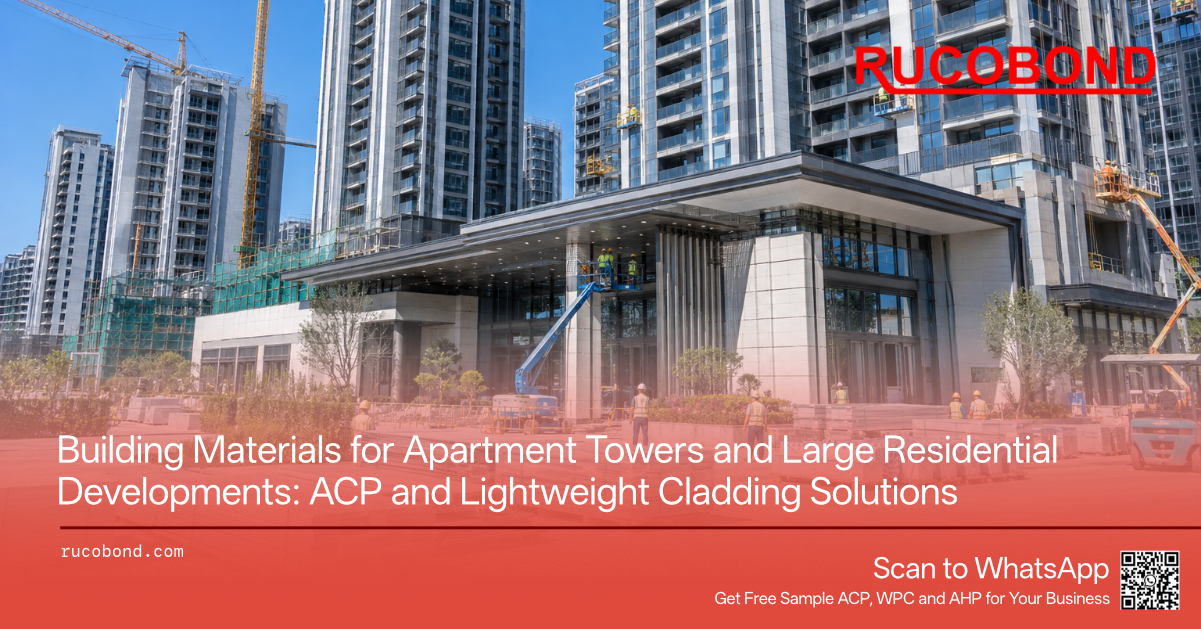
Why Large Residential Projects Need a Different Material Procurement Strategy
A large residential development can contain hundreds or even thousands of apartments, multiple towers, shared podiums, community facilities, car parks, entrance lobbies and landscaped public areas. From a distance, the project may look repetitive. From the procurement desk, repetition is exactly what makes mistakes expensive. A specification error repeated across twenty towers is no longer a small error. A color difference that might disappear on a single villa can become a visible band stretching across several apartment blocks. A supplier that misses one delivery window may leave façade installers waiting while cranes, scaffolding and subcontractors continue generating cost.
Residential developers therefore need materials that balance appearance, budget, installation efficiency and long-term maintenance. Premium materials may be justified around entrances, clubhouses and public lobbies, while broad residential elevations usually need a more economical solution. The strongest material strategy is rarely “use the most expensive product everywhere.” It is deciding where each material produces enough practical value to justify its cost.
Founded in Guangzhou, China in 2013, Rucobond manufactures and exports Aluminum Composite Panels, Aluminum Honeycomb Panels, Aluminum Veneer, Aluminum Coils, WPC products and Sintered Stone Slabs for international construction markets. The company works with developers, general contractors, façade engineering firms, decoration companies, building material importers and regional distributors across Southeast Asia, Europe, the Middle East, North America and other markets.
For apartment projects, Rucobond can support broad ACP façade areas, customized Aluminum Veneer around entrances and balcony details, Honeycomb Panels in premium public spaces, Aluminum Coil for local fabrication, WPC for suitable outdoor community zones and Sintered Stone for shared interiors. This wider product range allows buyers to create a project-based material combination instead of managing a completely separate supplier for every zone.
The practical goal is straightforward: keep the large repetitive areas economical, use customized products where shape or visibility matters, and maintain enough manufacturing consistency that Phase 3 does not look like it accidentally came from another development.
Cost Control Becomes More Difficult When Thousands of Units Share One Façade System
Residential projects are extremely sensitive to unit cost because small differences multiply quickly. A developer comparing two façade materials may see only a modest price difference per square meter. Across 30,000 or 50,000 square meters, that difference becomes substantial. This is why residential procurement teams often spend more time studying material combinations than buyers working on smaller commercial buildings.
The cheapest quotation, however, can create hidden costs later. Poor dimensional consistency slows fabrication. Weak packaging increases site damage. Surface differences lead to replacement. A supplier that cannot reproduce the same color during later phases can force contractors to reserve additional stock simply because nobody trusts the next batch.
Imagine a residential community with eight towers built over three phases. Phase 1 uses a cool grey aluminum finish around podiums and balcony edges. Two years later, Phase 3 needs the same finish. If the later material has a warmer tone or different gloss, the inconsistency is visible from across the road. Residents may not know the technical reason, but they can immediately see that the buildings do not quite match.
This is why physical sample approval, clear product specifications and repeat-production records matter. Rucobond can work from confirmed samples and specifications to support later orders. Buyers planning long-term developments should communicate expected future phases early, even when the entire project quantity will not be purchased at once.
Cost control also means using different materials intelligently. Standard ACP may cover broad podium walls and service areas. Aluminum Veneer may be reserved for curved entrances, balcony frames and architectural features. Honeycomb Panels may appear only in premium lobbies or clubhouses. WPC can be used in selected outdoor community spaces instead of natural timber where easier maintenance is valuable.
This type of selective specification gives developers more control over the total project budget while preserving the areas that directly affect the buyer’s first impression. It is a less glamorous strategy than simply putting “premium materials throughout” into the sales brochure, but construction budgets tend to prefer arithmetic over adjectives.
Aluminum Composite Panels for Residential Towers, Podiums and Community Buildings
Aluminum Composite Panels are widely used in residential and mixed-use developments because they provide relatively low weight, flexible fabrication and a wide choice of decorative finishes. They can be applied to podium façades, entrance walls, retail areas below apartment towers, community buildings, parking structures, service areas and selected parts of residential elevations.
Rucobond supplies solid matte colors, glossy solid colors, metallic surfaces, brushed finishes, wood grain patterns, mirror styles and stone-inspired designs. For residential developments, white, grey, silver, charcoal and muted metallic finishes are common because they coordinate easily with glass, concrete, paint and stone-like materials.
A large apartment project may use neutral ACP around the podium while darker panels frame retail entrances. A serviced apartment development may introduce wood grain panels around the drop-off zone or clubhouse. Affordable housing may rely more heavily on practical solid colors where long-term appearance and budget control matter more than decorative complexity.
ACP can also be cut, routed and folded into different forms. This fabrication flexibility helps contractors work around windows, doors, parapets, columns and podium edges while maintaining consistent architectural lines.
For exterior applications, buyers should specify the climate and exposure. Projects in the Philippines or Thailand may face high humidity, strong sunlight and heavy seasonal rainfall. Middle Eastern housing developments may deal with heat, dust and intense UV exposure. Coastal residential towers may require additional consideration of salt air and maintenance conditions.
Rucobond works with buyers to confirm total panel thickness, aluminum skin, coating, color, finish, dimensions, quantity and intended application before production. For projects delivered in several phases, approved samples and production references help support repeat orders.
The main advantage of ACP is not that it makes every residential building look luxurious. It is that it allows developers and contractors to cover large architectural areas efficiently while retaining enough design flexibility to create a clear and consistent visual identity.
Aluminum Veneer for Balconies, Entrances, Canopies and Architectural Details
Residential architecture contains plenty of areas where standard flat panels become inconvenient. Balcony edges, entrance canopies, decorative fins, roof crowns, columns, curved podiums and mechanical screens often require custom fabrication.
Aluminum Veneer is well suited to these zones because it can be manufactured according to technical drawings. Panels can be folded, curved, perforated and produced in different dimensions depending on the architectural requirement.
A residential tower entrance is a common example. The architect may design a deep canopy with integrated lighting, large columns and folded metal edges. This area forms the transition between the street and the lobby, so it receives much more visual attention than a service wall at the back of the building. Using customized Aluminum Veneer here allows the design to create stronger depth and cleaner geometry.
Balcony and podium details may also benefit from custom pieces. Mechanical equipment can be screened with perforated panels. Roof-edge elements can be fabricated according to the profile of the building. Decorative fins can create shade or vertical rhythm across otherwise repetitive residential elevations.
Rucobond supports drawing-based Aluminum Veneer manufacturing for professional project orders. Buyers should provide dimensions, thickness, folds, curves, perforations, coating, color, panel codes and quantities. Accurate drawings are especially important on large housing developments because one custom detail may be repeated hundreds of times.
Panel identification can also improve site efficiency. When several towers are being built simultaneously, packaging can be organized according to building, elevation or panel code where agreed. This reduces the chance of installation teams discovering that the correct component is sitting three towers away under another pallet.
Factory fabrication helps reduce complicated forming work on site and can improve repeatability across identical building sections. That repeatability is one of the strongest advantages in residential construction, where one detail may appear again and again until everyone on the project can recognize it from fifty meters away.
Aluminum Honeycomb Panels for Premium Lobbies and Large Shared Spaces
Large residential developments increasingly include premium shared areas such as entrance lobbies, clubhouses, sales centers, residents’ lounges and covered drop-off zones. These spaces often require cleaner, larger architectural surfaces than ordinary residential corridors.
Aluminum Honeycomb Panels can be considered for these applications because their internal honeycomb structure provides strong rigidity while keeping overall panel weight relatively low. This helps larger panels maintain flatter surfaces and can reduce the number of visible joints.
A premium apartment lobby may use large Honeycomb Panels across the ceiling, especially where the design continues from an exterior canopy into the interior arrival space. A clubhouse may use them on feature walls or large ceilings. A serviced apartment development may specify them around executive reception areas where a more refined finish supports the positioning of the property.
Rucobond supports customized Aluminum Honeycomb Panels according to dimensions, thickness, surface finish, color and edge requirements. Technical drawings are recommended because panel size and support details influence production.
Honeycomb Panels generally involve a higher cost than standard ACP, so selective use is usually the more practical approach. Developers can reserve them for the spaces that buyers and residents experience directly while using more economical materials in secondary areas.
This produces a better relationship between cost and visible value. Nobody purchases an apartment because the service corridor ceiling was engineered to impress visiting architecture critics. The main lobby, entrance and clubhouse are much more likely to influence perception.
For distributors, Honeycomb Panels also provide a higher-value product category that can serve residential, commercial, office, transportation and hospitality projects alongside standard ACP.
Aluminum Coils for Local Fabrication, Roofing and Supporting Components
Large housing projects require many secondary metal components that may be easier to fabricate locally. Roofing details, trims, ceiling components, signage, gutters and smaller architectural pieces often need adjustment as construction progresses.
Aluminum Coil gives local manufacturers flexibility to produce these products closer to the project site. Rucobond supplies Aluminum Coil according to thickness, width, coating, color, surface finish, quantity and downstream application.
This can be especially useful in residential projects delivered tower by tower. The main cladding modules may be manufactured according to standardized drawings, while local workshops produce smaller trims or roof details after final measurements are confirmed.
Renovation and later-phase construction also benefit from local processing. An existing podium may have slightly different dimensions from the new tower. A drainage detail may need revision. A signage zone may be adjusted after the retail tenant is confirmed. Local fabrication can respond to these changes faster than waiting for every secondary component to arrive from overseas.
For regional building material distributors, Aluminum Coil broadens the customer base. Roofing manufacturers, signage workshops, ceiling factories and local metal processors can become customers even when they do not purchase finished ACP.
Packaging and handling must be planned carefully because coils carry concentrated weight. Secure supports, moisture protection and suitable warehouse equipment are essential. A residential project already contains enough objects that should not be dropped. An aluminum coil does not need to join the list.
A mixed supply model can therefore make sense: finished ACP for broad wall areas, custom Aluminum Veneer for architectural features and Aluminum Coil for local fabrication of smaller supporting components.
WPC and Sintered Stone for Community Landscapes and Residential Interiors
Residential developments are not only façades. Buyers spend time in gardens, clubhouses, rooftop terraces, entrance lobbies, cafés and shared community facilities. These spaces can influence how the entire development is perceived.
WPC products can be used for suitable outdoor decking, garden paths, terrace areas and decorative walls where a wood-like appearance is desired. Compared with many untreated natural timber products, WPC provides improved resistance to moisture and insects, which can make maintenance more manageable in certain outdoor environments.
A tropical apartment complex may use WPC around a poolside terrace, community garden or clubhouse deck. A mixed-use podium may use it in outdoor restaurant areas. A residential rooftop may use WPC to create a warmer visual environment beside metal and glass architecture.
Sintered Stone Slabs can support reception counters, shared kitchens, bathroom surfaces, lobby walls, tables and other residential common areas. Their controlled stone-inspired patterns allow designers to create premium interiors without depending entirely on natural stone variation.
A serviced apartment lobby, for example, may combine Sintered Stone behind the reception desk with Aluminum Honeycomb Panels on the ceiling and Aluminum Veneer around the exterior canopy. Each material is placed where its appearance and performance create useful value.
For contractors, sourcing these categories under one broader material relationship can reduce repeated supplier communication. For distributors, WPC and Sintered Stone create additional sales opportunities with landscape firms, interior contractors, kitchen companies and residential developers.
The point is not to make every community area use every material in the catalog. A good residential project has enough decisions already. The value is having suitable options when different zones require different solutions.
Color Consistency, Packaging and Phased Delivery Across Large Housing Projects
Residential developments are often constructed in phases because developers release towers according to sales, financing and infrastructure progress. This means façade materials may need to be reproduced months or years later.
Color consistency therefore becomes a serious procurement issue.
Rucobond encourages professional buyers to approve physical samples and maintain clear product specifications. Metallic, brushed and darker finishes can appear different under changing daylight, so approved references are useful when later production needs to match earlier phases.
For repeat orders, panel thickness, coating, color, gloss level, finish and dimensions should remain aligned with the original standard wherever possible. Buyers should communicate the expected development program early so records can be maintained more systematically.
Packaging also needs to follow the project sequence. ACP pallets can be separated by tower, elevation or color. Custom Aluminum Veneer can use panel codes linked to drawings. Honeycomb Panels can be grouped by lobby or clubhouse zone.
This reduces unnecessary movement around large developments. A residential construction site may cover several hectares, and sending the wrong pallet to the wrong tower creates more than a minor inconvenience. Somebody eventually needs to move it back, usually after enough people have already discussed whose fault it is.
Rucobond products are supported by SGS, CE and ISO-related certifications and quality systems according to product category and project requirements. Quality control can include specification verification, surface inspection, dimensional checking, color comparison and packaging review.
For phased projects, delivery schedules can be discussed according to construction progress, order volume and factory capacity. This helps buyers avoid holding excessive stock on site while still preparing materials before installation begins.
Predictable phased supply is particularly valuable for developers who need to manage cash flow and construction progress at the same time.
OEM, ODM and Bulk Supply for Developers, Contractors and Building Material Distributors
Residential projects create repeat purchasing opportunities because developers often build several communities using similar architectural standards. Contractors may work with the same developer on multiple projects, while regional distributors may supply many local apartment developments.
Rucobond supports OEM and ODM cooperation for professional buyers requiring private-label protective films, customized packaging, product labels, selected colors, dimensions and repeat specifications.
A regional distributor may develop a residential ACP collection focused on white, silver, grey, charcoal and wood-inspired finishes. Standard products can serve broad housing demand, while custom Aluminum Veneer and Honeycomb Panels support premium developments.
For contractors and developers, standardization can simplify approval. If several projects use the same exterior grey or the same entrance finish, a known specification reduces repeated product selection and makes future procurement easier.
Private-label packaging can also help distributors create stronger local recognition. Consistent product codes, sample collections and protective film allow contractors to reorder known products more easily.
Rucobond mainly serves developers, construction contractors, façade engineering firms, importers, wholesalers, decoration companies and building material distributors requiring bulk production and long-term supply.
For large residential programs, staged production can be discussed according to construction sequence. One tower may need panels this quarter while the next phase begins later. Early communication gives the factory more opportunity to plan capacity rather than discovering the project only when the buyer’s email subject suddenly contains three versions of “URGENT.”
The most useful OEM relationship is not the one with the most customized printing. It is the one where the buyer knows what product will arrive on the next order and the local customer recognizes it as the same product again.
Preparing a More Accurate Inquiry for Residential Construction Materials
A useful quotation begins with clear project information. Buyers should identify whether the project is a high-rise apartment complex, affordable housing program, serviced apartment development, residential community, mixed-use project or renovation.
For Aluminum Composite Panels, provide total panel thickness, aluminum skin, coating type, color, gloss level, surface finish, dimensions, quantity and exterior or interior application. If several towers use the same specification, provide the estimated total program quantity even if purchasing will happen in phases.
For Aluminum Veneer, provide technical drawings showing dimensions, folds, curves, perforations, fixing edges, coating, color and panel quantities. Repetitive balcony or entrance details should be clearly identified so the factory understands the total manufacturing volume.
For Aluminum Honeycomb Panels, provide panel dimensions, thickness, surface finish, edge requirements and installation area. For Aluminum Coil, include thickness, width, coating, color, quantity and downstream fabrication use. WPC and Sintered Stone inquiries should include application, dimensions, finish or pattern and estimated quantity.
Project location is also important. Exterior materials for a humid coastal apartment development face different conditions from a dry inland housing project. Buyers should mention high humidity, strong UV, coastal exposure or other relevant environmental factors.
The construction schedule should be clear. Which tower begins first? Are materials required by elevation or phase? Will shipments go directly to the project site or to a regional warehouse? Is long-term repeat supply expected?
BOQ files, façade drawings, architectural renderings, panel schedules and physical color references can all improve quotation accuracy.
Rucobond welcomes inquiries from residential developers, general contractors, façade engineering companies, building material importers, regional distributors and decoration businesses. OEM, ODM, customized production, samples and bulk international supply can be discussed according to project requirements.
Send the drawings, material specifications, quantities, destination and expected construction schedule. A residential development already has enough moving parts. The material quotation should not become another one simply because the first inquiry contained only “need ACP for apartment, best price.”
Q: What Rucobond materials can be used in large residential developments?
A: Rucobond supplies Aluminum Composite Panels, Aluminum Honeycomb Panels, Aluminum Veneer, Aluminum Coils, WPC products and Sintered Stone Slabs. These materials can support podium façades, apartment entrances, balconies, canopies, lobbies, community facilities, outdoor areas and other architectural applications.
Q: Can Rucobond repeat the same ACP color for later housing phases?
A: Rucobond can work from approved samples, confirmed specifications and color references to support repeat production. Buyers planning multi-phase residential developments should communicate expected future quantities early and retain approved material references where appearance consistency is important.
Q: Can Aluminum Veneer be customized for apartment balconies and entrance canopies?
A: Yes. Rucobond supports drawing-based Aluminum Veneer production for balcony edges, canopies, columns, roof details, perforated screens and other custom architectural elements. Buyers should provide dimensions, folds, coating, color and quantities.
Q: Can residential project materials be supplied in several phases?
A: Staged production and shipment can be discussed according to total quantity, tower sequence, construction schedule and factory capacity. Buyers should provide the expected project phases early so production and packaging can be coordinated more practically.
Q: Does Rucobond support OEM products for residential building material distributors?
A: Yes. OEM and ODM options may include private-label protective films, customized packaging, product labels, selected colors, dimensions and repeat specifications for professional importers, contractors and regional building material distributors.
Name: Gina Chen
Mobile:+86-189-2412-4951
Tel:+86-189-2412-4951
Whatsapp:8618924124951
Email:gina@rucobond.com
Add:Room 708, No. 8 Jingang Avenue, Nansha Street, Nansha District, Guangzhou


