
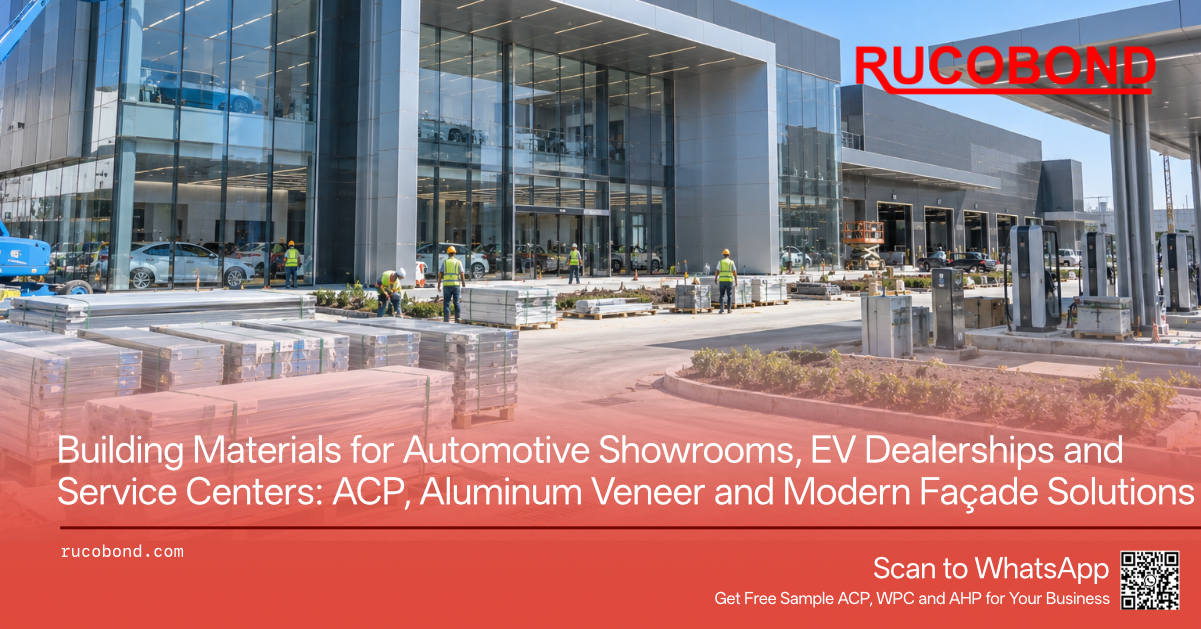
Why Automotive Showrooms Need More Than an Attractive Façade
Automotive architecture has changed significantly. A traditional dealership once needed a large glass showroom, several signs and enough space to park vehicles outside. Modern automotive brands, especially electric vehicle companies, increasingly treat the showroom as part of the product experience. Clean metal façades, large glazed entrances, carefully controlled lighting, premium customer lounges and recognizable brand colors are used to make the building communicate the same identity as the cars displayed inside.
That makes material procurement more complicated than it initially appears. The façade contractor may need thousands of square meters of consistent Aluminum Composite Panels, while the entrance requires custom Aluminum Veneer. The showroom ceiling may use larger lightweight panels, the service center may need simpler economical surfaces, and local fabricators still need metal materials for trims, signs and secondary details. A single dealership can therefore contain several very different construction zones.
The challenge becomes larger when the same brand opens ten or fifty locations. Each building has different dimensions, landlords and local contractors, but the final appearance is expected to remain recognizable. A metallic grey that works perfectly on the first showroom cannot quietly become a warmer grey on the fifth. A canopy detail cannot change simply because one site team decided to improvise. Brand guidelines eventually become manufacturing requirements.
Founded in Guangzhou, China in 2013, Rucobond manufactures and exports Aluminum Composite Panels, Aluminum Honeycomb Panels, Aluminum Veneer, Aluminum Coils, WPC products and Sintered Stone Slabs for international construction projects. Rucobond works with façade contractors, building material distributors, importers, decoration companies, developers and professional project buyers across Southeast Asia, Europe, the Middle East, North America and other markets.
For automotive projects, Rucobond can support both individual flagship showrooms and repeat dealership programs. OEM, ODM, customized dimensions, surface finishes, protective films and staged production can be discussed according to project requirements. The useful objective is not simply making one showroom look impressive. It is creating a material system that can be repeated when the brand opens the next location.
Brand Consistency Becomes a Construction Issue Across Multiple Dealerships
Automotive brands spend heavily on visual identity. Colors, signs, entrance proportions, lighting and interior finishes are often specified in detail because the showroom needs to look familiar whether it is located in Bangkok, Manila, Riyadh or another city. Once this design is translated into construction materials, manufacturing consistency becomes part of brand management.
Imagine an EV company launching fifteen dealerships over eighteen months. The approved exterior combines cool silver metallic ACP with dark charcoal Aluminum Veneer and a large glass curtain wall. The first six locations are completed successfully. Several months later, another supplier provides “the same” silver for three new sites. Under daylight, the gloss is different and the metallic particles reflect light differently. The color code on paper may look correct, but the dealerships no longer appear identical.
This is why physical samples and detailed product records matter. Metallic surfaces, brushed finishes and mirror effects cannot be judged reliably from a computer screen alone. Viewing angle, sunlight and nearby glass can change the way the surface appears. For flagship projects, comparing actual material samples beside the selected curtain wall glass can prevent expensive surprises later.
Rucobond works with buyers to confirm panel specifications, surface finish, color, gloss level, dimensions, coating requirements and packaging before production. Approved references can also support repeat orders when additional dealerships are constructed later.
Standardization can extend beyond color. A dealership group may use one ACP specification for broad wall areas, one dark Aluminum Veneer finish for entrances and one branded protective film across all locations. Local dimensions can change while the material language remains consistent.
For contractors, this reduces repeated approval work. For automotive brands, it protects visual identity. For regional building material distributors, it creates repeat demand instead of a one-time project sale.
A showroom chain is supposed to look repetitive. In most architecture that might sound insulting. In automotive retail, repetition is often exactly what the brand paid for.
Aluminum Composite Panels for Showroom Façades and Service Buildings
Aluminum Composite Panels are particularly suitable for automotive projects because they combine relatively low weight, flexible fabrication and a large range of surface finishes. They can be used around glass curtain walls, solid façade areas, showroom entrances, service-center buildings, parking structures, signage backgrounds and secondary elevations.
Rucobond supplies solid matte colors, glossy solid colors, metallic surfaces, mirror finishes, wood grain, brushed silver, brushed gold and stone-inspired patterns. Automotive architecture often favors metallic silver, cool grey, charcoal, white and black because these finishes work naturally with glass, vehicles and modern lighting. More distinctive corporate colors can be introduced around signs, entrance frames or feature walls.
A premium EV showroom may combine large glass panels with brushed or metallic ACP across solid wall zones. A mass-market dealership may use economical solid-color ACP around the main façade and service building. A used-car retail center may use stronger corporate colors around signage while maintaining neutral panels across broader surfaces.
ACP can be cut, routed and folded into cassette panels and other architectural forms. This makes it easier to align metal modules with curtain wall grids, doors, windows and signage systems. Contractors can adapt fabrication to individual showroom dimensions while keeping the same approved finish across multiple sites.
For exterior applications, the specification should match the local climate. Strong sunlight, humidity, rainfall, dust and coastal exposure can affect material selection. Buyers should provide the project location, exterior or interior application, total panel thickness, aluminum skin, coating type, finish, dimensions and quantity.
For large dealership programs, repeat production becomes especially important. A brand may renovate older showrooms while simultaneously opening new ones. If the same panel finish can be maintained across these different projects, the procurement team avoids restarting material selection every time.
The benefit of ACP is therefore not limited to appearance. It provides a scalable way to cover broad architectural surfaces while allowing customized fabrication and repeat use across a retail network.
Aluminum Veneer for Entrances, Canopies and Signature Brand Architecture
The most recognizable parts of an automotive showroom are often the parts that standard flat panels cannot handle efficiently. Large entrance portals, projecting canopies, folded frames, vertical fins and curved features are frequently used to distinguish the showroom from neighboring commercial buildings.
Aluminum Veneer provides greater fabrication freedom for these details. Panels can be manufactured according to technical drawings, including custom folds, curves, perforations, column covers, roof edges and entrance structures.
A dealership may use a deep charcoal metal frame around the glass showroom to create a strong rectangular portal visible from the road. Another brand may use a curved canopy extending over the vehicle handover area. An EV experience center may use perforated Aluminum Veneer around charging equipment or technical service zones to create a cleaner exterior appearance.
Rucobond supports drawing-based Aluminum Veneer production. Buyers can provide dimensions, thickness, folds, curves, perforations, coating, color, panel codes and quantities. Accurate shop drawings allow components to be fabricated before shipment, reducing the amount of complex forming required at the construction site.
Panel coding is especially useful for repeat architectural features. A large dealership may contain many custom pieces around entrances and corners, while a rollout program may use similar components at several locations. Clear identification helps local installers match the correct panel with the correct drawing and project.
This becomes important because automotive projects often operate under short opening schedules. Marketing campaigns, vehicle launches and dealership openings may already be planned before construction is complete. Losing several days because custom panels were packed without clear identification is an impressively avoidable problem.
Aluminum Veneer therefore works best where shape, depth and visual identity matter. ACP can cover broad economical surfaces, while Veneer handles the signature architectural elements customers notice first.
Aluminum Honeycomb Panels for Premium Showrooms and Large Interior Ceilings
Automotive showrooms often contain large open interiors with high ceilings and relatively few visual obstructions. Lighting, vehicles and digital displays become the main focus. In this type of space, uneven ceiling surfaces and excessive joints can become more noticeable than they would in a conventional retail store.
Aluminum Honeycomb Panels can be considered for large ceilings, feature walls, entrance soffits and premium customer areas where panel rigidity and larger formats are useful. The internal honeycomb structure provides strength while keeping overall weight relatively low, helping larger panels maintain a flatter appearance.
A luxury vehicle showroom may use large Honeycomb Panels across the ceiling above the main display area. An EV flagship center may continue the same metal surface from an exterior entrance canopy into the interior reception space. Corporate lounges, delivery suites and customer briefing areas may also use larger-format panels where a cleaner visual finish supports the premium positioning of the brand.
Rucobond supports customized Aluminum Honeycomb Panel production according to dimensions, thickness, surface finish, color and edge requirements. Drawings are recommended because panel size and installation method affect manufacturing details.
Honeycomb Panels generally cost more than standard ACP, so selective use usually produces a better budget. Premium customer areas may justify the additional investment, while service corridors and workshop offices can use simpler materials.
This distinction matters in automotive construction. A customer collecting a new vehicle may spend an hour in the delivery lounge. The workshop storage room has fewer aesthetic responsibilities. Giving both areas the same premium specification would demonstrate admirable equality and questionable cost control.
By combining Honeycomb Panels with ACP and Aluminum Veneer, dealerships can create a hierarchy of materials that matches the importance of each area.
Aluminum Coils for Signage, Local Fabrication and Supporting Metal Work
Automotive dealerships rely heavily on signage. Large brand names, illuminated logos, directional signs, service-center identification and charging-zone markers all need supporting metal components. Many of these pieces are fabricated locally because dimensions and electrical details vary from site to site.
Aluminum Coil can support local manufacturing of signage panels, trims, ceilings, roof components and other secondary architectural products. Rucobond supplies Aluminum Coil according to thickness, width, coating, color, surface finish, quantity and downstream application.
This creates a useful combination for dealership contractors. Finished ACP can arrive for large façade areas, custom Aluminum Veneer can be produced for signature entrance elements, while local manufacturers use Aluminum Coil for smaller components that need final adjustment.
Local fabrication is especially useful during renovations. An older dealership may contain undocumented repairs or signage structures that do not match the drawings. Once existing panels are removed, new dimensions can be measured and smaller trims fabricated without waiting for another international shipment.
For distributors, Aluminum Coil also opens additional customer channels. Signage workshops, roofing manufacturers, ceiling factories and metal fabricators may purchase the material even when they are not involved in full façade projects.
Proper handling remains important. Coils contain concentrated weight and require secure packaging, stable support and appropriate unloading equipment. The warehouse should confirm handling capacity before delivery rather than discovering the laws of gravity during unloading.
For dealership networks, combining imported finished products with local fabrication can create a more flexible supply chain, especially when several locations are being constructed or renovated simultaneously.
WPC and Sintered Stone for Customer Lounges and Outdoor Commercial Areas
Automotive showrooms are increasingly designed as hospitality environments. Customers may spend considerable time waiting for service, discussing financing, configuring vehicles or collecting a new car. Comfortable lounges, cafés, terraces and premium reception areas have therefore become an important part of dealership design.
WPC can be used in suitable outdoor terraces, café areas, pedestrian zones and decorative wall applications where a warmer wood-like appearance is desired. Compared with many untreated natural timber products, WPC offers improved resistance to moisture and insects and can reduce maintenance requirements in suitable outdoor environments.
An EV dealership may use WPC around an outdoor charging lounge or café terrace. A premium showroom may combine WPC with glass and dark metal surfaces around the vehicle handover area to make the building feel less industrial.
Sintered Stone Slabs can be used for reception counters, customer lounge tables, coffee areas, washrooms, sales desks and interior feature walls. Their stone-inspired appearance can support premium interiors while offering practical surfaces for regular commercial use.
A flagship showroom might therefore combine metallic ACP outside, customized Aluminum Veneer around the entrance, Honeycomb Panels on the ceiling and Sintered Stone around the reception and consultation areas. WPC could appear in an outdoor lounge beside charging points.
For contractors, this wider product range can simplify procurement across façade and interior zones. For distributors, it creates additional opportunities with showroom designers, interior contractors and automotive developers.
The objective is not to make buying a car feel like checking into a resort. Although judging from some showroom lounges, parts of the industry are clearly considering it. The purpose is to select materials that support the customer experience without forgetting maintenance and project budget.
Managing Color, Surface Direction and Replacement Materials
Automotive façades are unusually sensitive to visual inconsistency because the architecture is often clean and simple. Large uninterrupted metal surfaces leave very few places for differences to hide. Metallic finishes, brushed surfaces and dark solid colors therefore require careful control.
Surface direction is one issue that deserves attention. Brushed and certain metallic panels can appear different when installed in opposite orientations. Fabricators should maintain consistent direction according to protective film markings and approved drawings.
Color references should also be kept for later production. Dealerships are frequently renovated, expanded or repaired. Vehicle entrances may be widened, charging areas added, or signage changed when brand standards are updated. Replacement panels may therefore be needed years after the original project.
Rucobond can work from approved samples, product specifications and color references to support repeat orders. Buyers expecting future expansion should retain approved samples and provide clear information about the original product whenever replacements are required.
Packaging can also be organized according to panel size, finish, building area or project location where agreed. Custom Aluminum Veneer can be labeled according to shop drawings, while ACP pallets can identify color and dimensions.
This becomes especially useful for contractors managing several dealerships at once. Materials for Shanghai, Bangkok and Manila should ideally not depend on somebody reading a handwritten note on the corner of a pallet after it has crossed half the planet.
Quality control can include specification verification, dimensional inspection, surface checking, color comparison and packaging review according to product category and project requirements. Rucobond products are supported by SGS, CE and ISO-related certifications and quality systems according to applicable requirements.
For multi-location automotive projects, consistency is not a decorative extra. It protects the brand identity that the building was designed to express in the first place.
OEM, ODM and Bulk Supply for Dealership Contractors and Material Distributors
Automotive showroom construction is particularly suitable for repeat supply because dealership networks expand and renovate continuously. A façade contractor may build several locations for the same brand, while a regional material distributor may supply multiple automotive groups within one market.
Rucobond supports OEM and ODM cooperation for professional buyers requiring private-label protective film, customized packaging, product labels, selected colors, dimensions and repeat specifications.
A regional distributor could develop an automotive façade collection built around common silver, white, charcoal, black and brushed finishes. Custom colors could then be reserved for specific vehicle brands. Aluminum Veneer and Honeycomb Panels could support premium projects, while standard ACP handles broader dealership demand.
For contractors working under global automotive brand guidelines, standardization may be more valuable than private labeling. Once a material is approved for one showroom, using the same specification across future locations reduces repeated selection work and helps maintain visual consistency.
Rucobond mainly serves façade contractors, construction companies, building material importers, wholesalers, decoration firms and distributors requiring commercial quantities and repeat manufacturing.
Staged production can be discussed for dealership rollout programs. One group may open three locations this quarter and another five later in the year. Early information about expected total demand helps manufacturing and color references remain more organized.
The strongest supplier relationship is one where the second order is easier than the first. If every new dealership requires everyone to rediscover the same specifications from old email attachments, the supply chain has technically survived but has learned very little.
Preparing a Better Material Inquiry for Automotive Retail Projects
A practical quotation should begin with the project type. Buyers should explain whether the project is a new automotive showroom, EV experience center, dealership renovation, service center, flagship store or multi-location rollout.
For Aluminum Composite Panels, provide total panel thickness, aluminum skin, coating type, color, gloss level, surface finish, dimensions, quantity and exterior or interior application. If the panels must coordinate with curtain wall glass or an automotive brand color, provide relevant samples or references.
For Aluminum Veneer, send technical drawings showing dimensions, folds, curves, perforations, fixing edges, coating, color and quantities. Entrance portals, canopies and decorative fins should be clearly identified.
For Aluminum Honeycomb Panels, provide panel dimensions, thickness, finish, edge requirements and installation area. For Aluminum Coil, provide thickness, width, coating, color, quantity and downstream fabrication application. WPC and Sintered Stone inquiries should include dimensions, application and finish requirements.
For dealership rollouts, buyers should also provide the number of expected locations, estimated material volume and approximate construction sequence. Even if exact orders will be released later, this helps the supplier understand whether the project is one building or the beginning of a regional program.
Destination and schedule matter as well. Provide the country, destination port, expected opening date and whether materials will be shipped directly to the construction site or to a regional warehouse.
Rucobond welcomes inquiries from automotive dealership contractors, EV showroom developers, façade engineering companies, building material distributors, importers and commercial decoration firms. OEM, ODM, customized manufacturing, samples and bulk export supply can be discussed according to actual project requirements.
Send the drawings, BOQ, finish references, estimated quantity, destination and construction schedule. “Need panels for car showroom” can begin a conversation. It should not be expected to finish the quotation.
Q: What Rucobond materials can be used for automotive dealerships and EV showrooms?
A: Rucobond supplies Aluminum Composite Panels, Aluminum Veneer, Aluminum Honeycomb Panels, Aluminum Coils, WPC products and Sintered Stone Slabs for showroom façades, entrance canopies, ceilings, customer lounges, service buildings and other commercial architectural areas.
Q: Can Rucobond match a specific automotive brand façade color?
A: Rucobond can work from physical samples, color references and confirmed project specifications to develop or reproduce project finishes. Physical sample approval is recommended where metallic appearance, gloss or exact brand identity is important.
Q: Can Aluminum Veneer be customized for dealership entrance portals and canopies?
A: Yes. Aluminum Veneer can be manufactured according to technical drawings for entrance frames, canopies, columns, curved elements, perforated screens and other customized architectural details.
Q: Can Rucobond support the same material specification across multiple dealership locations?
A: Yes. Repeat production and staged supply can be discussed for multi-location programs. Buyers should provide approved samples, confirmed specifications, expected quantities and rollout schedules as early as possible to improve consistency across future orders.
Q: Does Rucobond support OEM materials for automotive façade distributors?
A: Yes. OEM and ODM options may include customized protective film, private-label packaging, selected finishes, product labels, dimensions and repeat specifications for professional distributors, contractors and importers.
Name: Gina Chen
Mobile:+86-189-2412-4951
Tel:+86-189-2412-4951
Whatsapp:8618924124951
Email:gina@rucobond.com
Add:Room 708, No. 8 Jingang Avenue, Nansha Street, Nansha District, Guangzhou


