
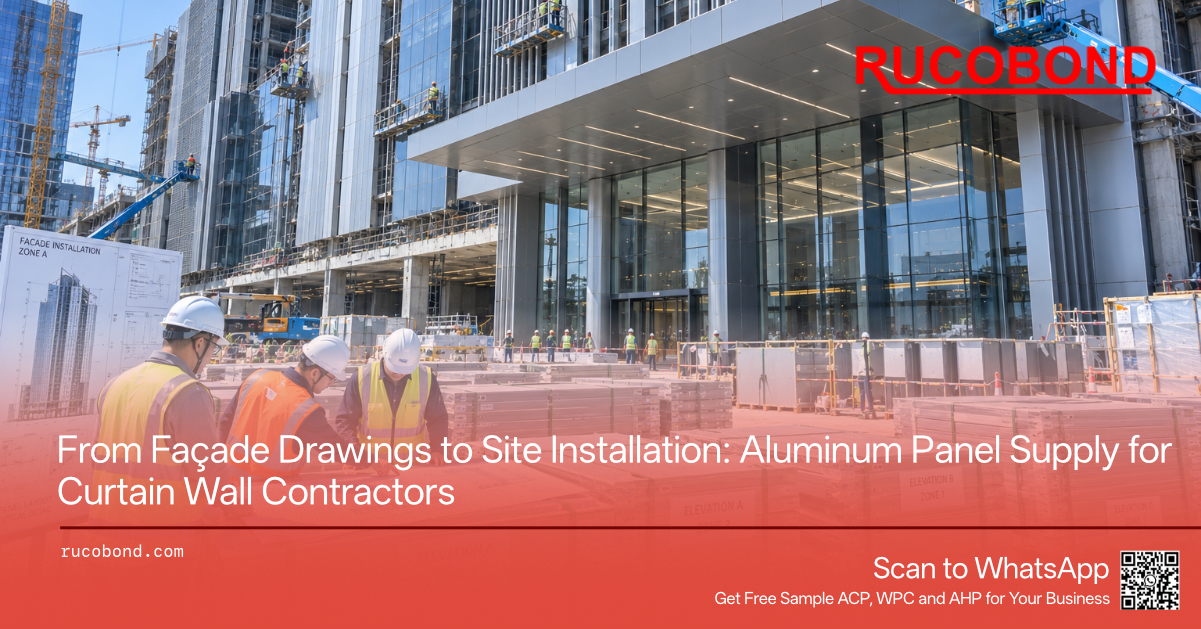
Why Façade Contractors Need More Than a Panel Price
For a façade contractor, the price per square meter is only the beginning of the calculation. A panel can be inexpensive at the factory and still become very expensive after it reaches the project. Wrong dimensions create rework. Weak packaging creates scratches. Poor color consistency produces visible patches. Unclear labeling wastes installation time. A late replacement shipment can leave scaffolding, boom lifts and installation crews waiting while the project manager explains to the developer why one corner of the building is still unfinished.
This is why serious façade procurement rarely begins and ends with “send your best ACP price.” The contractor needs to know whether the supplier can understand drawings, maintain a confirmed specification, manufacture custom components, identify panels correctly and support later production when the project changes. Large façade projects are not simply product purchases. They are manufacturing programs linked directly to the construction schedule.
Founded in Guangzhou, China in 2013, Rucobond manufactures and exports Aluminum Composite Panels, Aluminum Veneer, Aluminum Honeycomb Panels, Aluminum Coils, WPC products and Sintered Stone Slabs for international construction projects. Rucobond works with façade engineering firms, curtain wall contractors, general contractors, building material importers, decoration companies and regional distributors requiring commercial quantities and customized production.
A typical façade package may combine several Rucobond products. Standard ACP can cover large repetitive zones. Aluminum Veneer can handle columns, entrances, roof edges, fins and irregular shapes. Aluminum Honeycomb Panels may be selected for large ceilings or premium architectural areas. Aluminum Coil can support local fabrication of secondary trims and components. The value comes from selecting these products according to the drawing rather than forcing every square meter into the same material category.
For façade contractors, the strongest supplier is therefore not necessarily the one sending the shortest quotation. It is the one that helps turn a stack of architectural drawings into materials that can actually be manufactured, shipped, found on site and installed in the correct place.
Turning Architectural Drawings into a Workable Material Specification
Architectural drawings show what the building should look like. Manufacturing specifications explain how the façade materials will actually be produced. The gap between those two documents is where many expensive misunderstandings begin.
A rendering may show a clean metallic façade, but the factory still needs to know the panel thickness, aluminum skin, coating, gloss level, dimensions, joint design and expected quantity. A drawing may show a dramatic folded entrance, but Aluminum Veneer manufacturing requires exact folds, returns, curves, perforations and panel codes. “Silver façade” is an architectural idea. It is not yet a production specification.
Rucobond encourages project buyers to provide façade drawings, shop drawings, BOQ documents, panel schedules, finish references and destination information before mass production. The more precise the information, the easier it becomes to identify which areas can use standard panels and which require customized manufacturing.
This also creates opportunities for cost optimization. A large flat podium wall may not need the same material as a deep entrance frame. Standard ACP may be sufficient for the repetitive wall area, while Aluminum Veneer handles the complex geometry. Honeycomb Panels can be reserved for large premium surfaces where rigidity and panel size create a clear benefit.
For example, a commercial tower might contain 8,000 square meters of relatively simple opaque façade, several hundred custom fins and a large entrance ceiling. Treating all three areas as one material category can increase cost unnecessarily or make fabrication more difficult. Separating the façade according to function gives the contractor a more practical purchasing plan.
Early technical communication also reduces late changes. Once a panel has been coated, fabricated, packed and loaded, changing a fold by 20 mm becomes considerably more expensive than changing it on a drawing. Construction has many opportunities for drama already. Manufacturing does not need to volunteer for more.
Aluminum Composite Panels for Repetitive Façade Zones
Aluminum Composite Panels are particularly useful for façade contractors when a project contains large repetitive surfaces. Podiums, solid wall zones, commercial façades, parking structures, service buildings, signage backgrounds and many curtain wall infill areas can use ACP to balance appearance, weight and project cost.
Rucobond supplies solid matte colors, glossy solid colors, metallic finishes, brushed surfaces, mirror styles, wood grain patterns and stone-inspired designs. For larger façade projects, solid and metallic finishes remain especially common because they coordinate easily with glass curtain walls and other architectural materials.
ACP can be cut, routed and folded into cassette panels according to the contractor’s fabrication requirements. Regular modules can follow window grids, structural bays or architectural joint lines. This makes the material suitable for repeated sections where installation efficiency matters.
A façade contractor should still avoid treating ACP as a completely generic product. Total panel thickness, aluminum skin, coating, color, gloss level and application all need to be confirmed. Exterior projects in coastal Southeast Asia face different environmental conditions from inland developments in Europe or hot, dusty projects in the Middle East.
Panel orientation also matters with certain metallic and brushed finishes. When sheets are rotated during fabrication, reflection can change and create the appearance of different colors even when the coating itself is identical. Protective film direction markings and disciplined fabrication help reduce this problem.
For very large projects, production planning should also consider batch consistency. If one elevation is produced now and another several months later, approved samples and specifications should remain available for reference. Buyers expecting phased construction should communicate the total estimated volume as early as possible.
The advantage of ACP is straightforward: it provides a scalable solution for the parts of the façade that repeat. The contractor can then spend more budget and engineering attention on the parts of the building that refuse to behave so conveniently.
Aluminum Veneer for Custom Shapes, Corners and Architectural Features
If ACP handles repetition, Aluminum Veneer usually appears where the façade stops repeating. Entrances, corners, fins, columns, roof edges, canopies, parapets, curved elements and equipment screens often require a material that can be fabricated more freely according to drawings.
Rucobond supports custom Aluminum Veneer manufacturing based on technical specifications. Panels can include folds, curves, perforations, special edge returns and other project-specific geometry. Surface finishes and colors can also be coordinated with surrounding façade materials.
The most important information is the shop drawing. A custom panel needs exact dimensions and clear panel codes. If two pieces look almost identical but contain different return depths or fixing edges, the difference needs to appear in both manufacturing documents and packaging identification.
Consider a headquarters building with a large entrance portal made from dark Aluminum Veneer. The architectural drawing may show a simple rectangular frame, but the manufactured system could contain dozens of panels with different widths, corner conditions and fixing details. If those components arrive without clear codes, installation becomes slower even when every individual piece is technically correct.
Panel coding allows the site team to connect physical products with the drawing. Labels can identify elevation, zone or panel number according to agreed project requirements. This is particularly valuable when several pallets of similar custom components arrive together.
Factory fabrication can also reduce complex work on site. Panels manufactured according to approved drawings arrive ready for installation rather than requiring extensive cutting and folding beside the building. This can improve consistency and reduce waste, especially on dense urban sites where fabrication space is limited.
Aluminum Veneer is therefore not simply the “premium version” of ACP. Its value lies in customization. Using it on every flat wall may waste budget, while using it strategically on difficult architectural details can solve problems that standard panels handle poorly.
Aluminum Honeycomb Panels for Large-Format and Premium Areas
Some façade and interior zones need larger panel sizes with stronger rigidity. Building entrances, lobby ceilings, drop-off canopies, large soffits and premium feature walls are typical examples. Aluminum Honeycomb Panels can be considered in these areas because the internal honeycomb structure helps large panels maintain greater stability while keeping overall weight relatively low.
For façade contractors, the benefit is fewer visible joints and a cleaner large-format appearance where architectural quality is more noticeable. A headquarters entrance ceiling, for example, may look substantially calmer with broad panel modules than with a dense grid of smaller pieces.
Rucobond supports customized Aluminum Honeycomb Panels according to panel dimensions, total thickness, surface finish, color and edge requirements. Technical drawings should identify the installation area and panel layout because the edge structure and support method influence manufacturing.
Honeycomb Panels can also be combined with Aluminum Veneer and ACP within one project. A commercial tower might use ACP across large solid wall areas, custom Veneer around columns and roof features, and Honeycomb Panels beneath the main entrance canopy. Each material handles a different requirement.
This combined approach gives façade contractors more control over budget. Honeycomb Panels generally involve a higher material cost than standard ACP, so there is little reason to use them in locations where larger format or additional rigidity provides no practical value.
Specification should follow function rather than prestige. The fact that a building brochure calls something “iconic” has not yet been recognized as an engineering property.
For distributors, Honeycomb Panels also expand the product portfolio beyond standard ACP. Potential customers include façade contractors, airports, office towers, transportation projects, elevator manufacturers and premium commercial interior firms.
Managing Samples, Colors and Batch Consistency Before Mass Production
A digital color reference can start a conversation, but it should not always finish one. Metallic, brushed, mirror and decorative surfaces respond to light, viewing angle and surrounding materials. A sample photographed under factory lighting may look different when installed beside blue curtain wall glass under direct sunlight.
For projects where color is important, physical sample approval provides a much stronger reference. Architects, developers and contractors can compare the finish with glass, stone, paint or other façade materials before bulk production begins.
Rucobond can work with confirmed samples, color references and project specifications for mass production. Buyers should clearly identify the product, coating, gloss level, surface direction and expected quantity associated with the approved finish.
Mock-ups can be particularly useful for large commercial buildings. A façade mock-up allows the project team to review panel joints, color relationships, glass reflection and installation details before thousands of square meters are manufactured.
Batch planning also deserves attention. Large projects may require several shipments, and the construction program can stretch over many months. Where appearance consistency is critical, expected quantities and phasing should be discussed before production so the supplier understands the broader requirement.
Replacement panels create another issue. Damage during fabrication or installation is difficult to eliminate entirely, and late design changes can increase quantities. Contractors should retain approved samples and clear records so later production has the strongest possible reference.
The cost of proper sampling is tiny compared with replacing an installed façade because somebody approved a metallic grey from a JPEG attachment. Humans have invented remarkably advanced construction software, yet this particular shortcut remains strangely popular.
Panel Coding, Packaging and Loading According to Installation Sequence
A façade material is not finished when it leaves the production line. It still needs to survive transportation, reach the project and arrive in a form the installation team can understand.
Packaging therefore needs to consider both protection and site logistics. ACP requires flat support and surface protection. Custom Aluminum Veneer may need corner protection and panel identification. Honeycomb Panels require careful stacking. Large or irregular components may need dedicated reinforcement according to dimensions.
For customized panels, coding can connect each piece to the shop drawing. A façade contractor may choose identifiers based on elevation, floor, zone or panel number. Rucobond can discuss labeling arrangements according to project requirements.
Pallet organization can also follow installation sequence. If the east elevation begins first, those materials can be separated from later zones. If podium panels are installed before tower panels, packaging can reflect that sequence. On multi-building developments, project or building references can help prevent material from disappearing into the wrong storage area.
Container loading should also account for product dimensions and unloading conditions. A perfectly optimized container is less impressive if the project site cannot remove the first pallet without unpacking half the shipment. Buyers should explain important limitations regarding forklifts, cranes, warehouse doors or site access where relevant.
This is especially important for international projects where the factory never physically sees the destination construction site. Good information from the contractor allows packaging and loading decisions to reflect reality instead of assumptions.
A good shipment should be boring. The container opens, the materials are protected, the labels are readable and the correct panels can be found. Nobody receives an award for this, largely because society has questionable priorities.
Phased Production, Replacement Panels and Unexpected Site Changes
Even a well-designed façade project changes. Structural dimensions move slightly. A tenant requests another door. A mechanical opening changes. A panel is damaged during installation. The consultant modifies an entrance detail. Contractors therefore need a supply plan that can deal with changes without treating every additional order as an entirely new project.
Phased production is common on high-rise towers, mixed-use developments, residential projects and large commercial complexes. One elevation may begin months before another. Podium materials may be required before upper-floor cladding. Custom entrance components may only be confirmed after structural work is complete.
Rucobond can discuss staged manufacturing and shipment according to quantity, product type and production schedule. Buyers should provide the expected project sequence as early as possible so manufacturing can be considered alongside installation priorities.
Replacement and additional panels should reference the original order information whenever possible. Product specification, finish, color reference, dimensions and panel codes help the factory understand what needs to be reproduced.
For Aluminum Veneer, updated drawings are essential if dimensions have changed. For ACP, the buyer should identify whether replacement sheets will be fabricated locally or require factory processing. Honeycomb Panel replacements should include edge and thickness details rather than only overall dimensions.
Contractors should also consider keeping a reasonable quantity of spare material where future maintenance is expected. This can be particularly valuable for custom finishes or projects where access becomes difficult after completion.
The objective is not pretending changes can be eliminated. Construction has made it clear that it will continue changing things regardless of everyone’s feelings. The better strategy is maintaining enough documentation and supplier continuity that those changes remain manageable.
OEM, ODM and Long-Term Supply for Façade Contractors and Distributors
Façade contractors often work repeatedly with the same developers, architects or construction groups. Regional building material distributors may serve dozens of contractors using similar panel specifications. This creates a strong case for standardized and private-label product programs.
Rucobond supports OEM and ODM cooperation for professional buyers requiring customized protective films, packaging, labels, colors, dimensions and repeat product specifications.
For a distributor, an OEM ACP collection can create a recognizable local product range. Common solid and metallic colors can serve general commercial demand, while wood grain, brushed and mirror finishes provide additional design choices. Aluminum Veneer and Honeycomb Panels can then support project-based customization when contractors need more advanced solutions.
For façade contractors, the benefit may be standardization rather than branding. A contractor working repeatedly on commercial towers could establish preferred ACP specifications and surface ranges, reducing repeated product selection on future projects.
Long-term cooperation also makes replacement and repeat orders easier because product information remains more organized. The supplier understands what has been produced previously, while the buyer develops clearer expectations regarding samples, packaging and manufacturing requirements.
Rucobond mainly serves façade contractors, curtain wall companies, construction firms, building material importers, distributors and decoration companies purchasing commercial quantities. OEM, ODM, samples, customized manufacturing and repeat export supply can be discussed according to actual business requirements.
The strongest supplier relationship gradually becomes less dramatic. Specifications become clearer, samples are approved faster and repeat orders contain fewer surprises. Considering how much construction depends on crisis management, a little boredom is a respectable competitive advantage.
What to Send Rucobond Before Requesting a Project Quotation
The fastest route to a useful quotation is providing useful information. A supplier cannot accurately understand a façade project from “need aluminum panel, 10,000 sqm” unless everyone is comfortable letting assumptions perform most of the engineering.
Start with the building type, project location and application area. Explain whether the materials are intended for a high-rise tower, shopping center, residential development, hotel, transportation project, industrial building or renovation.
For Aluminum Composite Panels, provide total panel thickness, aluminum skin, coating, surface finish, color, gloss level, sheet dimensions and estimated quantity. State whether the panels will be fabricated locally or require additional processing.
For Aluminum Veneer, provide shop drawings showing dimensions, thickness, folds, curves, perforations, edge returns, coating, finish and panel numbers. A panel schedule can help connect quantities with drawings.
For Aluminum Honeycomb Panels, provide overall dimensions, thickness, surface finish, color, edge structure and installation area. For Aluminum Coil, provide thickness, width, coating, color, quantity and intended fabrication use.
The logistics information matters too. Provide the destination country and port, expected installation schedule and whether products are required in multiple phases. If goods need to be separated by elevation, building or floor, mention this before packaging begins rather than after the container has been closed, which is traditionally considered slightly late.
Façade drawings, BOQ documents, panel schedules, renderings and physical finish samples can all improve the discussion. If the project is a renovation, photographs of the existing building can reveal details that old drawings may miss.
Rucobond welcomes inquiries from façade engineering contractors, curtain wall companies, general contractors, developers, building material distributors and importers. Send the drawings, material specifications, quantities, finish requirements, destination and schedule. The objective is not merely to receive a number per square meter. It is to build a quotation that still makes sense when the panels reach the construction site.
Q: Can Rucobond manufacture aluminum panels according to façade shop drawings?
A: Yes. Rucobond supports customized Aluminum Veneer and Aluminum Honeycomb Panel manufacturing according to technical drawings, while ACP specifications can be coordinated with project dimensions, finishes and fabrication requirements. Clear shop drawings and panel schedules improve quotation and production accuracy.
Q: Can customized Aluminum Veneer panels be labeled according to panel numbers?
A: Panel coding and packaging identification can be discussed according to project requirements. Linking labels with approved shop drawings can help façade contractors organize installation for complex entrances, columns, fins, canopies and other custom components.
Q: Can Rucobond supply different aluminum panel products for one façade project?
A: Yes. A project can combine Aluminum Composite Panels for broad repetitive areas, Aluminum Veneer for customized architectural details, Aluminum Honeycomb Panels for large-format premium zones and Aluminum Coil for local fabrication where appropriate.
Q: Can a large façade order be manufactured and shipped in several phases?
A: Phased production and shipment can be discussed according to product type, total quantity, construction sequence and factory schedule. Buyers should provide the expected installation phases early so manufacturing and packaging can be planned more effectively.
Q: What information is needed for an accurate aluminum façade quotation?
A: Buyers should provide the project location, application, drawings or BOQ, panel specifications, dimensions, colors, finishes, estimated quantities, destination and construction schedule. For customized panels, detailed shop drawings and panel codes are especially useful.
Name: Gina Chen
Mobile:+86-189-2412-4951
Tel:+86-189-2412-4951
Whatsapp:8618924124951
Email:gina@rucobond.com
Add:Room 708, No. 8 Jingang Avenue, Nansha Street, Nansha District, Guangzhou


