
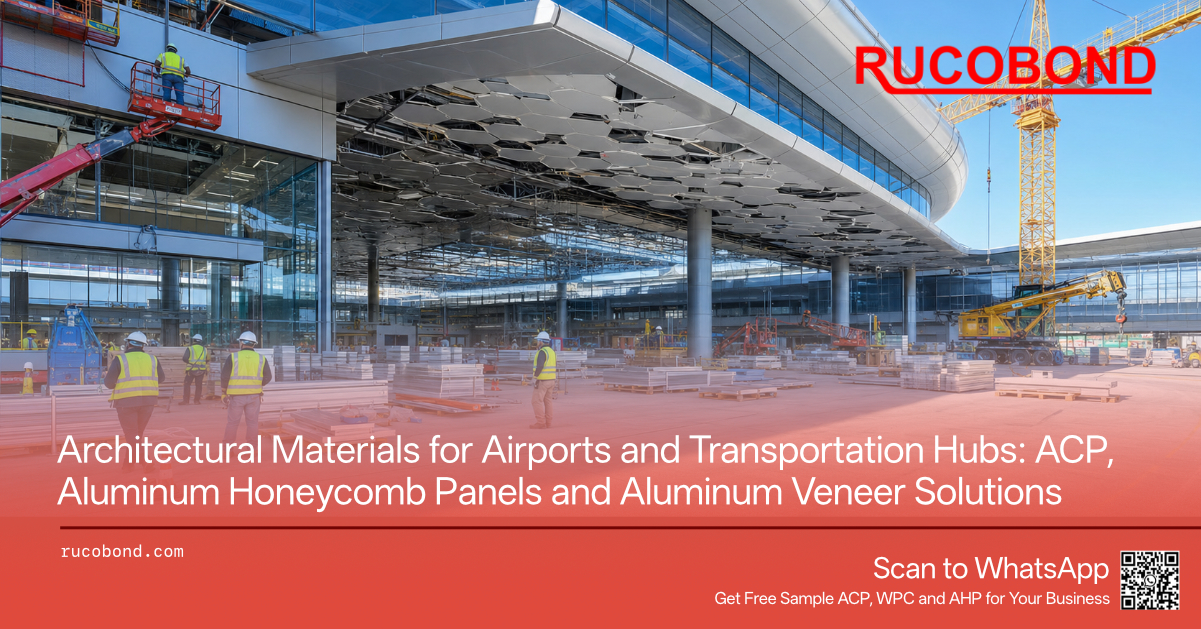
Why Transportation Projects Require More Reliable Building Materials
Airports, railway stations, metro terminals and transportation hubs are among the most demanding types of construction projects. Unlike ordinary commercial buildings, these facilities operate with continuous passenger movement, strict construction schedules and high expectations for appearance, safety and durability.
A shopping mall can close one area for renovation. A transportation terminal usually cannot. Thousands of passengers, staff members and service teams rely on these buildings every day. A delay in material delivery or an installation problem can affect not only the construction team but also the entire operation schedule.
For contractors working on transportation projects, choosing building materials is not simply about selecting attractive finishes. The material needs to handle large surface areas, frequent cleaning, environmental exposure, transportation requirements and long-term maintenance.
A modern airport terminal may include glass curtain walls, aluminum façades, large ceilings, passenger corridors, check-in halls, waiting areas and commercial spaces. Each zone has different requirements. A material suitable for an exterior wall may not be the best choice for a large indoor ceiling. A decorative entrance feature may require completely different fabrication compared with standard façade panels.
This is why professional buyers usually prefer suppliers who can provide multiple architectural material solutions instead of only one product category.
Founded in Guangzhou, China in 2013, Rucobond specializes in manufacturing and exporting architectural building materials for international construction projects. The company supplies Aluminum Composite Panels, Aluminum Honeycomb Panels, Aluminum Veneer, Aluminum Coils, WPC products and Sintered Stone Slabs for airports, railway stations, commercial buildings, public facilities and large-scale architectural projects.
Rucobond works with construction contractors, engineering companies, building material distributors and international project suppliers. The company provides customized production, OEM, ODM and bulk order support for professional buyers.
For transportation projects, the biggest value of a reliable supplier is not only product quality. It is the ability to understand project requirements, maintain consistency during large production runs and support delivery schedules when construction pressure increases.
Common Material Challenges in Airport and Station Construction
Large transportation projects usually involve complicated coordination between architects, engineers, contractors and suppliers. A small material issue can become a large project problem because the installation area is often enormous.
One common challenge is maintaining appearance consistency.
A railway station façade may require thousands of square meters of aluminum panels. During the tender stage, a small sample may look perfect. However, when materials are produced in multiple batches, differences in color, gloss or surface texture can become obvious after installation.
On a small building, this difference might be ignored. On a large terminal building, it can create visible patches across the façade.
Another challenge is delivery timing.
Transportation projects often have fixed opening dates. An airport expansion may need to begin operation before a major travel season. A railway station renovation may need to complete before a public holiday. If building materials arrive late, contractors may need to arrange additional workers, extend equipment rental periods or change installation plans.
This is why experienced project buyers evaluate suppliers based on manufacturing ability, communication and production management, not only price.
Rucobond understands that international construction projects require careful preparation before production. Customers can provide drawings, material schedules, project locations, quantity requirements and technical specifications. The factory team can then review the application and recommend suitable solutions.
For example, a transportation hub located in a coastal city may require different considerations compared with an inland terminal. Humidity, salt air, sunlight exposure and cleaning frequency can influence material selection.
The purpose of professional material planning is to reduce problems before they happen. A good construction project should be remembered because of its architecture, not because the contractor spent six months explaining why the replacement panels were delayed.
Aluminum Composite Panels for Large Transportation Building Facades
Aluminum Composite Panels are widely used in transportation architecture because they provide an effective balance between design flexibility, installation efficiency and project cost control.
Large terminals often require extensive façade coverage. Using heavy traditional materials across thousands of square meters may increase structural requirements and installation complexity. ACP provides a lightweight alternative while offering a wide range of visual finishes.
Rucobond supplies Aluminum Composite Panels with solid colors, glossy finishes, mirror surfaces, wood grain designs, brushed metallic effects and stone-inspired textures.
For airports, designers may choose metallic silver or grey finishes to create a modern technological appearance. Railway stations may combine neutral panels with stronger accent colors to improve passenger navigation. Commercial areas inside transportation buildings may use wood grain or premium finishes to create a warmer atmosphere.
The advantage of ACP is not only appearance. The panels can be processed through cutting, routing and folding, allowing contractors to adapt them to different architectural details.
This flexibility is especially useful in renovation projects. Many transportation buildings require upgrades while maintaining existing structures. ACP can help refresh the exterior appearance without completely rebuilding the façade system.
For large orders, quality consistency becomes critical. A terminal building may require several containers of panels delivered in different stages. Rucobond works with customers to confirm product specifications, including thickness, aluminum skin, coating type, color, surface finish, dimensions and quantity before production.
Professional buyers also understand that packaging is part of product quality. Panels may travel thousands of kilometers before reaching the construction site. Proper protection during loading and transportation helps reduce scratches, deformation and unnecessary losses.
For contractors and distributors, ACP remains one of the most practical materials for large commercial and transportation projects because it combines visual flexibility with efficient application.
Aluminum Honeycomb Panels for Large Interior Spaces and Ceilings
Transportation buildings often contain some of the largest public interior spaces in modern architecture.
Airport departure halls, railway waiting areas, metro stations and passenger corridors require ceilings and interior surfaces that can maintain a clean, professional appearance across huge areas.
Aluminum Honeycomb Panels are commonly considered for applications where larger panel dimensions and higher rigidity are required.
The honeycomb core structure helps create a lightweight but stable panel. This allows architects to design larger surfaces with fewer visible joints while reducing unnecessary weight.
In an airport terminal, the ceiling is one of the first things passengers notice. Lighting systems, ventilation equipment and information displays are integrated into these spaces. Uneven panels or poor surface quality can affect the overall feeling of the building.
Honeycomb Panels provide a solution for these large architectural areas.
Rucobond supports customized Aluminum Honeycomb Panel production according to project requirements. Customers can provide panel dimensions, thickness, surface finish, colors, edge processing details and installation information.
For engineering companies, this customization capability is important because transportation projects rarely follow simple standard dimensions. Each terminal, station or public facility may have unique architectural requirements.
However, experienced project teams also understand that every material should be used where it creates value. Honeycomb Panels may be selected for major ceilings, premium halls or special architectural areas, while ACP may remain the more economical choice for large exterior surfaces.
A smart material strategy combines different products according to actual application needs.
Aluminum Veneer for Entrance Canopies and Architectural Features
Transportation buildings often use architectural details to create a strong identity.
A major airport entrance, railway station canopy or metro terminal façade needs to be functional, but it also represents the image of the city or organization behind it.
Aluminum Veneer is commonly used for customized architectural features because it provides greater fabrication flexibility.
Rucobond Aluminum Veneer can be used for entrance canopies, columns, roof edges, decorative façades, ceilings and customized metal structures.
For example, an airport drop-off area may require a large curved canopy protecting passengers from rain and sunlight. The design may include special angles, integrated lighting and complex shapes. Standard panels may not achieve the desired result efficiently.
With drawing-based manufacturing, Aluminum Veneer components can be produced according to approved designs before shipment.
This reduces complicated fabrication work at the construction site and helps contractors improve installation efficiency.
For international projects, communication is especially important. Buyers should provide technical drawings, dimensions, thickness, colors, surface treatment requirements and quantities.
Rucobond also supports organized packaging and labeling for customized components, helping installation teams identify different parts more easily after delivery.
In large transportation projects, small organizational details often create large efficiency improvements.
Aluminum Coils for Local Fabrication and Supporting Structures
Many transportation projects involve local manufacturing alongside imported finished products.
Building material distributors, roofing companies and metal fabrication factories may prefer Aluminum Coils because they can process the material according to local construction requirements.
Rucobond supplies Aluminum Coils for applications such as roofing components, ceilings, trims, signage and architectural fabrication.
For example, a regional supplier may import ACP and Aluminum Veneer from Rucobond while using Aluminum Coil for locally manufactured supporting components.
This approach provides more flexibility, especially for renovation projects where actual site conditions may differ from original drawings.
Transportation facilities often contain complex details around equipment rooms, service areas, entrances and maintenance zones. Local fabrication allows contractors to adjust smaller components more efficiently.
Rucobond supports customers with different requirements regarding thickness, width, coating, color and quantity.
For professional distributors, Aluminum Coil can also expand their product portfolio by serving additional customers such as roofing manufacturers, signage companies and fabrication workshops.
Combining Different Materials for Complete Transportation Projects
Large transportation buildings rarely rely on one material only.
A modern airport may use ACP for exterior walls, Aluminum Veneer for entrance structures, Honeycomb Panels for ceilings, Aluminum Coil for local fabrication and Sintered Stone for premium interior areas.
A railway station may combine metal panels with glass, stone surfaces and decorative materials to create different passenger experiences.
The advantage of working with a supplier that provides multiple product categories is coordination.
Instead of managing separate suppliers for every small material category, project buyers can communicate with one experienced manufacturer who understands different architectural applications.
Rucobond helps customers create practical combinations according to project requirements.
The goal is not to replace every material with aluminum products. The goal is selecting the right material for the right location.
Exterior walls, entrances, ceilings, waiting areas and commercial zones each have different functions. Professional procurement means understanding these differences.
Rucobond Manufacturing Capability for Large Engineering Orders
Large projects require stable production capability.
Since 2013, Rucobond has focused on manufacturing architectural materials for global customers. The company operates from Guangzhou, China and supplies international markets including Europe, Southeast Asia, the Middle East and North America.
Rucobond supports professional buyers with product customization, bulk production, export packaging and project communication.
The company’s product range includes Aluminum Composite Panels, Aluminum Honeycomb Panels, Aluminum Veneer, Aluminum Coils, WPC products and Sintered Stone Slabs.
Products are supported by SGS, CE and ISO-related certifications according to product category and project requirements.
For contractors and distributors, reliable supply means more than having products available. It means receiving consistent materials according to the agreed specification and schedule.
OEM and ODM Support for Global Construction Material Buyers
Many international building material companies want to create their own product collections.
Rucobond supports OEM and ODM cooperation for distributors, importers and professional construction suppliers.
Customization options include protective film printing, private-label packaging, colors, finishes, dimensions and project-specific requirements.
For example, a regional distributor supplying airports and commercial buildings may develop its own aluminum panel collection with selected colors and specifications.
A contractor working on multiple transportation projects may require standardized materials for different locations.
OEM cooperation helps professional buyers build long-term business value while relying on experienced manufacturing support.
Building Long-Term Supply Partnerships with Rucobond
Transportation projects require suppliers who understand both construction requirements and international procurement challenges.
Rucobond welcomes cooperation with airport contractors, railway project suppliers, façade engineering companies, building material distributors and commercial construction businesses.
Customers can provide project details including:
Building type
Application area
Material requirements
Dimensions
Quantity
Surface finish
Technical drawings
Delivery schedule
Rucobond supports customized production, OEM, ODM and large-volume export orders.
With manufacturing experience since 2013, professional production capability and international project experience, Rucobond helps global construction companies source reliable architectural materials for demanding projects.
Frequently Asked Questions
Q: What materials does Rucobond supply for airport and transportation projects?
A: Rucobond supplies Aluminum Composite Panels, Aluminum Honeycomb Panels, Aluminum Veneer, Aluminum Coils, WPC products and Sintered Stone Slabs for airports, railway stations, metro projects and public buildings.
Q: Can Rucobond provide customized aluminum panels based on drawings?
A: Yes. Rucobond supports customized Aluminum Veneer and Honeycomb Panel production based on technical drawings, dimensions, finishes and project requirements.
Q: Are ACP panels suitable for large transportation buildings?
A: ACP is widely used for large façades because it provides design flexibility, lightweight construction and various surface options suitable for commercial and public projects.
Q: Does Rucobond support bulk engineering orders?
A: Yes. Rucobond welcomes bulk orders from contractors, distributors, importers and engineering companies requiring customized and repeated supply.
Q: How can buyers start a transportation project inquiry?
A: Buyers can send project information including application, quantity, drawings, destination country and delivery schedule. Rucobond will review the requirements and provide a suitable material solution.
Name: Gina Chen
Mobile:+86-189-2412-4951
Tel:+86-189-2412-4951
Whatsapp:8618924124951
Email:gina@rucobond.com
Add:Room 708, No. 8 Jingang Avenue, Nansha Street, Nansha District, Guangzhou


