
Table of Contents
Why Public Building Material Procurement Carries Higher Project Risk
A delayed material shipment is inconvenient in almost any construction project. In a public building project, it can become far more serious. An unfinished airport terminal affects passenger routes. A delayed railway station renovation can interfere with daily transport operations. A hospital extension that cannot open on schedule may leave departments working in temporary spaces longer than expected. Schools, municipal buildings and emergency facilities often face similar pressure.
These projects are not ordinary decoration jobs. They usually involve more stakeholders, stricter approval procedures and larger quantities. Architects, general contractors, façade engineers, government departments, project consultants and local distributors may all participate in the same purchasing decision. A product must satisfy design expectations, installation needs, documentation requirements, budget limits and the actual construction schedule. Humans apparently decided that buying wall panels required a committee, but for projects of this scale, the caution is understandable.
Material failure can appear in many forms. The color may vary between production batches. Panels may arrive with dents or scratches. Protective film may leave marks after removal. Customized pieces may not match drawings. A supplier may promise an unrealistic lead time simply to win the order and begin inventing excuses once production starts. Even small mistakes can become expensive when a project requires several thousand square meters.
Rucobond was founded in Guangzhou, China in 2013 and has more than a decade of experience supplying architectural materials to overseas buyers. The product range includes Aluminum Composite Panels, Aluminum Honeycomb Panels, Aluminum Veneer, Aluminum Coils, WPC products and Sintered Stone Slabs. These materials can support transportation buildings, hospitals, schools, government offices, public service centers, exhibition halls and other commercial or civic developments.
The company mainly serves professional buyers, including engineering contractors, façade companies, building material importers, regional distributors, decoration companies and project procurement teams. The focus is not on scattered retail orders. Rucobond is better suited to customized production, full-container quantities, staged deliveries and repeat supply for buyers who need dependable manufacturing behind their local business.
For public projects, a reliable supplier must do more than provide an attractive sample. The supplier should understand drawings, confirm specifications clearly, communicate production progress, arrange suitable packaging and support export documentation. These capabilities are less glamorous than a polished product brochure, but they are the things that prevent a construction site from becoming an expensive waiting room.
Selecting Cladding Materials for Airports, Railway Stations and Civic Buildings
Public buildings are expected to work hard. An airport terminal may operate almost continuously. A railway station handles large passenger volumes, luggage, cleaning equipment and constant maintenance. Hospitals require surfaces that can support hygiene and long-term use. Schools and government buildings need materials that balance budget, appearance and durability.
Because these buildings have different functional zones, one material is rarely suitable for every area. A broad exterior wall may use Aluminum Composite Panels. A large ceiling or entrance feature may require Aluminum Honeycomb Panels. Curved columns, canopies and custom façade shapes may be better suited to Aluminum Veneer. Interior counters and wall surfaces may use Sintered Stone, while outdoor walkways or landscape areas may include WPC.
The correct choice depends on more than appearance. Buyers should consider panel size, structural requirements, weather exposure, installation method, maintenance expectations, project budget and local standards. A material that works well inside a municipal office may not be suitable for an exposed airport canopy. Likewise, a premium honeycomb solution may be unnecessary for a small interior partition where standard ACP can complete the job efficiently.
Climate also changes the procurement decision. Public buildings in the Philippines and Thailand face strong sunlight, humidity and seasonal heavy rain. Projects in Saudi Arabia may experience intense heat, dust and large temperature differences. Buyers in Europe or North America may place greater attention on certification documents, coating performance and fire-related requirements.
Rucobond works with international buyers to discuss product selection according to the real application. For Aluminum Composite Panels, the conversation may include panel thickness, aluminum skin, coating type, color and surface finish. For Aluminum Veneer and Honeycomb Panels, drawings and panel dimensions become more important. For WPC and Sintered Stone, use environment, size and installation position help determine the right option.
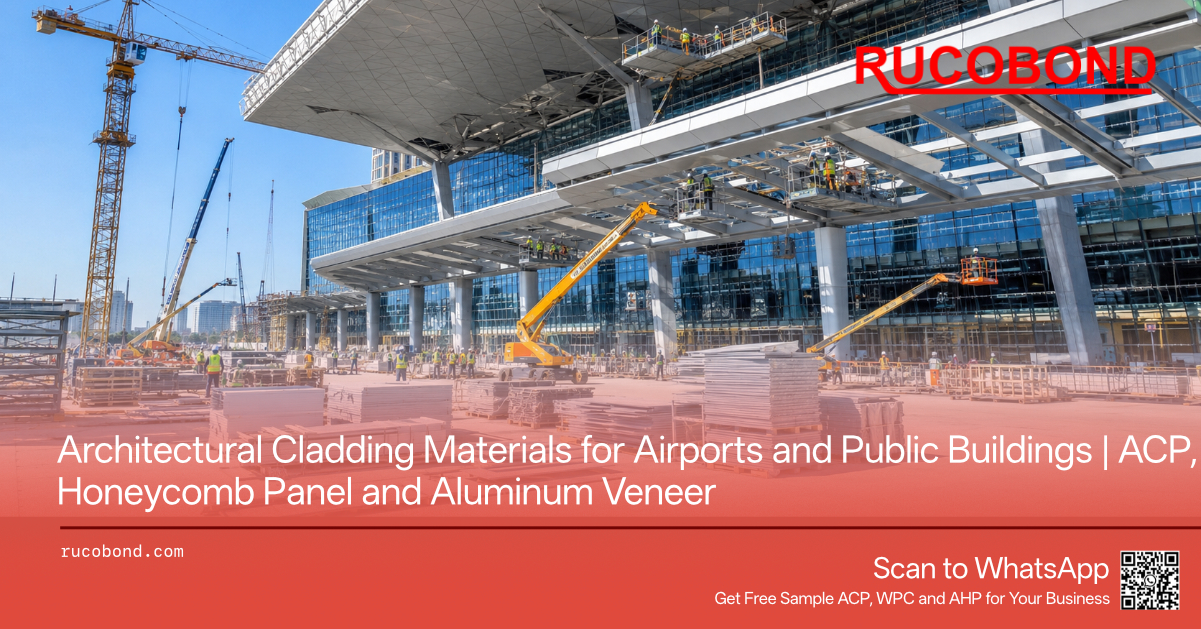
A practical material plan often combines different products instead of forcing one category across the entire building. An airport project might use ACP for broad wall areas, Aluminum Veneer around entrances and columns, Honeycomb Panels for large ceiling zones, and Sintered Stone in premium passenger lounges. This approach can control costs while placing higher-performance materials where their advantages are genuinely useful.
Public buildings need to look coherent, but coherence does not mean every surface must be made from the same thing. A thoughtful combination of materials usually produces a better result than using one product everywhere because the purchasing department was tired.
Aluminum Composite Panels for Large Public Façades and Interior Areas
Aluminum Composite Panels are widely used in public and commercial buildings because they offer a practical combination of low weight, fabrication flexibility and decorative variety. They can cover large wall areas efficiently and are available in many surface styles, including solid colors, metallic finishes, mirror effects, wood patterns, brushed surfaces and stone-inspired designs.
For airport and railway station projects, ACP can be used on exterior walls, interior corridors, ticketing areas, retail zones, columns, signs and service spaces. In hospitals, schools and municipal buildings, it can support entrance renovation, wall cladding, ceiling decoration and general interior upgrading.
One of the strongest advantages of ACP is processing flexibility. The panels can be cut, routed and folded according to project requirements, allowing contractors to create clean joints, cassette systems and decorative forms. This makes the material useful for renovation work where the original building surface may be uneven or visually outdated.
Imagine a regional railway station built twenty years ago. The concrete entrance has faded, signage is inconsistent and exposed pipes make the building look neglected. A renovation contractor can use ACP to create a cleaner façade, integrate new signs and cover old surfaces without introducing the structural weight of natural stone. The project gains a modern appearance while remaining manageable within a public construction budget.
Rucobond supplies ACP in different specifications and surface styles for exterior and interior applications. Buyers can discuss panel thickness, aluminum skin, coating, color, gloss level, dimensions, protective film and packaging. OEM and ODM options are also available for distributors who require private-label products for their regional markets.
For large public projects, batch consistency deserves special attention. A small color difference may be difficult to notice on a single sample, but it becomes obvious when hundreds of panels are installed across a long terminal wall. Rucobond confirms color and production requirements before bulk manufacturing and applies inspection procedures according to the order.
Packaging is also important. Panels may travel from the factory to the port, spend weeks inside a container and then move through another warehouse before reaching the construction site. Proper pallet support, surface protection and container loading help reduce scratching, bending and moisture exposure.
ACP does not need to be described as a miraculous material. It is useful because it performs several ordinary but important jobs very well. It helps contractors cover large areas, manage design requirements, control installation time and achieve a more modern appearance without making the entire building unnecessarily heavy.
Aluminum Honeycomb Panels for Wide Spans and High-Traffic Spaces
Large public buildings often contain wide ceiling areas, long wall surfaces and oversized architectural elements. These applications require panels that can remain stable across larger dimensions. Aluminum Honeycomb Panels provide a useful solution because their internal honeycomb structure combines rigidity with relatively low weight.
This construction gives the panel better resistance to deformation than many basic sheet materials. It is therefore suitable for airport ceilings, railway station halls, exhibition centers, elevator interiors, curtain wall systems, public corridors and high-end civic spaces.
An airport ceiling is a good example. The panels may sit several meters above the floor and extend across a very large area. Uneven surfaces, visible bending or inconsistent joints would be noticeable from the passenger hall below. At the same time, the supporting structure should not carry unnecessary weight. Aluminum Honeycomb Panels help address both concerns.
In transportation buildings, lighter panels can also improve handling and installation. Workers operating on elevated platforms or suspended systems can position panels more efficiently when the material provides strength without excessive mass. This does not remove the need for proper engineering, obviously. Buildings remain stubbornly unwilling to support themselves through marketing language alone.
Rucobond supplies Aluminum Honeycomb Panels for architectural and commercial applications. Customization can include panel thickness, aluminum surface, core structure, dimensions, color, finish, edge details and processing requirements. For customized projects, technical drawings are strongly recommended.
These panels can also be used in hospitals, government reception halls, conference centers and corporate public areas. Their flat appearance and structural stability make them suitable for clean, large-format architectural surfaces.
For project buyers, the main benefit is not simply that honeycomb panels are stronger. The more useful point is that they can help create larger and more stable architectural elements without introducing the weight associated with many solid materials. This may support cleaner visual design and more efficient installation.
Cost should still be considered carefully. Honeycomb panels are usually more expensive than standard ACP, so using them everywhere may not be necessary. A practical project may reserve honeycomb panels for large ceilings, premium entrances or other areas where their structural advantages justify the additional cost.
Rucobond can support mixed-material procurement, allowing buyers to use ACP on broad economical surfaces, Aluminum Veneer for complex shapes and Honeycomb Panels in the most demanding areas. This kind of combination usually makes more commercial sense than selecting products according to whichever brochure has the shiniest cover.
Aluminum Veneer for Canopies, Columns and Complex Architectural Details
Public buildings often depend on architectural details to create identity. The main entrance of a government building, the curved canopy of an airport, the folded metal roof around a railway station or the column covers inside a hospital atrium can all shape how the building is perceived.
These areas are rarely simple rectangles. They may require curved panels, folded edges, perforations, irregular dimensions or custom fixing details. Aluminum Veneer is well suited to these applications because it can be fabricated according to project drawings.
Rucobond Aluminum Veneer can be used for entrance canopies, exterior façades, column covers, ceilings, roof edges, balconies, wall features and other custom architectural elements. The material can work alongside glass curtain walls, concrete, stone and other metal products.
For contractors, factory fabrication can reduce the amount of complicated cutting and forming required on site. When drawings are confirmed properly, panels can be manufactured with specific dimensions, folds and edge details before shipment. This improves installation efficiency and can help create a cleaner finished result.
Consider the entrance of a new municipal service center. The architect may design a deep canopy with folded metal surfaces and integrated lighting. Standard flat panels may not provide enough flexibility for the shape. Custom Aluminum Veneer pieces can be processed to follow the design, creating sharper lines around the entrance.
The same principle applies to railway station columns, airport drop-off areas and hospital entrances. These locations are highly visible and often receive heavy daily use. A badly processed edge or uneven joint will remain visible to thousands of people, which is a rather public way to discover that procurement details matter.
Rucobond discusses Aluminum Veneer projects according to drawings, dimensions, quantity, coating, color, surface treatment and packaging needs. Buyers should provide clear technical information whenever possible. A low-resolution reference photo with “make same” written underneath is not a manufacturing specification, although the construction industry continues testing this theory with remarkable optimism.
For large public projects, individual panels may have different identification codes. Organized packaging and labeling can help installation teams find the correct pieces more efficiently. This is especially important when a project includes many custom shapes.
Aluminum Veneer gives architects freedom, but that freedom depends on accurate communication between designer, contractor and factory. When the information is clear, the material can support some of the most visible and memorable parts of a public building.
Aluminum Coils for Local Fabrication and Supporting Building Systems
Not every buyer needs finished architectural panels. Some distributors, roofing manufacturers, signage companies and local fabrication workshops prefer to purchase Aluminum Coils and process the material within their own facilities.
Aluminum Coil can support roofing systems, ceiling products, gutters, decorative trims, signage, cladding components and general metal fabrication. Buyers with local production equipment may use coils to manufacture products according to regional demand.
For example, a building material distributor in Southeast Asia may supply both finished ACP and coated Aluminum Coil. The ACP can serve façade contractors, while the coil is sold to local roofing and ceiling manufacturers. This allows the distributor to serve more customer types through one supplier relationship.
Rucobond can discuss Aluminum Coil orders according to thickness, width, coating, color, surface requirement, quantity and downstream application. Packaging must also be planned carefully because coils carry concentrated weight and require stable protection during international transportation.
For public building projects, Aluminum Coil may be used indirectly through local fabrication. A contractor may purchase finished Aluminum Veneer for the main façade while using locally processed coil for trims, roofing details or secondary building elements. This can give the buyer greater flexibility when local workshops are already part of the supply chain.
The main value is adaptability. Some overseas buyers want ready-to-install products. Others prefer to complete fabrication near the project site, where dimensions can be adjusted more quickly. Rucobond supports both approaches across its material range.
Coil quality also affects the finished product. Uneven coating, inconsistent color or poor surface condition can create problems during local processing. Buyers should confirm the intended application before ordering rather than choosing only by the lowest price per ton.
A local factory producing ceiling panels for hospitals may need different material from a signage workshop making outdoor advertising boards. One buyer cares about long production runs and color stability. The other may prioritize flexibility and common commercial colors. Understanding the final use allows the supplier to make a more practical recommendation.
For distributors and regional manufacturers, Aluminum Coil can become part of a broader product strategy. Combined with ACP, Honeycomb Panels and Aluminum Veneer, it helps create a more complete architectural material offering for local contractors and fabrication businesses.
WPC and Sintered Stone for Public Outdoor and Interior Areas
Public buildings include more than metal façades. Passengers wait in lounges, patients sit in reception areas, students walk through courtyards and government visitors pass through service halls. These spaces require materials that support everyday use while maintaining a clean and professional appearance.
WPC products can be used in outdoor walkways, public terraces, landscaped areas, balconies, garden paths and leisure spaces. They provide a wood-like visual effect with improved resistance to moisture and insects compared with many untreated timber products.
This can be useful in humid regions and public areas where maintenance budgets are limited. A hospital garden, school courtyard or railway station terrace may need an outdoor surface that looks warmer than concrete but does not require constant painting or replacement.
Rucobond supplies WPC decking and wall products for commercial and public projects. Buyers can discuss profile, color, dimensions, quantity and application. Packaging and loading plans depend on product format and shipment volume.
Sintered Stone Slabs are more suitable for interior and high-contact areas. They can be used for reception desks, public counters, wall surfaces, bathrooms, kitchens, waiting areas and premium interior features.
In an airport lounge, Sintered Stone can create a refined wall or counter surface. In a hospital, it may be used in reception areas or washroom applications. In government offices, it can support durable decorative surfaces that need to remain presentable under daily use.
The material provides stone-like patterns with more controlled appearance than many natural stone products. It is also valued for resistance to heat, scratches, stains and routine wear, depending on the specific product and application.
For public projects, cleaning and maintenance matter. A beautiful material that becomes difficult to maintain after six months may not be a very beautiful procurement decision. Buyers should consider how the surface will be used, how often it will be cleaned and what types of contact it will receive.
Rucobond’s wider product range allows buyers to discuss exterior metal cladding, outdoor WPC and interior Sintered Stone within one procurement relationship. A railway station project, for example, might combine ACP on exterior walls, Aluminum Veneer at the entrance, Honeycomb Panels in the main hall, WPC in an outdoor waiting area and Sintered Stone around ticket counters.
This does not mean every project needs every material. It means professional buyers can choose suitable products for different zones without rebuilding the supplier list from the beginning each time.
Quality Control, Certification and Packaging for International Projects
Public project procurement usually involves more documentation than ordinary commercial renovation. Contractors may need technical data, certification records, product samples, color approval and production confirmation before materials are accepted.
Rucobond products are supported by SGS, CE and ISO related certifications and quality systems, according to product category and project requirements. These documents can help buyers communicate with architects, project consultants, local distributors and government procurement teams.
Certification is important, but it is not a substitute for order control. A certificate cannot correct a wrong color, replace a damaged pallet or explain why an urgent shipment is still sitting unfinished at the factory. Real project quality depends on daily manufacturing discipline.
Before production, specifications should be confirmed clearly. This may include product type, dimensions, thickness, color, coating, surface finish, quantity, packaging and identification requirements. For Aluminum Veneer and Honeycomb Panels, drawings and processing details are particularly important.
During manufacturing, inspection procedures are applied according to the product. These may include surface checking, dimensional review, color comparison, panel flatness and packaging confirmation.
For multi-batch projects, approved samples or color references should remain consistent throughout the supply period. A railway station expansion or airport renovation may require several shipments over months. If the color changes noticeably between batches, the finished surface may reveal exactly where one shipment ended and another began. Buildings are surprisingly unforgiving witnesses.
Export packaging must reflect the length and difficulty of transportation. Panels can be damaged by poor stacking, weak corners, moisture or careless unloading. Custom Aluminum Veneer pieces may require individual protection or clearer labeling. Heavy Sintered Stone Slabs need stable support. Aluminum Coils require strong packaging designed for concentrated weight.
Rucobond discusses packaging according to product category, order size and destination. The objective is to help the material arrive ready for inspection and installation rather than looking as though it survived an argument with the entire logistics industry.
International project supply also requires clear communication. Buyers need realistic lead times, production updates and shipment information. Rucobond’s export team supports professional customers through sample confirmation, order coordination, documentation and delivery planning.
OEM, ODM and Staged Supply for Contractors and Material Distributors
Public projects often create long-term opportunities for local building material companies. A distributor that supplies one railway station renovation may later receive inquiries for schools, hospitals, offices or other transportation buildings. To serve these customers consistently, the distributor needs a stable manufacturing partner.
Rucobond welcomes OEM and ODM cooperation for regional distributors, importers, contractors and building material brands. Customization can include private-label protective films, branded packaging, product labels, selected color ranges, panel dimensions and other project or market requirements.
A distributor in Thailand may want wood grain ACP and WPC products for hospitality and public landscape projects. A supplier in the Philippines may focus on common solid colors for schools and retail buildings. A company in Saudi Arabia may require metallic, brushed or mirror finishes for transportation and government projects.
OEM manufacturing allows these buyers to develop their own market identity while relying on Rucobond’s production capability. The buyer controls the regional sales relationship, while the factory supports product supply behind the scenes.
For contractors, customization is usually more project-specific. They may need special dimensions, custom colors, protective film identification, drawing-based Aluminum Veneer or phased production according to the construction schedule.
Staged supply can be especially important for large public projects. A contractor may not want every material delivered at once. Exterior panels may be needed first, ceiling products later and interior materials near the final construction stage. Limited site storage can also make one-time delivery impractical.
Rucobond can discuss production and shipment plans according to actual order conditions. The feasibility depends on product type, quantity, schedule and manufacturing arrangement, but early planning gives both sides more room to coordinate.
For reconstruction work after floods, earthquakes or other disasters, timing may become even more critical. Schools, clinics and public facilities may need to reopen quickly. Rucobond welcomes inquiries from reconstruction contractors, public procurement teams and engineering organizations and can discuss project support based on production availability.
The most suitable customers are businesses with real project or distribution needs. Rucobond focuses on bulk orders, container shipments, customized production and repeat cooperation. It is not designed as a retail shop for one or two decorative sheets, because international freight has not yet developed a sense of humor.
Starting a Public Building Material Inquiry with Clear Project Information
A useful quotation begins with useful information. This is particularly true for airports, railway stations, hospitals, schools and government buildings, where product specifications can vary widely.
For Aluminum Composite Panels, buyers should provide total panel thickness, aluminum skin requirement, coating type, color, surface finish, size, quantity and intended application.
For Aluminum Honeycomb Panels, useful details include dimensions, total thickness, surface material, finish, edge requirements and installation position.
For Aluminum Veneer, drawings are highly recommended. The factory needs to understand dimensions, folds, curves, perforations, edges, quantities and surface treatment. A BOQ or panel schedule can make the discussion more efficient.
For Aluminum Coils, buyers should provide thickness, width, coating, color, coil weight or order quantity, and the type of product to be manufactured locally.
For WPC and Sintered Stone, dimensions, color, pattern, application and quantity help the supplier prepare a more relevant recommendation.
Project buyers should also provide the destination country or port, expected delivery schedule and any known certification requirements. For phased projects, explain which materials are needed first and which can be supplied later.
Rucobond welcomes inquiries from general contractors, façade engineering companies, transportation project suppliers, hospital and school contractors, government procurement companies, building material importers, regional distributors and decoration businesses.
Samples can support color approval and material evaluation. Drawings help with customized production. A BOQ allows the factory to understand the complete quantity and product mix. Even photographs of the existing building can provide useful context for renovation work.
The purpose of the first discussion is not to send a generic price list as quickly as possible. It is to understand the project well enough to provide a quotation that can actually be used.
Professional buyers can send product requirements, drawings, quantities, destination information and expected schedule to Rucobond. The team can then review the application and discuss suitable ACP, Aluminum Honeycomb Panels, Aluminum Veneer, Aluminum Coils, WPC or Sintered Stone solutions.
Frequently Asked Questions
Q: What materials can Rucobond supply for airports and railway stations?
A: Rucobond supplies Aluminum Composite Panels, Aluminum Honeycomb Panels, Aluminum Veneer, Aluminum Coils, WPC products and Sintered Stone Slabs. These materials can be used for façades, ceilings, entrances, columns, corridors, outdoor areas, ticketing zones and public interior spaces.
Q: Which material is suitable for large ceiling panels in public buildings?
A: Aluminum Honeycomb Panels are often considered for large ceiling areas because their internal structure provides good rigidity while maintaining relatively low weight. The correct specification depends on panel dimensions, support system, installation position and engineering requirements.
Q: Can Rucobond manufacture customized Aluminum Veneer from project drawings?
A: Yes. Rucobond supports customized Aluminum Veneer for professional project orders. Buyers should provide drawings, dimensions, quantities, surface finish, color and processing requirements so the factory can review production feasibility and prepare a quotation.
Q: Does Rucobond support private-label products for regional distributors?
A: Yes. OEM and ODM options may include branded protective films, customized packaging, product labels, colors, dimensions and market-specific product selections. The service is suitable for importers, distributors and building material companies planning repeat orders.
Q: Can materials be supplied in stages for a large public project?
A: Staged production and shipment can be discussed according to the product type, total quantity, construction schedule and factory arrangement. Buyers should provide the project timeline early so a more practical supply plan can be evaluated.
Name: Gina Chen
Mobile:+86-189-2412-4951
Tel:+86-189-2412-4951
Whatsapp:8618924124951
Email:gina@rucobond.com
Add:Room 708, No. 8 Jingang Avenue, Nansha Street, Nansha District, Guangzhou


