
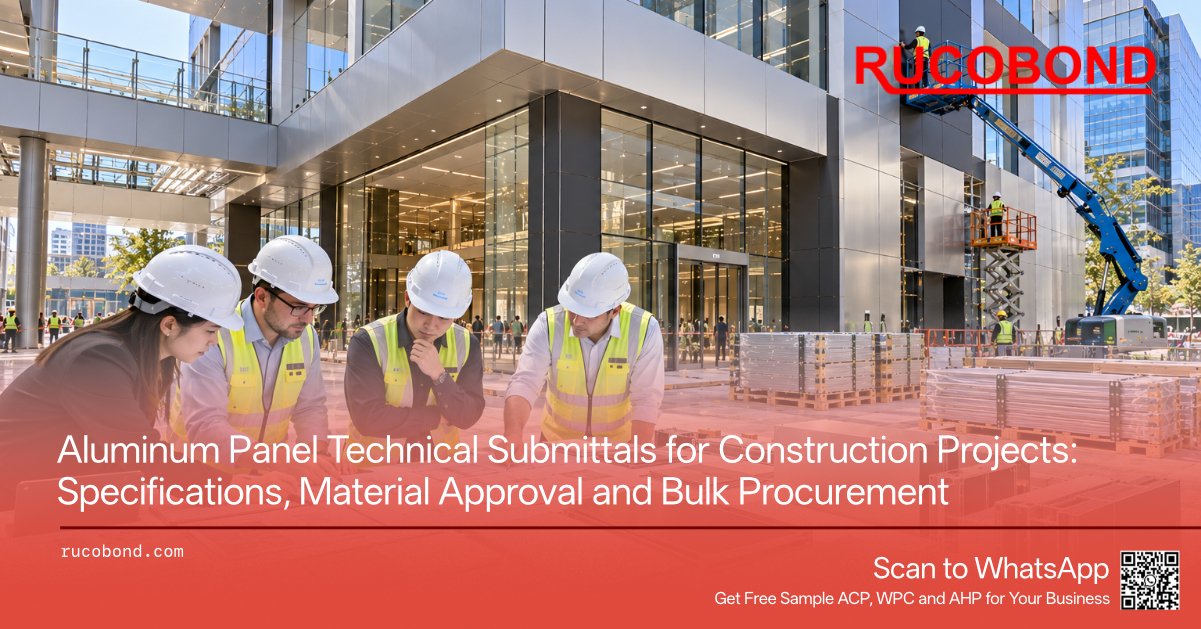
For commercial construction contractors, purchasing aluminum panels is not always as simple as selecting a product, comparing prices and issuing a purchase order. Large developments frequently involve a formal material approval process before the selected products can be installed. Architects, engineering consultants, project owners and main contractors may all need to review technical information to confirm that the proposed materials meet the requirements established during design.
This process can create difficulties for companies importing Aluminum Composite Panels, Aluminum Veneer and Aluminum Honeycomb Panels. A contractor may receive an attractive quotation from an overseas manufacturer, only to discover that the project consultant requires additional technical data, material samples or product-specific test reports before approving the purchase. If these requirements were not identified during the initial inquiry, the resulting delay can affect manufacturing schedules and project delivery.
Consider a contractor responsible for the aluminum cladding package of a new commercial complex. The tender documents specify panel construction, coating performance, surface finish, applicable fire classification and other project conditions. Several suppliers submit quotations, but their products do not necessarily follow identical specifications. The lowest-priced offer may use a different aluminum skin thickness or coating system, creating a technical discrepancy that cannot be resolved through commercial negotiation alone.
Founded in Guangzhou, China in 2013, Rucobond manufactures and exports Aluminum Composite Panels, Aluminum Veneer, Aluminum Honeycomb Panels, Aluminum Coils and other architectural materials. Rucobond works with construction contractors, architectural metalwork companies, building material distributors, importers and project procurement teams requiring customized manufacturing and bulk supply.
For professional buyers, the most effective procurement strategy begins with understanding the project's approval requirements. Technical specifications, supporting documentation and product samples should be evaluated before the final manufacturing commitment. This reduces the risk of purchasing materials that are commercially attractive but unsuitable for the approved construction design.
A technical submittal is a collection of information submitted for review before a material or product is incorporated into a construction project. Its purpose is to demonstrate that the proposed product corresponds with the relevant contract documents, design intent and technical requirements. The exact approval procedure varies by project, but it commonly involves product data, specifications, drawings, samples and supporting evidence.
For aluminum panel projects, a material submittal may identify the manufacturer, product type, panel thickness, aluminum skin or face-sheet requirements, core composition, coating system, finish and proposed application. Where the project requires particular test results or certifications, the relevant documentation may also need to be provided. The approval authority and required format are normally defined by the project's contract administration process.
This makes the submittal package more than a product catalog. Marketing brochures can introduce available finishes and product categories, but they may not establish whether a particular panel satisfies a specific technical requirement. A general statement describing a product as suitable for commercial buildings does not replace confirmation of the exact specification proposed for the project.
For example, a building contractor may submit a four-millimeter ACP product for exterior wall areas. The consultant may require information about both aluminum skins, core type, coating and product classification. If the supplier provides only a photograph and a thickness description, the reviewer may be unable to complete the evaluation.
Rucobond can discuss project specifications, product information and relevant available documentation according to the requested material. Buyers should share the applicable technical requirements as early as possible so the proposed product can be evaluated against the intended use.
A useful technical submittal should make the reviewer's work easier by connecting each important product characteristic with the relevant project requirement. Clear documentation can reduce repeated clarification and help keep the purchasing process moving toward approval.
Aluminum Composite Panels are frequently described using abbreviated specifications, but tender documents may require a much more detailed description. The total thickness is only one part of the product construction. Aluminum skin thickness, core composition, coating system, surface finish and sheet dimensions can all affect whether the proposed product meets the intended requirement.
Two suppliers may quote panels with the same nominal overall thickness while offering different internal constructions. One quotation may correspond with the tender specification, while another may represent a lower-cost product intended for a different application. Without a structured comparison, the purchasing team may incorrectly treat these offers as equivalent.
A practical approach is to review the project specification line by line before requesting final prices. The contractor should identify the required panel type, aluminum skin, core specification, coating, dimensions, finish and any performance criteria stated in the contract documents. Supplier information can then be compared against these requirements without relying on product names alone.
For example, an office development may require metallic ACP for its exterior cladding, with a specified coating system and aluminum skin construction. A supplier offering a visually similar metallic panel with a different coating should identify that difference rather than presenting the product as an exact match. The alternative may still be worth considering, but it requires a separate technical decision.
Rucobond supplies various ACP specifications and finishes, including matte solid colors, high-gloss surfaces, metallic finishes, brushed textures, mirror styles, wood grain patterns and stone-inspired designs. Buyers should provide the intended application and complete tender requirements when requesting project quotations.
For building material distributors participating in construction tenders, maintaining clear product records is equally important. Each commercial offer should correspond with a documented product specification, allowing the distributor to respond accurately when consultants request clarification.
The objective is not to make every quotation more complicated. It is to ensure that all suppliers are pricing products that can be evaluated against the same project requirements.
Fire-performance requirements are among the most important aspects of aluminum panel technical approval. Different buildings and applications may be subject to different rules depending on occupancy, height, location and the complete construction system. Buyers should therefore identify the applicable requirements directly from the project documents and relevant regulations.
An ACP product cannot be considered compliant simply because it is described as fire-resistant or fire-retardant. The core composition, tested product construction, classification and applicable assessment criteria all matter. Documentation should correspond with the actual product being supplied, and project teams may also need evidence relating to the complete installed assembly rather than the panel alone.
The same principle applies to coating performance. Exterior architectural applications may specify weathering resistance, color retention, coating adhesion or other characteristics. A product described as PVDF-coated may still require clarification of the exact coating specification and supporting information. The abbreviation alone does not establish compliance with every performance requirement.
Buyers should also distinguish between manufacturer management-system certifications and product-specific test results. An ISO-related quality-management certificate, for example, does not independently prove that a particular ACP construction satisfies a project fire classification. Likewise, the presence of an SGS report or CE-related document should be evaluated according to its scope, identified product and intended market.
Rucobond can discuss available SGS, CE and ISO-related documentation according to the specific material and certification scope. Professional buyers should provide the required standards, test classifications and destination-market conditions during the initial technical inquiry. Documentation can then be reviewed for relevance rather than assuming that one certificate covers every product category.
Where evidence is incomplete or outside the applicable scope, the project team should resolve the gap before approving the material. Additional testing, a different specification or an alternative product may need to be considered depending on the contract requirements.
This verification protects both the contractor and the building owner. Materials that cannot demonstrate required compliance should not be purchased simply because construction has reached an inconvenient deadline.
Technical approval becomes more complicated when the project includes customized Aluminum Veneer or Aluminum Honeycomb Panels. Unlike standard flat sheets, these products may be manufactured according to individual drawings, requiring the review process to address both material characteristics and component geometry.
Aluminum Veneer is commonly considered for architectural entrances, columns, canopies, curved walls, perforated screens and other customized details. A technical submittal may therefore need to describe aluminum thickness, alloy or temper where specified, surface coating, fabrication requirements, folds, perforation patterns and relevant reinforcement details.
For example, a commercial headquarters may use curved Aluminum Veneer around its entrance columns. The selected coating may satisfy the appearance requirement, but the consultant must also understand the proposed component geometry and its relationship with the installation system. A general Aluminum Veneer product sheet cannot replace the approved drawings required for the actual fabricated components.
Aluminum Honeycomb Panels introduce different considerations. Their construction typically includes face sheets, a cellular core and edge details, with the final properties depending on the specific product design. Large ceiling or wall panels may require information about total thickness, face-sheet construction, dimensions, edge configuration and intended support arrangements.
Rucobond supports customized Aluminum Veneer and Honeycomb Panel manufacturing according to approved technical drawings and product specifications. Buyers should distinguish information relating to the base material from information relating to the completed fabricated component.
For projects involving several aluminum product types, separate technical submissions may be required. A common finish or supplier name does not automatically mean that all products share the same test results, structural characteristics or installation details.
Clear separation helps reviewers understand what each material is intended to do. ACP may be proposed for repetitive flat cladding areas, Aluminum Veneer for complex architectural details and Honeycomb Panels for selected large-format surfaces. Each should be evaluated against its own application and relevant requirements.
Physical samples often play an important role in aluminum material approval because technical documentation cannot fully describe visual appearance. Color, gloss, metallic reflection, brushing direction and decorative texture may need to be evaluated under conditions reasonably representative of the finished building.
For commercial developments, sample review can involve the architect, main contractor, developer or other designated approval parties. The process may begin with a small finish sample and progress to a larger representative panel or installed mock-up when appearance and detailing are especially important.
A shopping mall using silver metallic ACP provides a useful example. The design team may approve a color based on an architectural rendering, but the final finish must coordinate with glass, painted steel and other visible materials. A physical sample may reveal a different metallic tone or gloss level from what was expected on screen.
Brushed and patterned finishes require additional attention because their appearance may depend on orientation. If one installed panel is rotated relative to the others, its reflected light or visible grain can appear inconsistent. Approved samples and fabrication drawings should therefore identify directional requirements where relevant.
Rucobond can discuss sample provision according to product requirements and order conditions. For large or highly visible projects, buyers should establish whether the approved sample will also serve as the manufacturing reference for bulk production.
The approval record should identify the actual product construction alongside its appearance. A finish sample for one ACP specification should not automatically be treated as approval of a different core, aluminum skin or coating system.
Once the relevant parties approve a sample, the contractor should retain a clearly labeled reference and the associated technical documents. These records can support production, inspection and future repeat orders.
The strongest approval process connects the appearance the architect selected with the exact material the procurement team intends to buy.
Material approval and shop drawing approval are related, but they are not the same process. A product may satisfy the project specification while its proposed dimensions, fabrication details or installation arrangement still require further engineering review.
Shop drawings translate architectural and technical requirements into information used for fabrication and installation. For aluminum panels, they may show finished dimensions, joint arrangements, folded edges, fixing interfaces, panel identification and coordination with surrounding construction elements.
Consider a commercial building entrance containing customized Aluminum Veneer frames around a glass wall. The manufacturer may receive the correct thickness and coating specification, but those details alone are insufficient for production. The fabricator also needs the approved geometry, connection interfaces and other relevant dimensions.
On projects using Aluminum Honeycomb ceiling panels, coordination may involve lighting fixtures, HVAC outlets, sprinkler components and maintenance access. The panel drawings should reflect the final service layout so openings and edge details can be manufactured correctly.
Rucobond supports drawing-based customization for Aluminum Veneer and selected Honeycomb Panel applications. Buyers should provide the approved fabrication information and identify which dimensions remain subject to site verification.
The responsible design and engineering professionals must confirm structural supports, fixing systems, movement allowances and other applicable performance requirements. Approval of a supplier's product data does not automatically establish that the proposed installation arrangement is suitable.
For international procurement, this distinction is particularly important. Manufacturing based on preliminary drawings can create expensive complications when final dimensions change after the panels have been shipped.
Contractors should therefore establish clear approval milestones. Product specifications, finish references and fabrication drawings need to be sufficiently coordinated before bulk manufacturing begins. This allows the factory to produce components according to information that has already passed the relevant project reviews.
Construction projects sometimes require material substitutions. The specified product may be unavailable within the required schedule, a contractor may identify an alternative supplier, or the project owner may request a cost-saving proposal. These situations are normal, but substitution should not be confused with silently changing the specification.
A proposed alternative may differ in aluminum skin thickness, core composition, coating, panel dimensions or other characteristics. Even when the visible finish is similar, the technical differences may affect product performance or compatibility with the approved installation system.
For example, a contractor may propose replacing a specified Aluminum Veneer component with ACP to reduce material costs. The change may seem reasonable for a flat decorative area, but it could be unsuitable for a complex folded component or an application with particular performance requirements. The proposal should therefore be assessed based on the actual function and engineering requirements rather than price alone.
A structured substitution request identifies the original specification, proposed alternative and any differences between them. Relevant product data, test information, samples and revised drawings may be required depending on the scope of the change.
Rucobond can review manufacturing options based on project requirements and advise which product specifications are available for discussion. However, final acceptance of any substitution belongs to the parties authorized under the construction contract and applicable regulatory framework.
For distributors, transparent technical comparison can support stronger customer relationships. An importer may offer several ACP specifications for different market segments, but it should not describe them as technically identical when meaningful differences exist.
Clear communication also protects the buyer. An approved alternative can create legitimate cost or availability benefits. An undisclosed deviation can create disputes during inspection, installation or project handover.
A lower quotation is valuable only when the proposed product remains acceptable for the intended project.
Technical approval is an important milestone, but it does not automatically mean every manufacturing decision is complete. Before bulk production begins, the contractor should confirm that the approved documents match the final purchase order, product quantities, finishes and fabrication drawings.
This is especially important when the project has experienced several technical revisions. An initial quotation may have been prepared using one ACP coating, while the approved submittal specifies another. A shop drawing may have changed the dimensions of several customized panels. If the purchasing team uses an outdated quotation or material schedule, the factory could receive instructions that no longer match the approved project information.
A controlled production handover should therefore connect the approved product specification, sample reference, drawings, quantities and delivery requirements. The buyer should identify the applicable revision of each document and communicate any approved deviations.
For large projects, a material schedule can help organize the order. Repetitive ACP sheets may be grouped by thickness, finish and dimension, while customized Aluminum Veneer components may require panel codes connected to shop drawings. Honeycomb Panels may need separate identification according to installation areas or edge configurations.
Rucobond can discuss production schedules, customization and packaging according to confirmed product information. Where a project requires several deliveries, buyers should provide the overall estimated quantity and planned construction sequence so phased supply options can be evaluated.
Manufacturing and export preparation also need to be considered separately from technical approval. Inspection, packing, shipping arrangements and destination transportation may affect the date materials become available for fabrication or installation.
For contractors, the practical objective is ensuring that the factory receives one clear, approved set of instructions rather than several contradictory versions accumulated during the tender process.
An efficient submittal process should make manufacturing more predictable. It should not simply produce a large collection of documents that nobody checks before placing the order.
Commercial construction procurement requires manufacturers capable of discussing material specifications, customized components and project documentation before bulk production. For contractors working under formal consultant approval procedures, clear product information is as important as competitive pricing.
Established in 2013 and headquartered in Guangzhou, Guangdong, China, Rucobond manufactures and exports Aluminum Composite Panels, Aluminum Veneer, Aluminum Honeycomb Panels, Aluminum Coils, WPC products and Sintered Stone Slabs for international construction markets.
Why choose Rucobond? Its architectural material range allows professional buyers to discuss different aluminum products within one manufacturing relationship. ACP can be evaluated for suitable repetitive cladding areas, Aluminum Veneer for customized architectural components and Honeycomb Panels for selected large-format applications. Product specifications, available supporting documents and project-specific manufacturing requirements can be reviewed before an order is finalized.
Rucobond supports discussions about aluminum skin thickness, panel construction, core requirements, coating systems, surface finishes, dimensions and customized fabrication. For drawing-based products, buyers can provide shop drawings and panel schedules to establish the required manufacturing scope.
SGS, CE and ISO-related documentation can be discussed according to the applicable product, certification scope and available records. These documents should be evaluated against the requirements of the destination market and individual project. Approval of a product for one application should not be assumed to establish suitability for every building or installation system.
OEM and ODM cooperation can also support building material distributors requiring selected finishes, private-label protective films, packaging, product codes and repeat supply. Clear specifications are particularly valuable for these arrangements because the distributor's local customers may rely on the same products across multiple construction projects.
For technical quotations, professional buyers should provide the project specifications, BOQ, required test standards, product dimensions, coating requirements, finish references, estimated quantities and destination. Customized Aluminum Veneer and Honeycomb Panel enquiries should also include drawings showing the relevant fabrication details.
Rucobond welcomes enquiries from general contractors, architectural metalwork companies, commercial developers, building material importers, distributors and construction procurement teams requiring bulk aluminum panel supply. Buyers can share the tender specification, material approval requirements and project schedule to discuss product availability, customization and relevant documentation.
A successful aluminum panel purchase begins before manufacturing and continues beyond delivery. By connecting technical approval, material selection and production planning, contractors can reduce procurement uncertainty and improve coordination across the construction project.
Q: What documents are normally included in an aluminum panel technical submittal?
A: Depending on the project, a technical submittal may include product data sheets, material specifications, relevant test reports, certificates, finish samples and supporting technical information. Customized components may also require approved fabrication drawings. The exact package should follow the contract and consultant's requirements.
Q: Does an SGS, CE or ISO-related certificate automatically prove ACP compliance?
A: No. The relevance of any certificate or report depends on its scope, identified product and applicable requirements. A general management-system certification does not replace product-specific performance evidence, and one product test result should not automatically be applied to a different panel construction.
Q: Can a contractor substitute ACP for Aluminum Veneer during a commercial project?
A: A substitution may be considered only when the alternative is suitable for the intended application and receives the required technical and contractual approval. The proposed materials can differ in fabrication behavior, construction, performance and installation requirements, so they should not be treated as automatically interchangeable.
Q: Should bulk aluminum panel production begin before the consultant approves the material?
A: Starting production before the required approvals are complete can expose the buyer to rejection, rework or additional cost. Contractors should confirm the applicable approval milestones, final specifications and fabrication drawings before authorizing manufacturing, unless the parties have formally agreed to a different arrangement.
Q: Can Rucobond support aluminum panel orders involving technical approval requirements?
A: Rucobond can discuss product specifications, available supporting documentation, finish samples and customized manufacturing requirements for professional project orders. Buyers should provide the relevant tender specifications, required standards, drawings, quantities and destination so the proposed products and available information can be evaluated.
Name: Gina Chen
Mobile:+86-189-2412-4951
Tel:+86-189-2412-4951
Whatsapp:8618924124951
Email:gina@rucobond.com
Add:Room 708, No. 8 Jingang Avenue, Nansha Street, Nansha District, Guangzhou


