
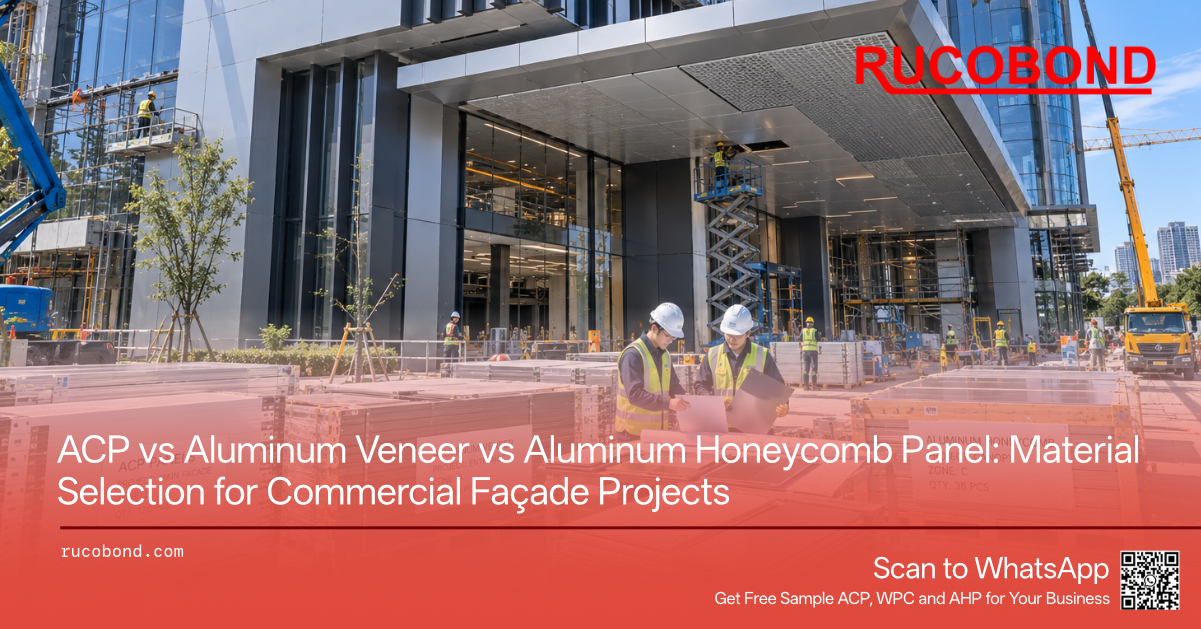
Why These Three Aluminum Panel Types Should Not Be Treated as Interchangeable
Aluminum Composite Panel, Aluminum Veneer and Aluminum Honeycomb Panel are often placed beside each other in building material catalogs, which makes them look like three versions of the same product. They are not. Each material has a different structure, fabrication behavior, typical cost level and best application. Treating them as direct substitutes can either push the project budget higher than necessary or force a lower-cost material into a location where it becomes difficult to fabricate or maintain.
This matters most on large commercial projects. A hotel, office tower, shopping center or transportation building may contain broad flat walls, deep entrance frames, curved columns, large ceilings and premium public areas. Using one panel type across all of them is usually less efficient than matching materials to each zone.
Aluminum Composite Panel is often the most economical choice for large repetitive surfaces. Aluminum Veneer provides greater freedom for custom folds, curves, perforations and architectural details. Aluminum Honeycomb Panel offers higher rigidity for larger panel formats and premium surfaces where flatness is more important.
Founded in Guangzhou, China in 2013, Rucobond manufactures and exports all three categories together with Aluminum Coil, WPC products and Sintered Stone Slabs. Rucobond serves façade engineering companies, contractors, developers, importers and building material distributors requiring commercial quantities, customized manufacturing and repeat supply.
For professional buyers, the more useful question is therefore not “Which aluminum panel is best?” It is “Which material is most suitable for this specific area of the building?” Once the façade is divided according to function, the material schedule usually becomes more rational and the budget considerably easier to defend.
Construction already has enough arguments. Making three different products compete for the title of “best aluminum panel” does not need to become another one.
Aluminum Composite Panel for Cost-Controlled Large Surface Areas
Aluminum Composite Panel is commonly selected for broad façade areas because it provides a practical balance between appearance, weight, fabrication flexibility and cost. A typical ACP consists of aluminum skins bonded to a core, creating a panel that is lighter than many solid metal alternatives while still providing enough rigidity for numerous architectural applications.
Commercial façades, retail podiums, office buildings, parking structures, service areas, signage backgrounds and renovation projects frequently use ACP because large quantities can be fabricated efficiently. Panels can be cut, routed and folded into cassette systems or other shapes according to the façade design.
Rucobond supplies ACP in solid matte, glossy, metallic, mirror, wood grain, brushed and stone-inspired finishes. This gives contractors enough visual flexibility to use the same material category across several architectural zones while maintaining different colors or effects.
The strongest advantage of ACP is scalability. If a project contains 10,000 m² of relatively flat opaque façade, ACP can provide a more cost-controlled solution than using custom solid Aluminum Veneer across the entire area.
For example, an office tower podium might use silver metallic ACP across the broad wall surfaces while reserving customized Aluminum Veneer for the entrance and corners. A shopping center may use ACP across long exterior elevations, with stronger branded colors around retail entrances.
ACP is also useful in renovation because it can cover existing substrates without adding excessive weight. Large commercial properties can update their appearance without completely rebuilding every wall system.
The specification still needs to be selected carefully. Total panel thickness, aluminum skin, coating, core type, finish and exterior exposure all influence performance and price. A contractor should not compare two ACP quotations based only on total thickness and assume the products are otherwise identical.
For most commercial projects, ACP earns its place by handling the repetitive work efficiently. It does not need to be the hero of the building. It simply needs to cover a lot of square meters without becoming a procurement problem, which is already a respectable career.
Aluminum Veneer for Customized Shapes and Complex Façade Details
Aluminum Veneer is a solid aluminum panel that can be cut, folded, curved, perforated and reinforced according to project drawings. This makes it particularly useful in architectural zones where standard composite panels are less convenient.
Entrances, canopies, roof edges, columns, fins, curved façades, perforated screens and large folded frames are typical applications. These areas often require precise geometry and deeper returns, making Aluminum Veneer more suitable than standard flat sheets.
Rucobond supports drawing-based Aluminum Veneer manufacturing according to dimensions, thickness, folds, curves, perforations, coating, color and panel codes. Custom pieces can be produced before shipment and labeled according to project requirements.
Consider a corporate headquarters with a large dark entrance portal around a glass curtain wall. The broad side elevations may use ACP economically, but the entrance frame includes deep folds, large corners and integrated lighting. Aluminum Veneer provides more freedom to create these shapes cleanly.
Perforated Aluminum Veneer can also be used around mechanical areas or equipment screens. Designers can control hole size, spacing and pattern while maintaining the architectural language of the façade.
The trade-off is cost. Aluminum Veneer usually involves more material and more fabrication than ACP. Using it across every flat wall may therefore increase the budget without creating proportional value.
This is why selective use is important. Aluminum Veneer performs best where shape, depth or custom fabrication justify its additional cost. It is not automatically “better” than ACP simply because it is solid aluminum.
A flat wall does not become more sophisticated just because procurement successfully made it more expensive.
Aluminum Honeycomb Panel for Large-Format and High-Rigidity Applications
Aluminum Honeycomb Panel uses aluminum face sheets combined with an internal honeycomb core. This structure provides higher rigidity while keeping overall weight relatively low, making the material useful for large-format panels and applications where surface flatness matters.
Large entrance ceilings, airport interiors, corporate lobbies, elevator panels, premium wall systems and broad soffits are common examples. These areas often benefit from larger panel modules with fewer visible joints.
A hotel drop-off canopy, for example, may require ceiling panels wider than standard ACP modules. Using Honeycomb Panels can help maintain a flatter appearance across the large surface. An office headquarters lobby may also use them to create clean ceiling lines with fewer interruptions.
Rucobond supports customized Aluminum Honeycomb Panels according to dimensions, total thickness, surface finish, color and edge requirements. Drawings are important because panel size, edge construction and installation method influence manufacturing.
The key advantage is rigidity. Compared with many lightweight sheet products, the honeycomb structure allows larger panels to remain more stable. This makes the material attractive in high-visibility areas where waves or uneven surfaces would be especially noticeable.
The trade-off is again cost. Honeycomb Panels are normally more expensive than standard ACP and are therefore better used where large format or higher rigidity creates a real architectural benefit.
A commercial project can combine all three materials rationally: ACP across broad wall areas, Aluminum Veneer around custom entrance structures and Honeycomb Panels beneath the large entrance ceiling.
This is usually more efficient than asking one material to perform three different jobs simply because the tender spreadsheet would look tidier.
Comparing Weight, Rigidity, Fabrication and Project Cost
Material selection becomes easier when the comparison is based on project requirements rather than product names.
ACP provides relatively low weight, straightforward fabrication and strong cost efficiency across large surface areas. It is often the preferred choice for repetitive façade modules where the geometry is relatively simple.
Aluminum Veneer provides greater fabrication freedom. Solid aluminum can be folded, curved and perforated into customized shapes, which makes it valuable around difficult architectural details. The material and processing cost, however, are generally higher than standard ACP.
Aluminum Honeycomb Panel offers higher rigidity at relatively low weight and performs well in large-format applications. Its structure can support broader panels with better flatness, but the manufacturing cost is typically higher than ACP.
Installation also influences total cost. A cheaper material that requires more complicated support or excessive site adjustment can lose part of its initial price advantage. A custom panel manufactured correctly in the factory may cost more per square meter but reduce site fabrication time.
Project buyers should therefore compare landed and installed value rather than only material price.
The same principle applies to weight. Lightweight materials can reduce handling pressure, but the final façade system still needs proper engineering. Panel weight alone does not determine structural performance.
For a typical mixed commercial project, ACP often covers the largest area, Aluminum Veneer handles specialized geometry and Honeycomb Panels appear selectively in large premium zones. This distribution tends to align material cost with actual architectural value.
The point of comparison is not to declare a winner. Buildings are inconveniently full of different problems, so one winner would have been suspiciously convenient.
Matching Materials to Glass Curtain Walls, Entrances and Podiums
Modern commercial architecture frequently combines glass curtain walls with aluminum panel systems. The metal panels cover opaque wall zones, slabs, columns, podiums, canopies and roof structures while glass provides transparency and daylight.
ACP works well around broad opaque curtain wall zones because the panel modules can align with the glazing grid. Metallic silver, grey and charcoal finishes are commonly paired with blue-grey or neutral glass.
Aluminum Veneer becomes useful when the curtain wall geometry becomes more complex. Deep entrance frames, external fins, columns and roof edges can be fabricated according to shop drawings and integrated with the surrounding glazing system.
Honeycomb Panels can be selected for larger entrance ceilings, soffits and premium wall surfaces where wide modules create a cleaner architectural appearance.
A headquarters tower may therefore use all three products within a few meters of the main entrance. The glass façade forms the transparent center. Aluminum Veneer creates the structural-looking outer frame. Honeycomb Panels cover the wide canopy ceiling. ACP continues around the adjacent podium walls.
The materials need to coordinate visually. Color, gloss level and reflectivity should be reviewed alongside the selected glass because exterior sunlight can change how surfaces appear.
Physical sample comparison is therefore useful. A silver metallic panel photographed in the factory cannot fully show how it will look beside reflective glass under afternoon sunlight.
Rucobond can work with architectural drawings, façade renderings and finish references when discussing material combinations. For premium projects, mock-ups can help architects and contractors review the relationship between different surfaces before mass production begins.
Mixed-material design works best when the transitions look intentional. Otherwise the building can end up resembling three suppliers independently won different parts of an argument.
Choosing Different Materials for Exterior and Interior Applications
The same aluminum panel category can appear indoors and outdoors, but the specification should not automatically remain identical.
Exterior materials face sunlight, rain, temperature changes, pollution and local climate conditions. Coating selection and product specification therefore need to match long-term exposure.
Interior applications usually face different requirements. Surface appearance, cleaning, panel size and decorative effect may matter more than weather resistance.
ACP can be used for exterior façades as well as interior commercial walls, signage and ceilings depending on the appropriate specification. Wood grain, mirror and brushed finishes are especially useful in interior environments such as retail stores, hotels and elevator areas.
Aluminum Veneer can be used outdoors for canopies, columns and screens or indoors for feature walls and large decorative elements. Custom perforation also allows designers to create architectural ceiling or partition effects.
Honeycomb Panels frequently appear in premium interior spaces because their rigidity supports larger panel dimensions. Lobby ceilings, elevator interiors and transport facilities can benefit from broad clean surfaces.
The buyer should therefore identify the application clearly during quotation. “Aluminum panel for building” does not provide enough information to select the right coating or structure.
Rucobond works with buyers according to exterior or interior use, climate, surface finish, dimensions and project requirements.
For contractors, separating interior and exterior specifications can also control costs. There is little benefit in paying for an exterior coating system on a decorative interior wall that will spend its entire life enjoying air conditioning.
Materials tend to perform better when their specification reflects where they actually live.
Color, Coating and Finish Consistency Across Mixed-Material Projects
A mixed façade creates another challenge: ACP, Aluminum Veneer and Honeycomb Panels may need to appear visually coordinated even though their structures and manufacturing processes are different.
This is particularly important when the same color crosses several material categories. An architect may specify one charcoal tone across ACP wall areas, Aluminum Veneer fins and Honeycomb ceiling panels.
The buyer should not assume that one written color code will automatically look identical on every substrate and finish. Surface structure, coating application and gloss can influence the final appearance.
Physical sample approval therefore becomes important. Samples from each relevant material category can be compared together before production.
Rucobond can discuss color coordination across multiple aluminum products according to project requirements. Buyers should provide color references, gloss expectations and application areas. Where exact visual continuity is critical, mock-up review can help confirm the result.
Directional finishes also require attention. Brushed and certain metallic surfaces should maintain consistent orientation during fabrication and installation. Protective film markings can help site teams identify direction.
Batch consistency matters as well. Large projects may be produced in several phases, so approved samples and production records should remain available for later orders.
For distributors, maintaining stable product codes across material categories can make project quotations easier. A contractor asking for “Charcoal Series” should still receive clear information about whether the product is ACP, Veneer or Honeycomb rather than assuming the same name means the same structure.
Color coordination is one of those things that looks effortless after installation. This is largely because the complicated part happened before anyone took the finished-building photograph.
Procurement, Packaging and Installation Planning for Combined Orders
Buying several panel categories for one project can simplify supplier coordination, but only if the products remain clearly separated throughout production and logistics.
ACP sheets may be packed by color, size or building zone. Custom Aluminum Veneer can be labeled by panel code and shop drawing. Honeycomb Panels can be grouped according to ceiling or wall location.
Rucobond can discuss packaging and identification according to project requirements. This helps contractors connect materials with the installation sequence after delivery.
For example, a hotel project may need ACP for the general façade first, Aluminum Veneer for the main entrance several weeks later and Honeycomb Panels near the end of interior finishing. Phased production and shipment can be coordinated more effectively when the buyer provides the construction sequence early.
Container loading also needs planning. Standard sheets, custom fabricated panels and large Honeycomb Panels have different packaging forms. The buyer should provide important unloading limitations and warehouse conditions before shipment.
This becomes even more important when materials are delivered directly to a construction site rather than a distributor warehouse. Site storage may be limited, so receiving every product at the same time can create congestion rather than efficiency.
Replacement planning should also be considered. Spare ACP sheets may be easier to store than custom fabricated components. Project records should retain specifications and panel codes so additional pieces can be ordered later if required.
A combined order should reduce coordination work, not create one enormous mixed pallet that requires a small archaeological expedition every morning.
Building a More Practical Material Schedule with Rucobond
A useful material schedule begins by dividing the building according to application rather than choosing one product for the entire façade.
Broad flat exterior walls, podiums and repetitive zones can be evaluated for ACP. Entrances, columns, curved structures, fins, screens and custom architectural details can be reviewed for Aluminum Veneer. Large entrance ceilings, premium lobbies and oversized panels can be evaluated for Aluminum Honeycomb Panel.
For ACP enquiries, provide total panel thickness, aluminum skin, coating, color, gloss level, dimensions, quantity and application. For Aluminum Veneer, provide shop drawings with thickness, folds, curves, perforations, finish and panel numbers. For Honeycomb Panels, provide dimensions, total thickness, surface finish, edge requirements and installation area.
Project location matters because exterior conditions influence coating and material recommendations. Buyers should also provide the destination, expected construction schedule and whether shipment will occur in several phases.
BOQ documents, façade drawings and architectural renderings are particularly useful for projects combining several material types. These allow Rucobond to understand which areas are repetitive and which require customized manufacturing.
Rucobond welcomes enquiries from façade engineering companies, curtain wall contractors, general contractors, developers, building material importers and regional distributors. OEM, ODM, samples, customized production and repeat bulk supply can be discussed according to project requirements.
The strongest material schedule usually does not ask ACP, Aluminum Veneer or Honeycomb Panel to prove which one is superior. It simply gives each product the part of the building it is actually good at.
That tends to produce a better façade and, as an unexpected bonus, fewer arguments during procurement.
Q: What is the main difference between ACP and Aluminum Veneer?
A: ACP uses aluminum skins bonded to a core and is commonly selected for lightweight, cost-controlled large surface areas. Aluminum Veneer is solid aluminum and offers greater flexibility for custom folds, curves, perforations and complex architectural details.
Q: When should Aluminum Honeycomb Panels be considered instead of ACP?
A: Aluminum Honeycomb Panels can be useful when larger panel formats, higher rigidity and relatively low weight are important, such as large ceilings, entrance soffits, premium lobbies and other high-visibility architectural areas.
Q: Can ACP, Aluminum Veneer and Honeycomb Panels be used on the same project?
A: Yes. Many commercial projects use ACP for broad repetitive zones, Aluminum Veneer for custom architectural details and Honeycomb Panels for larger premium surfaces. Combining the materials can improve both cost control and design flexibility.
Q: Can Rucobond coordinate similar colors across different aluminum panel types?
A: Rucobond can work with project color references and samples to coordinate finishes across ACP, Aluminum Veneer and Aluminum Honeycomb Panels. Physical sample approval is recommended where close visual matching is important.
Q: What information should buyers provide for a mixed aluminum panel quotation?
A: Buyers should provide façade drawings or BOQ documents, application areas, panel specifications, dimensions, colors, finishes, estimated quantities, destination and construction schedule. Customized Aluminum Veneer and Honeycomb Panel areas should include detailed technical drawings where available.
Name: Gina Chen
Mobile:+86-189-2412-4951
Tel:+86-189-2412-4951
Whatsapp:8618924124951
Email:gina@rucobond.com
Add:Room 708, No. 8 Jingang Avenue, Nansha Street, Nansha District, Guangzhou


