
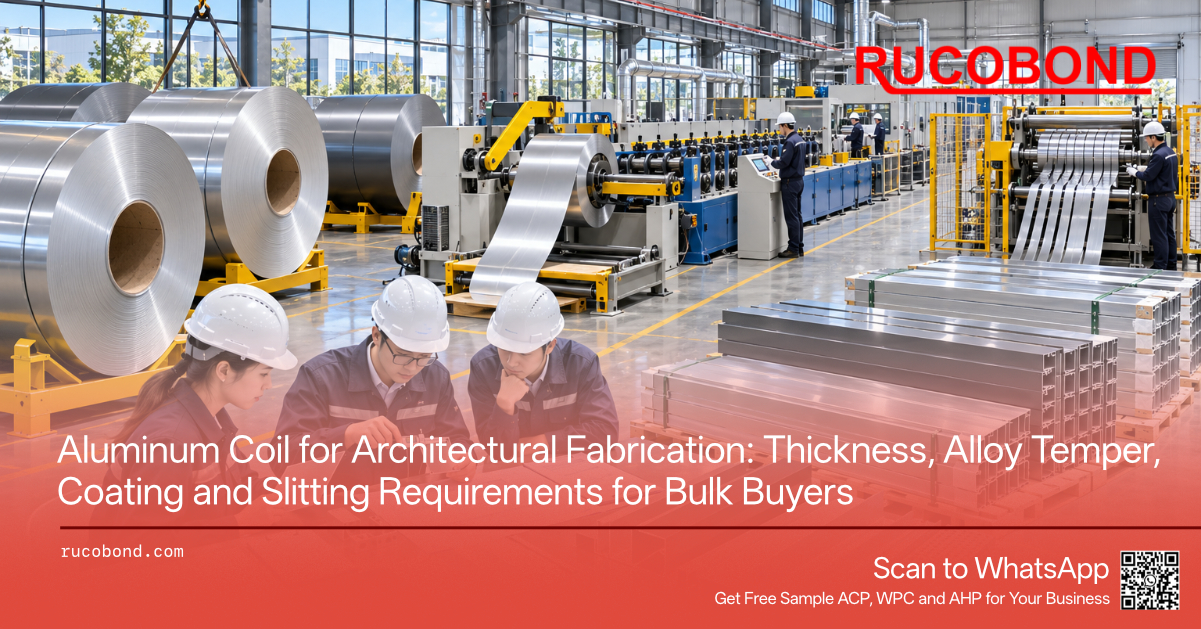
A metal fabrication company may purchase several tons of Aluminum Coil to manufacture ceiling strips, architectural trims, decorative metal profiles or other construction components. The purchasing department receives quotations based on thickness, width, surface finish and weight, then selects a supplier offering an attractive price. However, when the material reaches the workshop, the production team may discover that the coil is difficult to form, does not feed consistently through the equipment or produces more waste than expected. A competitive material price quickly becomes less attractive when the manufacturing process cannot operate efficiently.
Unlike finished Aluminum Composite Panels or fabricated Aluminum Veneer, Aluminum Coil is usually an intermediate material. Its commercial value depends on what the buyer intends to manufacture from it. A coil intended for simple flat cutting may not require the same properties as material that will be roll-formed into narrow architectural profiles. A prepainted coil used for decorative ceiling strips may also have different coating requirements from uncoated aluminum intended for subsequent surface finishing.
Consider a manufacturer producing thousands of narrow metallic ceiling panels for shopping malls. The factory may use continuous roll-forming equipment to convert aluminum strip into finished profiles. If the coil width is inconsistent or the selected material does not perform well during forming, the production line may generate dimensional variation, surface defects or excessive rejected material. These problems affect output long before the finished products arrive at the construction site.
Founded in Guangzhou, China in 2013, Rucobond manufactures and exports Aluminum Coils, Aluminum Composite Panels, Aluminum Veneer, Aluminum Honeycomb Panels and other architectural materials. The company works with building material manufacturers, metal-processing factories, construction contractors, importers and distributors requiring commercial quantities and repeat supply.
For professional buyers, the starting point should therefore be the finished product rather than the coil itself. When the supplier understands the intended fabrication process, required dimensions, surface treatment and operating environment, the material specification becomes more useful. The objective is not simply purchasing aluminum by weight, but ensuring the supplied material can be converted into acceptable finished components with predictable manufacturing costs.
Aluminum alloy and temper influence how material behaves during cutting, bending, roll forming and other manufacturing operations. Although different aluminum products may look similar in coil form, their mechanical characteristics are not necessarily interchangeable. A specification suitable for a relatively flat architectural component may be less appropriate for a profile requiring repeated bends or more demanding forming operations.
The alloy identifies the material composition, while temper describes its metallurgical condition and associated properties. Together, these characteristics influence strength, ductility and forming behavior. The appropriate combination depends on the finished product, forming process, equipment and engineering requirements.
For example, a manufacturer producing simple flat decorative strips may have different material requirements from a factory roll-forming aluminum into narrow ceiling profiles with several bends. The second application requires the material to pass through consecutive forming stations without unacceptable cracking, distortion or surface damage. Choosing an alloy and temper without considering this process can create problems even when the nominal thickness and width are correct.
Building material distributors may face a similar issue when supplying multiple fabrication workshops. One customer may manufacture architectural flashings, another may process aluminum into decorative wall profiles, and a third may require coated material for ceiling systems. Supplying all three with the same generic aluminum specification may not be appropriate if their forming requirements differ.
Rucobond can discuss Aluminum Coil specifications according to intended applications and confirmed manufacturing requirements. Buyers should identify the required alloy and temper where already specified, or explain the processing method when technical options are being evaluated. The final selection should be validated against the fabricator's process and any applicable product standards.
For demanding applications, a representative material trial can provide useful evidence before bulk purchasing. A small sample processed using the actual manufacturing equipment may reveal difficulties that would not appear during ordinary visual inspection.
The correct aluminum grade is not necessarily the strongest available material. It is the material whose properties suit the component being manufactured and the process used to produce it.
Thickness and width are among the first specifications mentioned in Aluminum Coil enquiries, but their importance extends beyond basic material pricing. These dimensions influence equipment settings, finished component geometry, material utilization and manufacturing consistency.
Nominal thickness should be selected according to the finished product and relevant performance requirements. A decorative ceiling profile, architectural flashing and metal enclosure component may require different gauges even when produced from similar aluminum material. Thickness tolerances also matter because variations can affect bending behavior, forming pressure and the dimensions of completed profiles.
Width is equally important for continuous processing. A manufacturer may require coils of a specific width to feed directly into a roll-forming line. If the material arrives significantly wider than required, additional slitting may be necessary. If the width is unsuitable or varies outside the agreed tolerance, production settings and finished component dimensions may be affected.
Consider a workshop producing repeated aluminum ceiling strips. Its forming equipment is configured around a specified input width, with a fixed sequence of bends creating the final profile. A coil with inconsistent width can complicate this process, particularly when thousands of identical components are expected from the same production run.
For buyers, it is also important to distinguish the thickness of the aluminum substrate from the thickness of any applied coating. Where the material is prepainted, coating layers and bare-metal gauge should be defined according to the applicable specification rather than combined into one ambiguous measurement.
Rucobond supplies Aluminum Coils for professional buyers and can discuss thickness, width, coating and quantity requirements. The relevant tolerances, measurement methods and applicable standards should be confirmed in the purchasing specification. Buyers should avoid relying on one generic tolerance for every aluminum alloy, temper and product form.
A clear quotation request should therefore contain more than a nominal dimension. It should identify the acceptable specification, processing requirements and whether the material will be used directly as supplied or converted into narrower strips.
A major purchasing decision is whether the buyer requires aluminum that already has a decorative coating or material that will receive its surface treatment after fabrication. Both approaches can serve architectural manufacturing, but they involve different production workflows.
Prepainted Aluminum Coil is coated while the material remains in continuous strip form. The coated material is then supplied to manufacturers who may cut, bend or roll-form it into finished products. This approach can be useful for repeated architectural components where consistent factory-applied color and surface appearance are important.
For example, a ceiling-system manufacturer may purchase prepainted metallic aluminum strip and use it to manufacture hundreds of identical decorative profiles. Because the material arrives with the specified finish, the factory may avoid adding a separate painting operation after forming, provided the coating is suitable for the intended process.
Uncoated Aluminum Coil offers a different manufacturing route. It can be processed into components that receive a suitable surface treatment later. This may be advantageous when the finished geometry, edge treatment or desired coating process makes post-fabrication finishing more appropriate.
The two options should not be treated as interchangeable simply because their visible colors can eventually appear similar. Prepainted material must tolerate the intended forming process without unacceptable coating damage. Material coated after fabrication must follow a different production and quality-control sequence.
Buyers should also define which surface requires the decorative coating. Some products have a visible front face and a less visible reverse face, with different requirements for appearance, protection or subsequent bonding. A quotation describing only the front color may leave important details about the reverse surface unresolved.
Rucobond can discuss coated and uncoated Aluminum Coil requirements according to the requested product specification and manufacturing availability. Professional buyers should identify the intended use, surface finish, coating requirements, downstream processing method and environmental exposure before approving the order.
The most economical choice depends on the entire manufacturing workflow. A lower raw-material price provides limited benefit if the selected product requires additional processing that was never included in the original cost comparison.
Aluminum Coil is frequently processed into narrower strips before being manufactured into finished architectural products. For metal-processing factories, slitting efficiency can influence both material cost and production throughput.
A manufacturer producing ceiling strips, decorative trims or narrow roll-formed profiles may purchase wide master coils and divide them into several smaller widths. The resulting material yield depends on the master-coil width, required strip dimensions, edge trimming, cutting losses and the capabilities of the slitting equipment.
Consider a simplified example in which a factory purchases a 1,250 mm wide coil and needs five strips measuring 240 mm each. The required strip widths total 1,200 mm, leaving 50 mm before accounting for edge trimming and slitting losses. Whether this arrangement is practical depends on the actual production equipment, required tolerances and acceptable edge conditions.
The calculation becomes more important when a workshop purchases many tons of material throughout the year. Even a modest improvement in width utilization can reduce the amount of purchased aluminum that becomes unusable trim. Conversely, choosing a master-coil width only because it offers a lower quoted price may increase waste when the material is processed into the required finished strips.
For distributors, customers may also have different preferences. Larger metal-processing factories may operate their own slitting lines, while smaller workshops prefer coils delivered in widths compatible with their equipment. These buyers have different handling requirements and may need different purchasing arrangements.
Rucobond can discuss coil widths and order specifications according to manufacturing feasibility and confirmed quantities. Buyers should provide the master-coil width or required slit widths, estimated consumption and details of the downstream process. Any special width or slitting requirement should be confirmed before production rather than assumed to be available.
Material utilization should be evaluated alongside processing costs. Narrower coils may reduce in-house preparation but affect purchasing terms, packaging or shipment arrangements. Wider coils may offer flexibility but require suitable slitting capacity and additional handling.
The useful comparison is therefore the cost of acceptable finished output, not simply the price per ton of incoming material.
Dimensional accuracy is not the only characteristic that affects Aluminum Coil processing. Shape irregularities and surface condition can influence how the material moves through manufacturing equipment and how the finished components appear.
One issue is coil set, which describes the tendency of material to retain curvature associated with being wound into a coil. Depending on the process, this may need to be managed through appropriate leveling or forming equipment. Edge wave and center buckle describe other forms of shape variation, while camber refers to lateral deviation along the length of the strip.
These conditions should not be treated as identical defects because they affect manufacturing in different ways. A strip that curves sideways may create tracking difficulties during processing, while a sheet with visible waviness can produce inconsistent results when converted into broad flat components.
Consider a factory manufacturing long metal ceiling profiles. The material must travel through several stations before cutting into finished lengths. If the incoming strip does not track consistently or contains shape variations beyond what the production line can accommodate, the manufacturer may experience adjustment delays, inconsistent dimensions or additional scrap.
Surface condition creates another set of concerns. Scratches, pressure marks, stains or coating irregularities may remain visible after fabrication, especially when the finished product uses a reflective metallic surface. A defect that appears minor on a large coil can become prominent when repeated across hundreds of architectural components.
Rucobond can discuss Aluminum Coil requirements according to the intended application and agreed specifications. Professional buyers should establish relevant surface and shape acceptance criteria before placing large orders, including any applicable inspection or measurement methods.
Receiving inspection is also important. Factories should examine the condition of packaging and the material before releasing coils for production. Where concerns are identified, preserving the coil identification and supporting inspection records can help clarify whether the issue originated before delivery or during subsequent handling.
The intended fabrication method should determine which tolerances are especially important. Material used for narrow roll-formed profiles may have different critical requirements from material intended for broad flat decorative panels.
Prepainted Aluminum Coil must satisfy two different demands: the finish needs to provide the desired appearance and environmental performance, while remaining compatible with the mechanical processing used to manufacture the final component.
This balance becomes especially important during bending and roll forming. When coated metal is bent, the material on the outside of the bend experiences tensile strain. If the coating system and substrate are not suitable for the forming conditions, cracking, adhesion problems or other surface defects may occur.
A factory producing simple flat panels may place relatively limited forming demands on the coating. A manufacturer producing narrow architectural trims with several tight bends faces a different situation. The chosen coating must be compatible with the actual forming process rather than selected only for its advertised weather resistance or gloss.
For example, a contractor may specify a decorative metallic finish for a series of folded aluminum ceiling profiles. The material looks acceptable in flat sample form, but after passing through the workshop's forming equipment, fine cracks appear near the bends. The problem may involve coating flexibility, material properties, bend radius, tooling or a combination of factors.
This is why representative forming tests can be useful before committing to large quantities. The test should reflect the actual substrate, coating system, bend geometry and manufacturing process as closely as practical. A general coating description does not guarantee acceptable performance under every forming condition.
The intended environment also influences coating selection. A decorative interior component and an exposed exterior trim may require different coating performance. Coating flexibility, weather resistance, appearance and processing requirements should be evaluated together rather than treated as separate purchasing decisions.
Rucobond can discuss coating requirements and intended processing methods with professional buyers. Contractors and fabricators should identify the finished product, minimum forming radius where relevant, required surface finish and any project-specific performance criteria.
For repeat manufacturing programs, documenting the approved material and forming conditions can help reduce uncertainty during subsequent orders. A product that has been successfully processed under controlled conditions provides a more useful manufacturing reference than an untested description of its coating chemistry.
Color consistency becomes particularly important when Aluminum Coil is used to manufacture components that will be installed beside other architectural materials. A commercial project may combine coil-formed decorative trims with ACP wall cladding, customized Aluminum Veneer and metal ceiling panels. Although the materials may share a written color reference, their final appearance can differ because of coating systems, substrates, gloss levels and manufacturing processes.
Consider a shopping center using silver metallic ACP around its retail entrances and matching aluminum ceiling strips manufactured from coated coil. The architect expects both components to appear visually coordinated. However, a metallic finish applied through one coating process may reflect light differently from another material with the same nominal color reference.
This does not necessarily mean either product is defective. Surface structure, coating formulation, gloss and viewing angle can influence perceived color. Brushed and directional finishes add further complexity because orientation affects reflection.
For high-visibility architectural projects, buyers should compare physical samples from the actual material categories rather than assuming one color code guarantees a perfect match. The samples should be reviewed under lighting conditions representative of the finished installation, particularly where metallic or glossy finishes are involved.
Rucobond supplies Aluminum Coils together with ACP, Aluminum Veneer and Honeycomb Panels, allowing professional buyers to discuss coordinated material requirements. Any visual matching should be established through approved samples and documented acceptance expectations rather than assumed from the shared supplier name.
Batch consistency also matters. A ceiling manufacturer may process several coil shipments during a long construction program. If the finish is intended to remain consistent across production runs, the purchasing records should retain the approved color reference, coating specification and relevant order information.
For distributors, stable product codes are particularly useful. A customer asking for the same metallic strip six months later should be able to reference a documented specification instead of relying on an informal color description.
A clear color-management process improves coordination between different manufacturing stages and helps contractors maintain the intended appearance when multiple metal products meet in the finished building.
Aluminum Coil presents different logistics challenges from ordinary flat sheets. A coil concentrates substantial weight into a compact form, requiring suitable equipment for unloading, lifting, storage and processing. The dimensions and weight of the individual coil therefore matter just as much as its width and thickness.
Before placing an international order, buyers should confirm the required internal diameter, external diameter limitations and acceptable weight per coil. These specifications affect compatibility with the factory's uncoiling equipment and available lifting machinery. A coil that meets the material specification but exceeds the receiving workshop's handling capacity can create immediate operational difficulties.
For example, a regional fabrication company may operate a decoiler designed for a particular coil weight and internal diameter. If the imported material arrives in a different configuration, the workshop may be unable to load it directly onto the production line. Additional handling or processing may be required before manufacturing can begin.
Packaging should protect the material against moisture, contamination, surface damage and movement during transportation. The appropriate arrangement depends on the coil dimensions, finish, transportation method and receiving conditions. Coated materials may require additional attention to prevent pressure marks or abrasion on decorative surfaces.
Storage practices also influence material condition. Coils should be handled using suitable equipment and stored according to the applicable manufacturer guidance. Poor handling can damage coil edges, while unsuitable storage conditions may contribute to surface problems or packaging deterioration.
Rucobond can discuss export packaging, coil specifications and order identification according to product requirements. Buyers should provide information about their receiving equipment and any restrictions affecting coil weight, diameter or storage arrangements.
Traceability is another important consideration for bulk manufacturing. When a factory processes multiple coil shipments, clear batch or coil identification helps connect incoming material with finished components. If a quality concern appears later, the manufacturer can identify the relevant material and review associated records more efficiently.
For professional importers, well-organized packaging and documentation support a smoother receiving process. The objective is to ensure that coils arrive in a condition suitable for safe handling and subsequent manufacturing rather than treating export delivery as the end of the material-quality process.
Professional Aluminum Coil procurement requires more than comparing nominal thickness, width and price. The material must be suitable for the intended fabrication process, compatible with downstream equipment and supplied with clearly defined surface and dimensional requirements. For manufacturers producing repeated architectural components, consistency and reliable purchasing information are essential.
Established in 2013 and headquartered in Guangzhou, Guangdong, China, Rucobond manufactures and exports Aluminum Coils, Aluminum Composite Panels, Aluminum Veneer, Aluminum Honeycomb Panels, WPC products and Sintered Stone Slabs for international construction and material-processing markets.
Why choose Rucobond? The company's architectural material portfolio allows professional buyers to discuss Aluminum Coil supply alongside finished panel products used in related construction projects. This can be useful for building material distributors, metal-processing factories and contractors sourcing several categories of aluminum material.
Rucobond can discuss Aluminum Coil specifications including thickness, width, coating, color and intended application according to manufacturing availability and order requirements. Buyers requiring particular alloy and temper combinations, surface finishes or coil configurations should provide the complete technical specification for review before confirming a purchase.
For companies manufacturing architectural trims, ceiling profiles or decorative metal components, the downstream fabrication method is particularly important. Enquiries should identify whether the coil will be cut, slit, bent, roll-formed or processed through another operation. Where appearance and forming performance are critical, representative samples or manufacturing trials may be appropriate before a larger production commitment.
Rucobond also supports OEM and ODM cooperation for professional building material buyers according to product category and order requirements. Selected finishes, packaging, identification and repeat specifications can be discussed where applicable. Relevant SGS, CE and ISO-related documentation should be reviewed according to the actual product and certification scope, without assuming that every aluminum material shares the same approvals.
For an accurate bulk quotation, buyers should provide the required alloy, temper, nominal thickness, width, coating system, color, surface finish, coil dimensions, acceptable coil weight, total quantity, destination and delivery schedule. Where dimensional tolerances or performance tests are specified, the applicable requirements should also be included.
Rucobond welcomes enquiries from metal fabrication factories, ceiling-system manufacturers, architectural trim producers, building material distributors, importers and construction procurement teams requiring commercial quantities of Aluminum Coil. Buyers can submit material specifications, expected annual consumption, downstream manufacturing requirements and destination information to discuss available production and export options.
The most effective aluminum sourcing relationship is one in which the supplier understands what happens to the material after delivery. A coil is not the finished architectural product. Its value depends on how reliably it can become one.
Q: What information is needed when ordering Aluminum Coil for architectural fabrication?
A: Professional buyers should provide the intended application, required alloy and temper, nominal thickness, width, dimensional tolerances, surface finish, coating requirements, coil dimensions, acceptable coil weight and estimated quantity. Details of the downstream fabrication process are also useful for evaluating material suitability.
Q: What is the difference between prepainted Aluminum Coil and uncoated Aluminum Coil?
A: Prepainted Aluminum Coil receives its coating before the material is fabricated into finished components. Uncoated Aluminum Coil can be processed first and may receive a surface treatment later. The preferred option depends on the finished product, forming process, coating requirements and manufacturing workflow.
Q: Can Aluminum Coil be used for roll-formed architectural profiles?
A: Aluminum Coil can be used for suitable roll-formed products, but the alloy, temper, thickness and coating must be compatible with the actual forming process. Buyers should confirm bend requirements and equipment conditions, particularly for prepainted material.
Q: Why do coil width and flatness matter to metal fabrication factories?
A: Coil width affects slitting yield, equipment compatibility and finished component dimensions. Shape characteristics such as camber, coil set and waviness can influence material tracking and processing quality. Appropriate requirements and measurement methods should be agreed before production.
Q: Can Rucobond supply Aluminum Coil for bulk manufacturing and repeat orders?
A: Rucobond supplies Aluminum Coil for professional buyers and can discuss thickness, width, coating, color, quantities and repeat specifications according to manufacturing availability. Buyers should provide complete requirements, intended processing methods and purchasing schedules so supply options can be evaluated.
Name: Gina Chen
Mobile:+86-189-2412-4951
Tel:+86-189-2412-4951
Whatsapp:8618924124951
Email:gina@rucobond.com
Add:Room 708, No. 8 Jingang Avenue, Nansha Street, Nansha District, Guangzhou


