
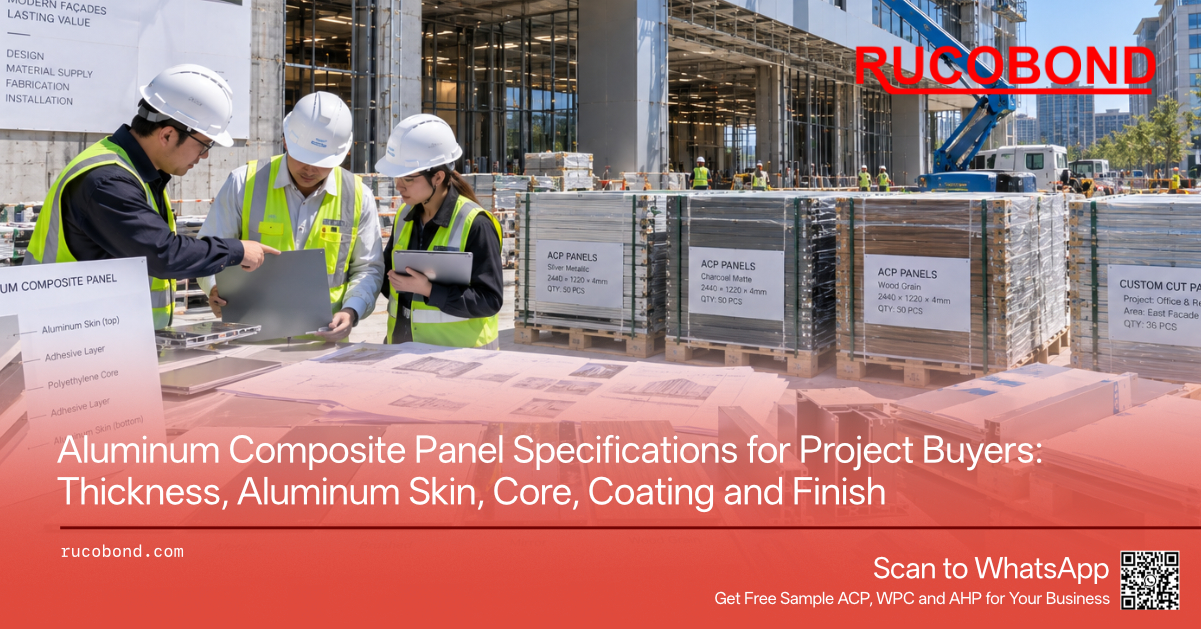
Why “4 mm ACP” Is Not a Complete Product Specification
A surprisingly large number of Aluminum Composite Panel enquiries begin with something like: “Need 4 mm ACP, please send best price.” The request sounds specific because it contains a number. In reality, it leaves most of the product undefined.
Two panels can both be described as 4 mm ACP while using different aluminum skin thicknesses, core materials, coatings, gloss levels, surface finishes and manufacturing specifications. They may be intended for completely different applications and sit at very different price levels. Comparing them only by total thickness is therefore a little like comparing two vehicles because both have four doors.
For contractors and building material distributors, this creates real procurement risk. A low quotation may appear attractive until the buyer discovers that the product was priced with a thinner aluminum skin, different coating or different core than the project specification requires. By that point, several rounds of negotiation may already have been wasted.
Founded in Guangzhou, China in 2013, Rucobond manufactures and exports Aluminum Composite Panels together with Aluminum Veneer, Aluminum Honeycomb Panels, Aluminum Coils, WPC products and Sintered Stone Slabs. Rucobond works with façade contractors, construction companies, importers and building material distributors requiring bulk and customized production.
A professional ACP enquiry should define the product in layers: total panel thickness, aluminum skin, core requirement, coating, finish, dimensions, application and quantity. Once these variables are clear, quotation comparison becomes substantially more meaningful.
This does not make procurement more complicated. The complexity was already inside the panel. Writing it down merely stops everyone from pretending otherwise.
Total Panel Thickness and What It Actually Tells the Buyer
Total thickness is usually the first ACP specification buyers mention. Common project requirements vary according to application, façade design and local market practice, and the final thickness should follow project engineering and tender requirements.
The total thickness describes the complete sandwich structure: front aluminum skin, core and rear aluminum skin. It does not tell the buyer how thick either aluminum layer is, what type of core is inside or what coating has been applied to the visible face.
This distinction matters because two panels with identical overall dimensions may behave differently during routing, folding and installation. A signage application and a commercial exterior façade may therefore use products that share the same nominal total thickness but have very different component specifications.
Contractors should avoid assuming that a higher total thickness automatically means every part of the product has been upgraded. The internal composition needs to be reviewed separately.
Rucobond can manufacture ACP according to different project requirements and works with buyers to confirm the complete panel structure before production. When requesting a quotation, the buyer should provide the required total thickness together with aluminum skin, application and coating requirements.
For distributors, clearly separating different specifications also prevents confusion inside the local sales team. If two 4 mm products are designed for different market segments, they should have different product codes and descriptions rather than relying on salespeople to remember which “4 mm grey panel” someone meant.
A number without context looks wonderfully efficient right until somebody has to build something with it.
Aluminum Skin Thickness and Its Effect on Fabrication and Project Positioning
The aluminum skins on the front and rear of an ACP are a major part of the product specification. Their thickness influences material cost, fabrication behavior and suitability for different applications.
For project buyers, the important point is that total panel thickness and aluminum skin thickness are separate specifications. Saying “4 mm ACP” does not automatically define the aluminum layer.
A product intended for price-sensitive interior decoration may use a different aluminum skin specification from one intended for a demanding exterior façade. The correct requirement should follow the project design, fabrication method, expected use and relevant standards.
Aluminum skin thickness also matters during routing and folding. Façade fabricators create grooves on the rear side of the panel before folding it into cassette shapes. Stable and clearly specified material gives the workshop a more predictable fabrication process.
For distributors, offering several skin specifications can help address different market segments, but the product categories need to remain clear. Selling everything simply as “ACP” encourages customers to compare price without understanding the difference in construction.
Rucobond works with contractors and distributors according to requested panel structure and application. Buyers should state the required aluminum skin thickness during quotation instead of asking the factory to assume it.
This is particularly important when comparing suppliers. A quotation that appears significantly cheaper may not represent an extraordinary manufacturing breakthrough. Sometimes it represents less aluminum.
Price differences become much less mysterious once the specifications stop hiding.
Core Materials and Fire-Performance Requirements
The core sits between the two aluminum skins and forms most of the panel thickness. Its composition affects weight, product classification, cost and potential fire-performance characteristics.
Different projects may require different core specifications depending on building height, occupancy, façade design and local regulations. Public buildings, high-rise projects, transportation facilities and other regulated construction may have specific requirements that are very different from those of small interior decorative applications.
Professional buyers should therefore provide the required fire-performance standard or project specification rather than simply requesting “fireproof ACP,” which is too vague to manufacture or verify accurately.
Where mineral-filled or other fire-performance core systems are required, the exact product classification and supporting documentation should be reviewed against the project requirement. Local building regulations should always take priority because standards and acceptance criteria vary by country and application.
Rucobond can discuss project-specific ACP core requirements with professional buyers and provide relevant product information and certification documentation according to the requested specification and available product category. Rucobond products are supported by SGS, CE and ISO-related certifications and quality systems according to applicable product and project requirements.
This is an area where procurement teams should resist simplifying the requirement into a marketing label. “Fire-resistant,” “fire-retardant” and similar commercial descriptions are not substitutes for a defined test standard or classification.
The safest purchasing document is the one that says exactly what the project requires. A dramatic adjective has yet to pass a fire test on its own.
PE and PVDF Coatings for Interior and Exterior Applications
The visible aluminum surface requires a coating or finish appropriate for the environment. Two common categories encountered in ACP procurement are polyester-based coatings and fluorocarbon systems such as PVDF, although the exact specification should always follow the project requirement.
PE-coated panels are commonly considered for interior decoration, signage and other applications where long-term exterior weather resistance is not the primary requirement. They offer a broad range of colors and surface effects and can provide a cost-effective solution for suitable indoor or lower-exposure applications.
PVDF coating systems are widely associated with exterior architectural applications because they are designed to provide stronger resistance to weathering, UV exposure and color change under outdoor conditions. The exact coating structure, resin content and performance requirements should still be confirmed according to the project rather than relying only on the abbreviation.
A shopping mall interior wall and a twenty-story exterior façade do not live the same life. Specifying them identically simply because they use the same color would ignore most of the environment surrounding the panel.
Project location also matters. Strong tropical sunlight, heavy rainfall, coastal air, desert heat and urban pollution create different exposure conditions. Buyers should provide the destination and application when requesting exterior panels.
Rucobond can discuss suitable coating specifications according to project location, intended use, color and required finish. For large exterior orders, physical samples are recommended where visual appearance is important.
For distributors, separating interior and exterior series clearly helps sales teams recommend products more responsibly. It also reduces the familiar situation in which the cheapest panel slowly migrates into applications nobody originally intended for it.
Solid, Metallic, Brushed, Mirror and Wood Grain Surface Finishes
Once the structural specification is clear, surface finish becomes the most visible part of the product. Rucobond supplies ACP across several decorative categories including solid matte, high-gloss solid, metallic, brushed, mirror, wood grain and stone-inspired finishes.
Solid colors are versatile and commonly used for commercial façades, signage, interiors and large construction projects. White, grey, black and other neutral tones can form broad architectural surfaces while stronger colors support branding and wayfinding.
Metallic finishes interact more strongly with light. Silver, champagne and darker metallic tones can create a more architectural appearance but require attention to batch consistency and panel orientation.
Brushed finishes contain a directional texture. Fabricators should keep sheet orientation consistent because reversing one panel can change how it reflects light. The issue may look like a color difference even when every sheet came from the same production batch.
Mirror finishes are highly reflective and are often used selectively in interior or decorative applications. They can create strong visual effects, but surface condition and installation quality become very noticeable because reflection is not particularly forgiving.
Wood grain and stone-inspired ACP provide decorative alternatives for hospitality, retail, restaurant and interior projects. They can create the visual impression of natural materials while maintaining the fabrication advantages of composite panels.
For professional buyers, finish selection should follow application rather than sample-book enthusiasm. A surface that looks spectacular on a 300 × 300 mm sample may become visually overwhelming across 5,000 m² of façade.
Good architecture occasionally benefits from not using every finish the factory knows how to manufacture.
Panel Size, Fabrication Method and Material Utilization
Panel dimensions affect more than shipping. They influence fabrication yield, façade joint layout, waste and total project cost.
Standard-sized sheets may be suitable for many projects, but larger or customized dimensions can sometimes reduce joints and improve material utilization. The correct approach depends on architectural modules and the fabrication plan.
For example, if a façade cassette requires dimensions that produce substantial offcuts from a standard sheet, changing the raw panel size may improve yield. Across several thousand panels, even a modest reduction in waste can have a meaningful impact on cost.
Façade contractors should therefore coordinate raw sheet dimensions with the fabrication workshop rather than selecting sheet size only from habit.
Routing and folding also need consideration. ACP cassettes typically require additional material around the visible face to create folded returns, so the raw sheet needs to be larger than the final visible panel.
Signage and interior projects may use simpler cutting layouts, while complex façade modules require more careful nesting and production planning.
Rucobond can discuss customized panel dimensions according to manufacturing capability, order quantity and project requirements. Buyers should provide finished panel sizes or fabrication drawings where material utilization is important.
Container loading must also be considered. Very large sheets may improve façade layout but reduce logistics efficiency or require different handling equipment. The best dimension is therefore not always the biggest one.
A sheet can save three joints and create four warehouse problems. Procurement enjoys these little reminders that optimization is rarely allowed to be simple.
Matching ACP Specifications to Climate and Building Application
ACP should be selected according to where the product will actually be installed. Climate, building type, height, exposure and maintenance environment all influence the correct specification.
A commercial façade in Singapore or the Philippines may face strong UV, high humidity and heavy rainfall. A project in Saudi Arabia may experience extreme heat, dust and intense solar exposure. Coastal buildings can introduce additional environmental considerations, while interior retail applications face almost none of these exterior conditions.
Building use matters as well. A high-rise office tower, supermarket sign, hotel lobby and temporary interior partition may all use something called Aluminum Composite Panel, but there is no reason to assume the same specification is appropriate for each.
Project buyers should therefore provide application details during the first enquiry. Is the panel exterior or interior? Is it installed on a high-rise building or used for signage? Is the project near the coast? Does the tender specify coating or fire-performance requirements?
Rucobond can then discuss the specification based on actual project information rather than guessing from a requested color and thickness.
This also helps control cost. Over-specifying interior material wastes budget, while under-specifying exposed exterior material can create longer-term problems. The goal is not choosing the strongest imaginable specification. It is selecting one appropriate to the real project.
For building material distributors, organizing ACP ranges by application can make local selling easier. Instead of one giant catalog, products can be grouped around exterior façade, interior decoration, signage or project-specific use.
The correct specification is usually less glamorous than the finish. It also has the inconvenient habit of mattering more.
Comparing Quotations Without Accidentally Comparing Different Products
Quotation comparison becomes useful only when every supplier is pricing the same requirement.
If Supplier A quotes 4 mm ACP with one aluminum skin specification and PVDF coating, while Supplier B quotes 4 mm ACP with a thinner skin and PE coating, placing the two prices in the same spreadsheet does not create a meaningful comparison. It creates two different products arranged neatly beside each other.
Professional buyers should therefore build a quotation specification before asking for price. At minimum, it should identify total panel thickness, aluminum skin, core requirement, coating, surface finish, dimensions, quantity and application.
Packaging, protective film and required certification documents should also be clarified where relevant.
For project orders, buyers should state whether sheets will be fabricated locally or whether custom processing is required. Destination and estimated delivery schedule help complete the commercial picture.
Rucobond encourages contractors and distributors to provide clear specifications so the quotation reflects the actual requirement. This reduces repeated revisions and makes price differences easier to understand.
If one supplier remains significantly cheaper after every specification is aligned, the buyer can investigate that difference intelligently. Before alignment, the spreadsheet may simply be rewarding whoever made the cheapest assumptions.
This is especially important for distributors sourcing private-label panels. A lower-cost product may still be appropriate for a particular market segment, but it should be deliberately positioned as a different specification rather than quietly replacing the established one.
Price competition is useful. Comparing different products and calling the cheapest one the winner is mostly spreadsheet cosplay.
Building a Clear ACP Procurement Specification with Rucobond
A strong ACP enquiry can be relatively short while still providing enough information for useful quotation and production planning.
Start with the application and destination. Explain whether the product is intended for an exterior façade, interior wall, signage project, commercial renovation or distributor inventory. Provide the country or climate where relevant.
Then define the panel itself: total thickness, front and rear aluminum skin requirements, core specification, coating system, surface finish, color, gloss level, sheet dimensions and estimated quantity.
If the project has fire-performance requirements, provide the required standard or classification from the project documentation. Avoid replacing technical requirements with general terms such as “good fireproof panel.”
For metallic, brushed or decorative finishes, physical samples or clear finish references can improve approval. For OEM orders, buyers should also provide protective film artwork, product codes, packaging requirements and expected repeat quantities.
Façade contractors can include shop drawings, cutting layouts or module dimensions when sheet optimization is important. Distributors should explain which products are expected to become regular stock so repeat specifications can be managed more systematically.
Rucobond welcomes enquiries from façade contractors, construction companies, developers, building material importers, wholesalers and distributors requiring commercial quantities, OEM or ODM production and repeat supply.
A useful enquiry might therefore read: exterior ACP for a commercial façade, 4 mm total thickness, specified aluminum skin, project-required core classification, PVDF finish, metallic grey, required sheet dimensions, total estimated quantity, destination and construction schedule.
That single paragraph gives the factory considerably more to work with than “4 mm ACP, cheapest price please,” although admittedly it contains fewer opportunities for mystery.
Q: Is all 4 mm Aluminum Composite Panel the same?
A: No. Total thickness is only one part of the specification. Aluminum skin thickness, core material, coating system, surface finish, dimensions and intended application can differ significantly between two 4 mm ACP products.
Q: What information affects Aluminum Composite Panel price?
A: ACP pricing can be influenced by total panel thickness, aluminum skin thickness, core specification, coating, finish, dimensions, order quantity, packaging and customization requirements. Buyers should compare complete specifications rather than only total thickness.
Q: Is PVDF ACP always required for exterior applications?
A: Exterior architectural projects commonly use coating systems designed for long-term weather exposure, including PVDF systems, but the correct specification should follow the project requirement, local environment and applicable standards. Buyers should provide the intended application when requesting a quotation.
Q: Why can metallic ACP panels look like different colors after installation?
A: Metallic and brushed surfaces can change appearance according to lighting, viewing angle and panel orientation. Consistent fabrication direction, approved samples and careful batch control help reduce visible differences.
Q: What should a buyer send Rucobond for an accurate ACP quotation?
A: Buyers should provide total panel thickness, aluminum skin requirement, core specification, coating, finish or color, dimensions, quantity, application, destination and project schedule. Fire-performance requirements, drawings and OEM packaging information should also be included where relevant.
Name: Gina Chen
Mobile:+86-189-2412-4951
Tel:+86-189-2412-4951
Whatsapp:8618924124951
Email:gina@rucobond.com
Add:Room 708, No. 8 Jingang Avenue, Nansha Street, Nansha District, Guangzhou


