
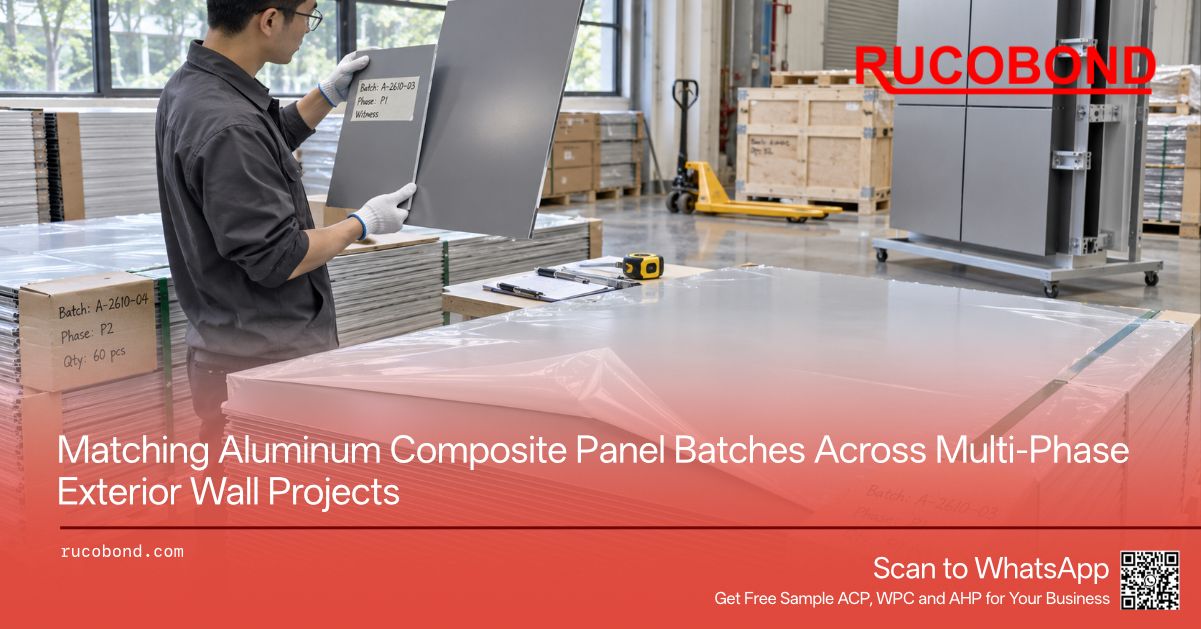
Multi-Phase Exterior Wall Projects Where ACP Color Continuity Matters
Many exterior wall programs do not ship as a single cladding release. A hotel podium may clad first while tower floors follow months later. A campus annex may reuse the same exterior wall language as an earlier building. A retail strip may open in stages, with parapets, canopies and revised openings ordered after the first elevation is already on the wall. In each case, Aluminum Composite Panel faces sit next to earlier sheets under daylight, across joints and corners, at viewing distances that a desk chip never fully represents.
Color continuity on those elevations is a product and supply question. An ACP sheet is a bonded sandwich of coated aluminum skins and a core. How adjacent fields read depends on coating formulation and application lot, gloss level, metallic or solid finish behavior, aluminum skin gauge, core construction, protective film condition and sheet orientation—not sandwich height alone. When Phase 1 and Phase 2 leave different production windows, pigment lots, flake distribution, oven conditions and gloss targets can shift unless the product identity and color reference were frozen early and later releases were framed as a continuation of the same build.
For building exteriors and wall cladding, every later release works best as a controlled continuation of a defined ACP product rather than a fresh commodity repurchase that only shares a color word. Distinguishing ACP from solid aluminum architectural panels and from coated aluminum coils keeps the conversation on the finished sandwich the fabricator will groove, fold and hang. Rucobond supplies Aluminum Composite Panels for exterior wall cladding applications. Teams planning staged exterior walls can describe the elevation sequence, finish intent and expected later releases when they inquire through www.rucobond.com so coating and build continuity enter the conversation before the first production window closes.
Custom Color, Gloss and Coating Choices for Continuous Elevations
Continuous exterior elevations often need more than a stock color name. Project teams may request a custom solid matched to an adjacent material, a metallic tone that carries across long horizontal bands, or a gloss level that softens midday glare on a street-facing wall. Those choices belong in the ACP product identity before Phase 1 production: coating system family, finish category, approved color reference, and a numeric gloss target or range. Exterior architectural ACP commonly uses fluorocarbon systems such as PVDF when project documents call for stronger outdoor weather performance; polyester systems are more often discussed for interior or lower-exposure uses. The correct family follows the specification and destination climate. For phased walls, the practical need is continuity of the agreed coating family across releases, not a late substitution that keeps thickness while changing the outdoor aging path.
Gloss is part of the visual contract. A low-sheen Phase 1 beside a higher-sheen Phase 2 can look like a different material even when hue is close. Recording gloss as a target or range, and judging later releases against retained color references under agreed lighting and viewing distance, gives fabricators and site teams a shared baseline. Metallic and pearlescent finishes need larger samples and clearer orientation notes, because viewing angle creates false color shifts that solid colors rarely show at the same strength. Protective film print, film aging and adhesive residue can create temporary appearance differences that disappear after peeling; stating film type and when the face will be judged helps keep temporary film effects out of the color conversation.
Custom color programs for multi-phase exterior cladding gain clarity when the mill receives the finish intent, sample reference and expected later elevations together. Buyers who need a structured view of thickness, aluminum skin, core, coating and finish fields can review Rucobond’s project-buyer specification guide at https://www.rucobond.com/new-29-761-n.html. Translating project language into a complete ACP description—then attaching that description to every later release—keeps continuous elevations tied to one documented visual and coating baseline.
Metallic Versus Solid Finishes on Large Exterior Fields
Solid and metallic Aluminum Composite Panel finishes behave differently once they cover a large exterior field. Solid colors are usually more forgiving across viewing angles, yet long continuous walls still expose small undertone or gloss drifts that a small chip hides. Metallic and brushed finishes add flake layout and coating direction. Sheets hung against the agreed orientation read as a continuous field; reversed sheets can look like a different tone even inside one coating lot. For multi-phase projects that mix long horizontal bands with returns and corner pieces, finish category and orientation belong in the product identity from the first release.
Large exterior fields also change how stakeholders judge match quality. Phase 1 may be approved under indoor light; Phase 2 may be judged on site at noon. Without a shared physical reference and a consistent viewing method, teams compare different scenes and attribute every difference to production alone. Metallic programs benefit from larger approval samples so flake distribution and direction are visible before fabrication starts. Brushed or directional finishes need an orientation convention written into the identity so later elevations, add-on canopies and replacement panels follow the same direction as the first wall.
Choosing solid versus metallic is therefore not only an aesthetic preference. It shapes sample size, orientation notes, coating-lot continuity expectations and how later phases should be described when they return to the mill. Exterior cladding programs that expect metallic bands across multiple releases can state that finish intent in the first enquiry through www.rucobond.com, along with orientation needs and any later elevations already visible on the drawings. Clear finish language early reduces the chance that Phase 2 is quoted as a near-match color name without the directional and lot context the wall will actually show.
Panel Build Options for Cassette Cladding Programs
Cassette cladding programs ask more of an Aluminum Composite Panel than a flat decorative sheet. Fabricators typically groove the reverse face and fold returns; stiffness, foldability, edge quality and flatness respond to aluminum skin gauge, core construction and total sandwich build. Two panels that share a 4 mm total thickness can still carry different front and rear skin gauges and therefore different workshop behavior. Core description likewise affects weight feel, routing response and how a panel sits in a cassette system. For multi-phase exterior walls, freezing thickness, skin gauges and core description against the written requirement keeps Phase 2 compatible with the tooling envelope already used on Phase 1.
Build options should stay inside the ACP product family unless engineering redesigns the cladding system. Substituting solid aluminum sheet because it is also aluminum, or arranging coated coil for local lamination without aligning the finished sandwich to Phase 1, breaks fabrication equivalence between phases. ACP is a finished bonded panel. Solid aluminum sheet is a different product build. Coated coil is an upstream or alternate supply form and does not automatically equal a cassette-ready ACP sheet. Mixing those terms in phased orders creates quotation noise that later appears as a “batch problem” when the underlying issue was product-type ambiguity.
Custom programs can also fix sheet dimensions and tolerance language alongside the sandwich build. Changing blank sizes between phases can alter nest patterns, cassette module rhythm and visible joint alignment on a continuous exterior wall. Confirming sheet size with skin, core and coating fields keeps the delivered pack compatible with the geometry already hung. Rucobond manufactures ACP as a finished composite panel product. Exterior cassette programs that need a stable build across releases can describe thickness, skin gauges, core requirement and sheet size in the enquiry so production quotes the same construction family rather than thickness alone.
Phased Release and Custom Quantity Planning With the Manufacturer
Phased exterior cladding is often a quantity and timing conversation as much as a color conversation. Phase 1 may cover a podium; Phase 2 may cover tower bands; small add-ons—parapets, canopies, revised openings—may appear after the main elevation is complete. Sharing estimated quantities by phase, even as provisional figures, gives the manufacturer a clearer signal than an open repurchase that only restates a color name. Asking the mill to note phased releases at Phase 1 enquiry time steers scheduling and coating-lot assignment toward the approved baseline when production capacity allows.
Continuity language on the order does not freeze pigment chemistry forever, but it separates a planned continuation from an unrelated stock job. Where later elevations are still undefined in quantity, freezing the product identity and sample reference still lets any future release queue against the same build. Micro top-ups placed long after the original coating window carry higher appearance variance risk simply because production conditions have moved on. Flagging known add-on elevations early helps keep those sheets inside a nearer production context when the program allows.
Custom quantity planning also covers how later releases should be labeled in documentation: same product identity, same color reference, same gloss target, and a note that the release continues an earlier exterior wall program. That framing helps quotation and production tickets point at one build twice instead of inventing a second near-match line. Teams preparing staged exterior walls can share estimated phase quantities, timing windows and destination with the Phase 1 identity through www.rucobond.com. Clear continuation notes on the enquiry help production plan coating-lot continuity for later releases rather than leaving them as anonymous color-name reorders.
Sample and Custom-Match Support Before Production
Digital swatches and brochure chips help early conversation. They are weak anchors when a later phase must match an elevation already supplied. Multi-phase exterior wall programs benefit from physical order-approval samples that survive the schedule: approved face samples for color and gloss, and retained color references held against the purchase identity so later releases can be judged against the same object, not against memory or an aged wall photograph taken under different conditions.
A useful sample package for ACP exterior cladding typically includes at least one approved face sample for color and gloss, plus retained references keyed to the product identity fields and approval date. Metallic and brushed finishes benefit from larger samples because small chips hide orientation and flake effects that full sheets reveal. Sample labels should carry the same thickness, skin, coating family, gloss and color codes used on the production ticket so the reference remains tied to the ordered build. Custom-match work—matching an adjacent material, refining a metallic tone, locking a gloss range—belongs in this sample stage before Phase 1 production starts.
Order approval against a physical sample gives the mill and the buyer a shared visual baseline. When later phases are expected, keeping that approved reference available for repeat-order comparison is more reliable than restating a color name alone. Sample and custom-match support for architectural ACP orders, combined with labeled retained references when later elevations are expected, keeps visual acceptance tied to a physical product. Multi-phase exterior programs can request sample and reference handling notes with the Phase 1 discussion through www.rucobond.com so repeat releases start from the same approved face.
Packaging and Marking Options for Appearance-Critical Export Orders
Appearance-critical exterior ACP often travels long distances and sits in interim storage before fabrication. Protective film grade, film print density, corner and edge protection, moisture barrier expectations, and outside pack marking are order fields the manufacturer can confirm as part of a custom program—not afterthought carton art. For multi-phase exterior walls, stating those preferences on the first order helps later releases arrive with the same surface protection language as Phase 1.
Protective film is temporary. Film that ages under sun or heat can yellow or leave residue that temporarily changes how a panel looks at receiving. Specifying film type and noting when the face will be judged relative to film removal keeps temporary film effects from being read as coating drift. Pack marking options—batch or pack codes, product identity shorthand, phase or elevation tags where agreed—let receiving teams keep Phase 1 and Phase 2 packs distinguishable without opening every crate into anonymous sheet piles. Moisture barrier and stacking method belong in the same conversation when sheets will travel far or sit in humid warehouses before fabrication.
Custom packaging language is especially useful on export orders where multiple elevations ship on different vessels or into different warehouses. Aligning film type, edge protection and pack marks across releases preserves the surface condition the coating window intended and makes later arrivals recognizable as part of the same exterior cladding program. Buyers who need consistent film and marking practice across phases can include those preferences in the ACP order identity when they inquire through www.rucobond.com, so packaging is quoted and produced as part of the product conversation rather than left to default carton practice.
OEM and Project-Specific Identity for Repeat Elevations
Repeat elevations—same campus, same brand exterior wall language, same cassette module—need a project-specific ACP identity that outlives a single purchase order. A workable identity goes beyond “4 mm grey panel.” Total thickness describes only sandwich height. Typical fields include total panel thickness; front and rear aluminum skin gauge; core type as required by the project documents; coating system family; finish category such as solid, metallic or brushed; approved color reference; gloss target or gloss range; sheet dimensions; protective film type; and intended use as exterior wall cladding. Where a custom color is approved, the identity should record the sample code, the approval date and which party holds the retained color reference.
OEM and project programs can also carry orientation notes for metallic or brushed finishes, preferred pack-marking conventions, and a short note that later elevations should continue the same build. Capturing these fields once at Phase 1 creates a stable baseline for every later enquiry and release. ACP should remain distinct from solid aluminum panels and coated coils in that identity so quotation tickets do not drift into a different product family while still using the same color word.
A project-specific identity is commercial as well as technical. It lets distributors, fabricators and contractors reorder against a named build instead of reconstructing the product from memory. Documented sample codes, retained references and continuation notes keep multi-building or multi-phase exterior programs aligned so each later release continues the same named build instead of a fresh near-match. Teams that expect repeat elevations can ask for a written product identity with the first order discussion via www.rucobond.com so later releases inherit the same coating, construction and finish baseline.
What to Share When Requesting a Custom or Multi-Phase ACP Quote
A custom or multi-phase ACP quote moves faster when the enquiry already carries the product and release context the mill needs. Start with the complete ACP identity: total thickness, aluminum skin gauges, core requirement from the project documents, coating system family, finish, color reference, gloss target, sheet size, protective film preference and exterior wall application. Attach or reference the approved physical sample or retained color reference when one exists, including sample code and approval date.
State estimated quantities by phase where known, and note that later releases should continue the same product identity. Flag metallic or brushed orientation needs. List packaging or pack-marking preferences that must stay consistent across releases. Destination and application as exterior wall cladding help production assign the correct exterior grade rather than an interior decorative near-match. If Phase 1 has already shipped, include pack or batch notes from that release when available so the mill can see the prior production context. If Phase 1 is still ahead, say that later elevations are expected so coating-lot continuity and sample retention can enter the discussion before the first window closes.
Avoid relying on “same as before” without the identity fields attached; color names alone do not define the build. Where a structured field list helps, the project-buyer specification guide at https://www.rucobond.com/new-29-761-n.html outlines thickness, skin, core, coating and finish language commonly used on exterior ACP programs. Sharing that level of detail in the quote request turns a custom or multi-phase need into a production-ready description instead of a color-word placeholder.
Turning a Phased Exterior Cladding Need Into a Clear Enquiry
A clear enquiry for phased exterior cladding connects the application scenario to a custom product ask. Describe the building exteriors involved: podium then tower, campus annex matching an earlier building, staged retail elevations, or add-on parapets and canopies after the main wall. Name the finish intent—solid or metallic, gloss preference, custom-match needs—and the cassette or cladding system expectations that drive thickness, skin gauge and core description. Attach sample references or ask for sample support before production. List estimated quantities by phase and any packaging or marking preferences for appearance-critical export shipments.
That package lets the manufacturer quote one ACP build for multiple releases instead of guessing from a color name. Rucobond works with contractors, importers, distributors and fabricators who need Aluminum Composite Panels for building exteriors and wall cladding programs, including projects that unfold across multiple releases. Teams preparing a multi-phase exterior cladding package can inquire via www.rucobond.com with Phase 1 specification notes, estimated later-phase quantities, finish and sample references, and any project identity fields that must stay consistent. A complete enquiry gives later elevations a clearer path than a color name alone—and opens a direct channel to discuss custom color, coating continuity and phased supply against the same documented ACP product.
Q: Why does color continuity matter on multi-phase Aluminum Composite Panel exterior walls?
A: Later elevations often sit next to earlier sheets under daylight across joints and corners. Coating lot, gloss, finish category, skin gauge and orientation can shift between production windows unless the ACP product identity and color reference were frozen early and later releases were planned as a continuation of the same build.
Q: What custom finish details help keep continuous elevations aligned?
A: Coating system family, finish category (solid, metallic or brushed), approved color reference, gloss target or range, and orientation notes for metallic or brushed faces. Physical approval samples and retained color references give later phases a stronger baseline than a color name alone.
Q: How do panel build options affect cassette cladding across phases?
A: Cassette fabrication responds to aluminum skin gauge, core construction and sheet size as well as total thickness. Freezing those fields with the coating identity keeps Phase 2 compatible with the tooling and module geometry already used on Phase 1. ACP should not be confused with solid aluminum sheet or coated coil when describing the build.
Q: What should a phased exterior cladding enquiry include?
A: Complete ACP identity, destination and exterior wall application, sample or color-reference details, estimated quantities by phase, finish and orientation needs, and packaging or pack-marking preferences that must stay consistent. Clear inputs make custom and multi-phase quotes easier to align than vague “same as before” requests.
Q: Where can project teams review ACP specification fields before sending a custom quote request?
A: Rucobond’s project-buyer specification guide at https://www.rucobond.com/new-29-761-n.html outlines thickness, aluminum skin, core, coating and finish language commonly used for exterior wall cladding. Teams can then inquire through www.rucobond.com with those fields plus phase quantities and sample notes attached.
Name: Gina Chen
Mobile:+86-189-2412-4951
Tel:+86-189-2412-4951
Whatsapp:8618924124951
Email:gina@rucobond.com
Add:Room 708, No. 8 Jingang Avenue, Nansha Street, Nansha District, Guangzhou


